

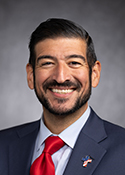
Maddy summaryHB 1044 amends Texas law to add specific religious officiants authorized to conduct marriage ceremonies, including Buddhist monks/priests, Hindu pundits, Muslim imams, and Sikh granthis. The bill expands the existing list under Family Code Section 2.202, which previously allowed Christian ministers/priests, Jewish rabbis, and judges. This change directly affects couples seeking weddings in Texas who wish to use these newly authorized religious officiants. The law takes effect September 1, 2025, applying only to ceremonies held on or after that date.
Rep. Marc LaHood
Sponsored bills
Maddy summaryHB 2969 prohibits the Texas State Bar from adopting rules, policies, or penalties that restrict law license applicants or holders based on religious beliefs or burden constitutional rights. It specifically bans limitations on licensing due to sincerely held religious beliefs, or restrictions on free speech (including religious or political views), religious association, or assembly. Exceptions allow rules that serve a compelling government interest narrowly tailored to that purpose, or that address willful bias in court proceedings. The bill enables licensees to challenge violations through administrative hearings or lawsuits under Texas law, but not in cases involving sexual misconduct allegations or criminal prosecution.
Maddy summaryHB 1674 would ban the production, sale, and use of certain agricultural products containing PFAS chemicals (like pesticides or crop protectants). It directly affects agricultural businesses, manufacturers, and sellers of these products. The bill creates criminal penalties for violations, treating unauthorized PFAS use as a punishable offense. The bill is currently pending in the Environmental Regulation committee after committee hearings. (Note: Full bill text is not yet available; this summary is based on the title and pending status.)
Maddy summaryHB 2275 requires that surplus lines insurance contracts (specialized policies for high-risk or hard-to-place coverage) containing arbitration agreements must specify that any arbitration occurs in Texas and follows Texas law. It mandates that both the arbitration process and contract interpretation be governed by Texas statutes, applying only to contracts delivered, issued, or renewed on or after January 1, 2026. Existing contracts before that date remain subject to prior law. The bill takes effect September 1, 2025, and directly affects insurers writing surplus lines policies in Texas.
Maddy summaryHB 298 requires Texas driver's licenses and personal ID certificates to include a clear indication that the holder is a U.S. citizen. This applies to all licenses issued or renewed on or after January 1, 2026. The bill specifies that licenses must also display the holder's full name, date of birth, a full-face photograph, a distinguishing number, and either a residence address or, for certain federal judges or officials, the courthouse address. It does not change existing requirements for non-citizens. The law takes effect September 1, 2025.
Maddy summaryHJR 161 proposes amending the Texas Constitution to explicitly prohibit non-citizen residents from voting in Texas elections. The bill would add "persons who are not citizens of the United States" as a new category barred from voting, alongside existing restrictions for minors, those declared mentally incompetent, and convicted felons. If approved by voters in November 2025, this constitutional change would formally enshrine the current legal standard - non-citizens already cannot vote in Texas - into the state constitution. The amendment requires voter approval at the 2025 general election, with ballot language specifying the change. This is a procedural constitutional amendment, not a new voting law.
Maddy summaryHB 3469 exempts certain bird control services from structural pest control regulations in Texas. It allows businesses to use laser lights, noise devices, or recorded sounds (within local noise limits) to manage nuisance birds without needing a pest control license. The exemption does not cover methods that kill birds, use chemicals or explosives, exceed noise ordinances, or risk harm to people, property, or the environment. This directly affects businesses offering non-lethal bird control services, such as those at airports, farms, or public venues.
Maddy summaryHB 3061 increases penalties for certain criminal offenses committed while wearing masks or disguises specifically to hide the offender's identity. It applies to offenses under Texas law covering assault, robbery, public disorder (Title 5, Chapters 28-30, or Sections 42.01/42.02). If proven, the punishment escalates to the next higher offense category, with a minimum 180-day jail term for Class A misdemeanors. Exceptions allow the penalty increase to be avoided if the disguise was for events like Halloween, proven by a preponderance of evidence.
Maddy summaryHB 4661 authorizes local county officials to temporarily close beaches near space launch sites during launch operations to protect public safety. It requires evacuations from FAA-defined hazard areas and allows beach closures on launch or backup dates, based on federal safety calculations. Violating these closure orders is a criminal offense, punishable as a Class B misdemeanor (or Class A if previously convicted). The bill directly affects beachgoers near launch sites, local governments managing closures, and spaceflight operators coordinating safety protocols.
Maddy summaryThis bill requires Texas licensing authorities to issue provisional occupational licenses for six months to applicants with criminal convictions who are otherwise qualified for the license, unless they have specific serious convictions listed in the Occupations Code. The provisional license begins upon the applicant's release from incarceration if they were imprisoned. It applies to most occupational licensing fields (like healthcare or trades) but excludes applicants convicted of offenses under Section 53.021(a). The bill provides a pathway for certain applicants to obtain licenses without full revocation of eligibility.