

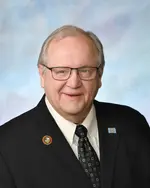
Photo of Carl Perry
R South Dakota Senate · District 3

Sen. Carl Perry

Compare
Total votes
2,454
all sessions
Attendance
98%
27 missed
Higher than 81% of chamber peers
With party
92%
of cast votes
Higher than 91% of chamber peers
Bipartisan score
6%
crosses aisle rarely
Lower than 92% of chamber peers
Sponsored
1,289
bills & resolutions
Higher than 97% of chamber peers
Committees
5
assignments
1,289 bills and resolutions

Sponsored bills

Total
1,289
Primary
1,289
Co-sponsor
0
This page
1,289
matching current filters
Primary HB 1099
Signed into law · South Dakota House · Lead sponsor
reschedule the pharmaceutical composition of crystalline polymorph psilocybin in a drug product approved by the Food and Drug Administration as a Schedule IV controlled substance.

Maddy summaryHB 1099 would reclassify FDA-approved psilocybin medications from Schedule I to Schedule IV under South Dakota law. This change would allow medical providers to prescribe these specific pharmaceutical products without the strict restrictions currently applied to Schedule I substances. The bill specifically affects only psilocybin in drug products approved by the FDA, not raw psilocybin or unapproved formulations. This amendment aligns South Dakota's scheduling with federal approval status for medical use.

Signed into law Mar 10, 2026 0 co-sponsors
Primary SB 113
Signed into law · South Dakota Senate · Lead sponsor
increase the penalty for preventing practice of religion.

Maddy summaryThis bill amends South Dakota law (§ 22-19B-4) to upgrade penalties for preventing someone from practicing their religion through threats or violence. Currently a Class 1 misdemeanor, the offense would become a Class 6 felony under this bill. It directly affects individuals who use intimidation or force to stop others from engaging in legally protected religious activities. The key change is reclassifying the penalty level in the statute, increasing the legal consequences for such conduct.

Signed into law Mar 10, 2026 0 co-sponsors
Primary HB 1106
Signed into law · South Dakota House · Lead sponsor
revise the terms of county extension board members.

Maddy summaryHB 1106 clarifies the term structure for county extension board members in South Dakota. It revises Section 13-54-11 to specify that board members serve staggered terms expiring annually on January 10th, replacing inconsistent phrasing about "one-to-three years." This change directly affects county extension boards and their appointment process, ensuring clear annual expiration dates for terms. The bill does not alter board composition requirements (such as farmer representation or county commissioner membership) or substantive responsibilities.

Signed into law Mar 10, 2026 0 co-sponsors
Primary HB 1164
Signed into law · South Dakota House · Lead sponsor
establish the crime of fraudulent assisted reproduction and provide a penalty and civil liability therefor.

Maddy summaryHB 1164 makes it a Class 5 felony for licensed healthcare providers to use reproductive material (like sperm or eggs) without a patient’s written consent during assisted reproduction procedures (e.g., IVF). It directly affects healthcare providers, patients, donors, and children born from such procedures. The bill establishes civil liability, allowing patients, spouses, intended parents, children, or donors to sue for $10,000 in liquidated damages plus other costs and attorney fees. Lawsuits must be filed within five years of the child’s 18th birthday or when evidence (like DNA results) is discovered.

Signed into law Mar 10, 2026 0 co-sponsors
Primary SB 180
Signed into law · South Dakota Senate · Lead sponsor
modify requirements regarding nondomiciled commercial driver licenses.

Maddy summarySB 180 modifies South Dakota's rules for issuing commercial driver licenses (CDLs) to non-residents ("nondomiciled" applicants). It specifically allows individuals with H-2A, H-2B, or E-2 work visas (or those from U.S. territories with these visas) and people from states with decertified CDL programs to obtain a South Dakota CDL. Key provisions require applicants to present valid visa documents at every license transaction, confirm immigration status via federal systems, and have licenses expire when their visa validity ends (or within one year of issuance). The license must display "nondomiciled," and holders must surrender any other state's nondomiciled CDL.

Signed into law Mar 10, 2026 0 co-sponsors
Primary SB 197
Signed into law · South Dakota Senate · Lead sponsor
modify the administration of the South Dakota-Ireland trade fund.

Maddy summarySB 197 amends South Dakota law to transfer administration of the South Dakota-Ireland Trade Fund from the Legislative Research Council's Executive Board to the Department of Agriculture and Natural Resources. The fund, which supports the South Dakota-Ireland Trade Commission's activities like promoting trade between South Dakota and Ireland, consists of donations, grants, and interest earned. This bill changes only the managing agency - no policy or funding changes are made to the fund's purpose or sources. The amendment clarifies that the Department of Agriculture will handle the fund's administrative expenses and disbursements.

Signed into law Mar 10, 2026 0 co-sponsors
Primary HB 1253
Passed · South Dakota House · Lead sponsor
adjust the assessment methodology for owner-occupied single-family dwellings and nonagricultural property.

Maddy summaryHB 1253 adjusts how property taxes are calculated for owner-occupied single-family homes and nonagricultural land by using a special averaging method. It requires county assessors to set each property's taxable value based on the "Olympic average" (removing the highest and lowest values) of its fair market value over the past eight years, or since a recent change in use or addition. This aims to stabilize tax bills by smoothing out annual value fluctuations. The bill specifically prevents this adjustment from increasing taxes on agricultural properties. It directly affects homeowners and nonagricultural property owners in South Dakota.

Passed Mar 9, 2026 0 co-sponsors
Primary HB 1062
Signed into law · South Dakota House · Lead sponsor
revise a provision related to aggravated assault.

Maddy summaryHB 1062 is a technical amendment to South Dakota's aggravated assault statute (§ 22-18-1.1). It renumbers existing subsections and removes references to provisions previously deleted by law (specifically removing references to subsections (3), (6), and (7) as deleted by prior legislation). The bill does not change the actual legal definition or penalties for aggravated assault, which remains a Class 3 felony for causing serious injury under specified circumstances. This is purely a procedural update to correct the statutory numbering and eliminate outdated references in the law.

Signed into law Mar 9, 2026 0 co-sponsors
Primary HB 1162
Signed into law · South Dakota House · Lead sponsor
add certain substances to Schedule I of the controlled substances schedule.

Maddy summaryHB 1162 adds 59 specific substances - including synthetic opioids like "W-18" and "butonitazene," as well as compounds such as "methiopropamine" - to South Dakota's Schedule I controlled substances list. This means these substances are now classified as having no medical use and a high potential for abuse under state law. The bill directly affects anyone in South Dakota who possesses, distributes, or uses these listed substances, making such actions illegal without specific exemptions. The key mechanism is the explicit inclusion of these chemical compounds (including isomers and salts) into Schedule I, closing potential legal gaps for enforcement.

Signed into law Mar 9, 2026 0 co-sponsors
Primary SB 81
Signed into law · South Dakota Senate · Lead sponsor
clarify the prohibition on injuring or harassing a service animal.

Maddy summarySB 81 clarifies South Dakota's law against harming service animals by specifying that it is illegal to maliciously beat, injure, harass, or interfere with a service animal that is controlled by a person with a disability and wearing a harness or control device. The bill directly affects individuals with disabilities who rely on service animals and anyone who might harass or harm such animals. It explicitly defines "service animal" as a dog trained to perform tasks directly related to a person's disability (per federal guidelines), excluding emotional support, comfort, or crime deterrent effects. The law makes it a Class 2 misdemeanor to violate these provisions.

Signed into law Mar 9, 2026 0 co-sponsors
Showing 41 to 50 of 1,289 bills
Previous 1 4 5 6 129 Next