

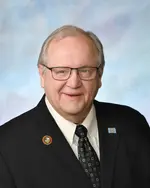
Photo of Carl Perry
R South Dakota Senate · District 3

Sen. Carl Perry

Compare
Total votes
2,454
all sessions
Attendance
98%
27 missed
Higher than 81% of chamber peers
With party
92%
of cast votes
Higher than 91% of chamber peers
Bipartisan score
6%
crosses aisle rarely
Lower than 92% of chamber peers
Sponsored
1,289
bills & resolutions
Higher than 97% of chamber peers
Committees
5
assignments
1,289 bills and resolutions

Sponsored bills

Total
1,289
Primary
1,289
Co-sponsor
0
This page
1,289
matching current filters
Primary SB 89
Signed into law · South Dakota Senate · Lead sponsor
create a task force to study the provision of emergency medical services as an essential service and the funding thereof.

Maddy summarySB 89 requires all South Dakota counties and municipalities to ensure a minimum level of emergency medical services (including response times, staffing, and treatment protocols) are available within their boundaries for prehospital care. It directs the state health department to create rules defining these minimum standards, covering aspects like ambulance response and required personnel. The bill also establishes a legislative task force to study funding mechanisms for these services and report recommendations by November 2026. The law would take effect on July 1, 2028, impacting local governments responsible for emergency medical service provision.

Signed into law Mar 30, 2026 0 co-sponsors
Primary SB 139
Signed into law · South Dakota Senate · Lead sponsor
revise a provision related to the transportation of an inmate upon discharge from a correctional facility.

Maddy summarySB 139 revises South Dakota law to clarify transportation requirements for inmates being discharged from correctional facilities. It requires correctional facilities to provide transportation to a location chosen by the inmate from three options: the county where the inmate lived at the time of the offense, the county where they received their sentence, or any location at the same distance as the closer of those two counties (based on mileage). This change gives inmates more flexibility in selecting a release location while ensuring transportation is provided to a reasonably accessible place near their previous residence or sentencing location. The bill directly affects inmates released from South Dakota correctional facilities under parole, suspended sentences, or final discharge.

Signed into law Mar 30, 2026 0 co-sponsors
Primary SB 107
Signed into law · South Dakota Senate · Lead sponsor
add licensed and registered child care programs to the definition of community safety zone.

Maddy summarySB 107 amends South Dakota law to explicitly include licensed and registered child care programs within the definition of "community safety zone." This means the 500-foot buffer zone around such facilities - including day care centers, group family day care homes, and registered family day care - will now be covered by the same restrictions on sex offender residence as schools, shelters, and public parks. The bill clarifies that all licensed and registered child care programs are explicitly included under existing definitions without adding new facilities to the list. This change directly affects sex offenders required to register under South Dakota law, as they are barred from residing within these zones without specific exemptions.

Signed into law Mar 30, 2026 0 co-sponsors
Primary SB 159
Signed into law · South Dakota Senate · Lead sponsor
revise requirements pertaining to the minimum age for marriage.

Maddy summarySB 159 raises South Dakota's minimum marriage age to 18, eliminating the previous exception allowing 16- to 17-year-olds to marry with parental consent. It requires court approval for any minor under 18 to marry, mandating an in-person hearing where the court assesses the minor's safety, maturity, and whether the marriage is voluntary, with written findings required. Alternatively, two parents' notarized consent (instead of one parent's) may be submitted, but the marriage license cannot be issued until 30 days after judicial approval. The bill also increases penalties for officiants who solemnize marriages without proper consent, classifying violations as a Class 1 misdemeanor. This directly affects minors aged 16-17 seeking marriage, their parents/guardians, and marriage officiants.

Signed into law Mar 30, 2026 0 co-sponsors
Primary HB 1220
Signed into law · South Dakota House · Lead sponsor
regulate the sale of nicotine products, and to provide a penalty therefor.

Maddy summaryHB 1220 regulates the retail sale of nicotine products in South Dakota by requiring retailers to obtain a $1,000 license for each business location. It bans sales to anyone under 21, prohibits sales through vending machines, online, by phone, or in-person at locations within 1,000 feet of schools (with exceptions for pre-July 1, 2026, stores), and forbids free samples. Retailers must display age restriction signs and maintain sales records. The bill defines "nicotine products" broadly to include nicotine analogs (unless FDA-approved) and directly affects stores selling e-cigarettes, nicotine pouches, and similar items.

Signed into law Mar 30, 2026 0 co-sponsors
Primary HB 1200
Signed into law · South Dakota House · Lead sponsor
make an appropriation for victim services provided by nonprofit organizations.

Maddy summaryHB 1200 appropriates $8 million from South Dakota's general fund to the Department of Public Safety for grants to nonprofit organizations providing specific victim services. It directly supports nonprofits focused on helping children abused or neglected, domestic violence victims, sexual assault victims, or victims of commercial sexual exploitation/trafficking. The bill allows grant funds to cover 24/7 emergency services, counseling, crisis lines, case management, sexual assault nurse examiner training, and child advocacy center services - excluding new programs or legal aid. Nonprofits must apply annually between July 1 and August 31, report on services delivered, and prioritize organizations seeking additional funding. The appropriation becomes effective June 30, 2026.

Signed into law Mar 30, 2026 0 co-sponsors
Primary HB 1082
Signed into law · South Dakota House · Lead sponsor
establish parameters for the reimbursement of school districts that provide free or reduced-price meals to students.

Maddy summaryHB 1082 requires South Dakota school districts to provide free or reduced-price meals to eligible students without charging them, as defined by federal programs (National School Lunch Program and School Breakfast Program) starting January 1, 2026. The bill mandates that the South Dakota Department of Education reimburse school districts for costs incurred on these meals, after subtracting any federal reimbursement received. This directly affects school districts serving students qualifying for federal meal programs and ensures state funding covers the gap between federal support and actual meal costs. The law amends Section 13-35-2 of South Dakota law to clarify these reimbursement parameters.

Signed into law Mar 30, 2026 0 co-sponsors
Primary HB 1199
Signed into law · South Dakota House · Lead sponsor
address prior authorization and reporting requirements by utilization review organizations and health carriers.

Maddy summaryHB 1199 is a definitional bill that clarifies terms related to health insurance preauthorization and utilization reviews. It adds specific definitions (like "adverse determination," "ambulatory review," and "authorized representative") to South Dakota law governing health benefit plans. The bill does not create new requirements or change current preauthorization rules - it only establishes clearer language for how these processes are described in law. This affects health insurers, providers, and patients by standardizing terminology used in coverage decisions. The bill has no substantive policy changes beyond these definitions.

Signed into law Mar 30, 2026 0 co-sponsors
Primary HB 1194
Signed into law · South Dakota House · Lead sponsor
clarify authority for the Cosmetology Commission to credit work experience for educational hours for certain out-of-state licensure applicants, and to require the commission to promulgate rules therefor.

Maddy summaryHB 1194 requires South Dakota's Cosmetology Commission to allow out-of-state cosmetology, nail technology, and esthetics license applicants to count relevant work experience toward their education hour requirements. Specifically, the bill mandates that two hours of work experience equals one hour of required education, but only for experience gained after the applicant's initial license, and work experience cannot cover more than half the total education hours needed. Applicants must provide documentation of their work history, and the commission may require a safety course if the experience is over five years old or deny a license if competence is in question. This change directly affects individuals seeking to transfer licenses from other states or countries who have practical experience but lack full in-state education hours.

Signed into law Mar 30, 2026 0 co-sponsors
Primary HB 1077
Vetoed · South Dakota House · Lead sponsor
consider a cultivated-protein food product to be adulterated food.

Maddy summaryHB 1077 classifies cultivated-protein food products (lab-grown meat alternatives made from animal cells grown in vitro) as "adulterated food" under South Dakota's existing food safety laws. This bill directly affects producers and sellers of these products by automatically subjecting them to current adulteration penalties without requiring new safety standards. The key provision adds a specific definition in Section 39-4-2(8), stating such products are deemed adulterated regardless of their safety or labeling. The law does not create new regulations but applies existing food safety definitions to this emerging food category. This change would require cultivated-protein producers to comply with all current adulteration enforcement mechanisms.

Vetoed Mar 30, 2026 0 co-sponsors
Showing 11 to 20 of 1,289 bills