

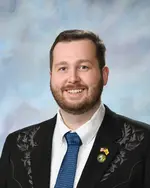
Photo of Dylan Jordan
R South Dakota House · District 4

Rep. Dylan Jordan

Compare
Total votes
807
all sessions
Attendance
99%
8 missed
Near the chamber average
With party
68%
of cast votes
Lower than 96% of chamber peers
Bipartisan score
19%
some cross-party votes
Higher than 95% of chamber peers
Sponsored
224
bills & resolutions
Higher than 91% of chamber peers
Committees
2
assignments
224 bills and resolutions

Sponsored bills

Total
224
Primary
224
Co-sponsor
0
This page
224
matching current filters
Primary HB 1314
Passed · South Dakota House · Lead sponsor
modify provisions pertaining to the testing and use of automatic tabulating equipment.

Maddy summaryHB 1314 modifies South Dakota's election equipment rules to enhance security and standardization. It prohibits internet-connected voting systems, requires vendors to submit software source code for independent review before certification, and mandates annual system updates. The bill directly affects election vendors (who must provide source code and maintain systems), the State Board of Elections (which must certify systems), and local jurisdictions (which must use updated systems or conduct manual counts). Systems approved before January 1, 2026, expire July 1, 2026, and vendors must cover costs if manual recounts are needed due to outdated equipment.

Passed Feb 11, 2026 0 co-sponsors
Primary HCR 6013
Passed · South Dakota House · Lead sponsor
encouraging the state's congressional delegation to meet with the Legislature.

Maddy summaryHCR 6013 is a non-binding resolution encouraging South Dakota's U.S. congressional representatives to meet annually with the state Legislature. It proposes that each member of the delegation meet for at least one hour with the Legislature (as a joint committee) to discuss federal government actions and their work representing South Dakota. The resolution does not require the delegation to attend or create new obligations, but formally invites them to engage with state lawmakers. This is a procedural gesture focused on fostering communication, not a policy change.

Passed Feb 11, 2026 0 co-sponsors
Primary HB 1325
Passed · South Dakota House · Lead sponsor
prohibit the Board of Regents and institutions under its control from requiring certain students to reside in on-campus housing or purchase meal plans.

Maddy summaryHB 1325 prohibits South Dakota's public universities (controlled by the Board of Regents) from requiring students to live in on-campus housing or buy meal plans after their first year of enrollment. This directly affects undergraduate students at institutions like the University of South Dakota and South Dakota State University. The bill removes mandatory requirements for housing and meal plans beyond a student's initial academic year. It does not change first-year housing or meal plan policies but gives returning students the choice to live off-campus or arrange their own meals. The law takes effect upon enactment.

Passed Feb 11, 2026 0 co-sponsors
Primary HB 1266
Passed · South Dakota House · Lead sponsor
make certain federal laws applicable to public employees.

Maddy summaryHB 1266 defines "public employees" to include state/local government workers, school staff, and public service personnel. It prohibits using official authority for political interference, soliciting political contributions in the workplace, coercing political activity, or engaging in political activity during work hours or in government facilities. The bill also restricts using state resources or vehicles for political purposes while allowing employees to vote, express political views, campaign, and contribute to political causes outside work hours. These rules align with federal standards for public employee conduct and apply to all state and local government roles covered by the law.

Passed Feb 11, 2026 0 co-sponsors
Primary HB 1031
Passed · South Dakota House · Lead sponsor
revise and repeal provisions related to rape offenses and to increase the penalty therefor.

Maddy summaryHB 1031 revises South Dakota's rape offense definitions and increases penalties, primarily affecting victims under 13 and perpetrators convicted of sexual crimes against minors. It adds new circumstances to rape definitions (e.g., victim incapacity due to intoxication) and establishes a 15-year minimum sentence for first offenses involving victims under 13. The bill also removes the statute of limitations for rape cases involving victims under 13 or using force/coercion, allowing charges to be filed until the victim turns 25. These changes directly impact criminal sentencing for sexual offenses and extend legal accountability for certain victims.

Passed Feb 11, 2026 0 co-sponsors
Primary HB 1167
Passed · South Dakota House · Lead sponsor
revise a provision related to loitering within a community safety zone.

Maddy summaryHB 1167 amends South Dakota law to clarify exemptions for certain sex offenders regarding loitering in community safety zones. It specifically adds that the prohibition does not apply if the offender was under 18 at the time of the offense and was not tried or convicted as an adult, or if a court has granted an exemption under § 22-24B-28. The bill directly affects registered sex offenders who meet these specific juvenile offense criteria. The amendment does not change the felony penalties (Class 6 for first offense, Class 5 for repeat offenses) or the core prohibition against loitering in safety zones or public libraries. This is a technical revision to the existing statute (§ 22-24B-24) with no new policy changes.

Passed Feb 11, 2026 0 co-sponsors
Primary SB 155
Passed · South Dakota Senate · Lead sponsor
increase legislative oversight procedures and protections against conflicts of interest, and to provide a penalty therefor.

Maddy summarySB 155 strengthens legislative oversight by expanding subpoena and document-request powers to both the Government Operations and Audit Committee and the Judiciary Committees in the House and Senate. It prohibits retaliation against state employees, consultants, or contractors who cooperate with investigations, allowing civil lawsuits for damages, back pay, or whistleblower rewards up to $50,000. The bill also extends a two-year ban on former state officials (including department heads) working as lobbyists or accepting contracts they previously approved, with violations now classified as felonies. These changes aim to improve transparency and accountability in state government operations.

Passed Feb 11, 2026 0 co-sponsors
Primary HCR 6010
Passed · South Dakota House · Lead sponsor
urging the Supreme Court of the United States to overturn the decision in Obergefell v. Hodges.

Maddy summaryHCR 6010 is a non-binding resolution passed by the South Dakota legislature urging the U.S. Supreme Court to overturn its 2015 *Obergefell v. Hodges* decision, which established same-sex marriage as a constitutional right. The resolution expresses the legislature's view that *Obergefell* conflicted with constitutional principles and state authority over marriage, citing arguments about judicial overreach and the state's 2006 voter-approved definition of marriage. This resolution has no legal effect and does not change marriage laws in South Dakota or elsewhere. It serves solely as a symbolic statement of legislative opinion.

Passed Feb 11, 2026 0 co-sponsors
Primary SB 12
Signed into law · South Dakota Senate · Lead sponsor
provide for a refund of property taxes in previous years for qualifying veterans and surviving spouses.

Maddy summarySouth Dakota's SB 12 allows qualifying veterans with certain disabilities (like loss of use of both lower extremities) or their unremarried surviving spouses to request refunds for property taxes paid in the previous four years if they missed the application deadline for an existing property tax exemption. The bill amends tax exemption rules to permit petitions to county commissioners for these refunds, which the commissioners may approve or deny at their discretion. It directly affects veterans and surviving spouses who previously paid taxes they might have qualified to avoid. The refund mechanism applies only to taxes paid in the four years prior to the petition, not future exemptions.

Signed into law Feb 11, 2026 0 co-sponsors
Primary SB 2
Signed into law · South Dakota Senate · Lead sponsor
provide that a firearm silencer is not a controlled weapon.

Maddy summarySB 2 amends South Dakota law to clarify that firearm silencers (devices reducing gunshot noise) are not classified as "controlled weapons." This change removes silencers from the category of weapons subject to strict state regulations, such as special permits or licensing requirements. The bill directly affects gun owners, manufacturers, and sellers of silencers in South Dakota by eliminating these regulatory barriers. The key mechanism is an amendment to the definitions section of the state's criminal code (§ 22-1-2), specifically excluding silencers from the definition of "controlled weapon."

Signed into law Feb 11, 2026 0 co-sponsors
Showing 51 to 60 of 224 bills
Previous 1 … 5 6 7 … 23 Next