

Maddy summaryThis bill amends the National School Lunch Program to allow schools participating in the program to serve whole milk as an option to students, in addition to reduced-fat and fat-free milk. It permits schools to offer whole milk (organic or non-organic), reduced-fat, low-fat, and fat-free milk, as well as lactose-free milk and nutritionally equivalent nondairy beverages that meet specific nutritional standards. The bill clarifies that milk fat in whole milk should not be counted as saturated fat for compliance with meal nutrition standards. Additionally, it requires schools to include food allergy information in training for food service personnel. These changes directly affect schools participating in the National School Lunch Program and the students who eat school meals.
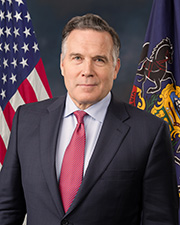
Sen. David McCormick
Sponsored bills
Maddy summaryThis bill increases base pay for Federal correctional officers by 35% above their current General Schedule or law enforcement officer rates, replacing their existing base pay for all compensation purposes. It directly affects Bureau of Prisons correctional officers whose duties involve inmate custody, control, or routine direct contact in custodial settings, including certain supervisory roles. The pay increase is capped at the rate for Executive Schedule Level V (for officers) or Level IV (for Federal Wage System employees), and expires after five years unless the Department of Justice Inspector General certifies progress in reducing non-custodial staff "augmentation" and excessive overtime. The law requires a review 180 days before expiration to assess staffing changes and impacts on recruitment, retention, and safety.
Maddy summaryS 3610, the "No Funding for Foreign Agents Act," prohibits U.S. government funding to entities controlled by agents of specific foreign governments. It bars direct or indirect U.S. financial assistance (including grants, loans, and vouchers) from being provided to any organization controlled by an agent of a "covered foreign principal," defined as governments of nations including China, Russia, Iran, North Korea, and several African countries listed in the bill. The law specifically targets entities acting under the direction of these foreign governments, excluding individuals or U.S.-based organizations not controlled by such agents. This policy change restricts federal funding eligibility for foreign-influenced groups without altering existing foreign aid programs.
Maddy summarySRES 288 is a Senate resolution condemning recent ideologically motivated attacks on Jewish individuals, including a violent assault in Boulder, Colorado, on June 1, 2025, and other incidents like the attack on Israeli Embassy staff in Washington, D.C., and fires at the Pennsylvania Governor’s Residence. The resolution formally expresses the Senate’s condemnation of these acts as part of a growing pattern of antisemitism and politically motivated violence. It reaffirms the Senate’s commitment to protecting peaceful assembly and religious practice, while urging federal, state, and local law enforcement to thoroughly investigate such incidents and calling on community leaders to publicly oppose antisemitism. This resolution has no legal effect but serves as a formal statement of the Senate’s position.
Maddy summaryThis is a Senate resolution (SRES 573), not a legislative bill, expressing the Senate's position on U.S. leadership in religious freedom. It reaffirms the U.S. commitment to promoting religious freedom globally, encourages the Secretary of State to use diplomatic tools to address foreign violations, and supports existing roles like the Ambassador-at-Large for International Religious Freedom. The resolution does not create new laws or change policies but serves as a symbolic statement urging continued U.S. engagement on this issue. It directly affects U.S. diplomatic efforts and messaging toward countries with religious freedom concerns, such as China and Nicaragua, as cited in the resolution's background.
Maddy summaryThis bill amends the Financial Stability Oversight Council's (FSOC) process for addressing threats posed by nonbank financial companies. It requires the FSOC to first determine, in consultation with the company and its primary regulator, that alternative actions (like new safeguards or company plans) are impractical or insufficient before voting on a formal determination. The key change adds a new step (paragraph (3)) to Section 113 of the 2010 Financial Stability Act, directly affecting how the FSOC evaluates risks to U.S. financial stability. This applies specifically to U.S. nonbank financial companies under FSOC review.
Maddy summaryThis bill reauthorizes a federal program providing funding for wildlife crossings - such as overpasses or underpasses - to help animals safely cross roads. It authorizes $100 million annually from 2027 through 2031 from the Highway Trust Fund, making the program permanent (removing "pilot" language). Key provisions include requiring 90% federal funding for projects in small, rural, or disadvantaged communities (up to 100% if financial hardship exists) and allocating 0.5% of funds yearly to help tribes and other eligible groups apply for and access program funding more efficiently. The bill directly affects communities and tribes seeking to build wildlife crossings near highways.
Maddy summaryS 3519, the Remote Access Security Act, amends the Export Control Reform Act of 2018 to regulate remote access to U.S.-controlled items (like dual-use technology) via cloud services from outside the U.S. by "foreign persons of concern" (including governments of specified countries and their entities). It defines prohibited remote access as activities posing national security risks, such as enabling weapons development, offensive cyber operations, or human rights violations through spyware. The bill requires new licensing for remote access, imposes penalties for violations, and mandates annual reports to Congress on implementation, with controls set to expire after 10 years. It directly affects U.S. cloud service providers and foreign entities seeking remote access to controlled items.
Maddy summaryS 3513, the "Decreasing Russian Oil Profits Act of 2025," imposes U.S. sanctions on foreign entities (including companies and individuals) involved in purchasing or facilitating the import of Russian oil or petroleum products after a 90-day delay from enactment. The sanctions block all U.S. financial transactions with these entities, though the bill includes four exception frameworks: countries reducing Russian oil purchases, payments for Ukraine support, countries providing military/economic aid to Ukraine, and limited temporary port-specific exemptions. Exceptions require annual congressional certifications and strict fund usage rules (e.g., Ukraine aid funds must support defense or humanitarian needs). The sanctions expire 5 years after enactment.
Maddy summaryThis bill requires U.S. exporters to obtain a license before sending digital sequences of human- or AI-designed synthetic DNA or RNA to "foreign entities of concern" (such as entities tied to specific countries like China). It directly affects biotechnology companies, researchers, and academic institutions that export these digital genetic blueprints. The key mechanism is a new license requirement for exporting the digital files representing synthetic biological sequences, which are defined as binary files or digital representations of DNA/RNA molecules. This policy change aims to prevent foreign adversaries from accessing U.S. biotechnology research and intellectual property through export channels.