

Federal Firearms Licensee Protection Act of 2021 This bill modifies criminal penalties for an offense involving the theft of a firearm from a licensed importer, manufacturer, or dealer, or from their business premises. Specifically, the bill does the following: increases from 10 to 20 years the maximum prison term, and creates a 3- or 5-year mandatory minimum prison term for an offense that occurs during the commission of a burglary or robbery. An attempt to commit an offense is subject to the same penalties as a substantive offense.
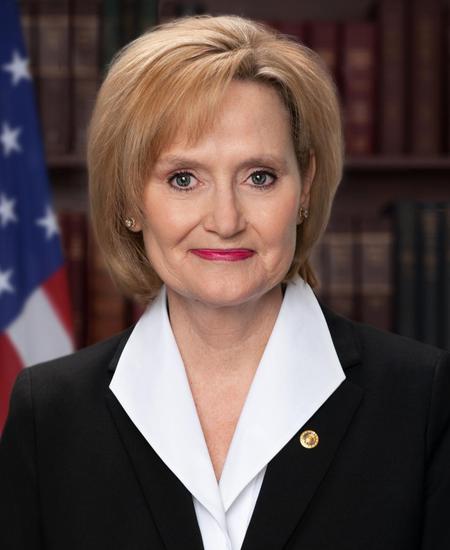
Sen. Cindy Hyde-Smith
Sponsored bills
This resolution declares that the Pledge of Allegiance has been a valuable part of life for the people of the United States for generations and defends its constitutionality.
Protecting Life on College Campus Act of 2021 This bill prohibits the award of federal funds to an institution of higher education (IHE) that hosts or is affiliated with a school-based service site that provides abortion drugs or abortions to its students or to employees of the IHE or the site. An IHE that hosts or is affiliated with a site must, in order to remain eligible for federal funds, annually certify that the site does not provide abortion drugs or abortions to students or employees.
This resolution congratulates the Mississippi State University baseball team on winning the 2021 National Collegiate Athletic Association Division I baseball championship. The resolution further recognizes Mississippi State University for its excellence as an institution of higher education.
Taiwan Partnership Act This bill requires the Department of Defense to submit a report annually to the Congressional defense committees on the feasibility and advisability of enhanced cooperation between the National Guard and Taiwan.
Uyghur Forced Labor Prevention Act This bill imposes importation limits on goods produced using forced labor in China, especially the Xinjiang Uyghur Autonomous Region, and imposes sanctions related to such forced labor. The Department of Homeland Security shall report to Congress a strategy for preventing the importation of goods produced in China using forced labor. The strategy must contain certain information, including a list of entities working with the government in Xinjiang to move forced labor or Uyghurs, Kazakhs, Kyrgyz, or members of other persecuted groups out of Xinjiang. The U.S. Customs and Border Protection shall generally presume that goods produced by these entities and certain other entities, generally those sourcing material from Xinjiang or involved with Chinese government forced labor programs, are barred from importation into the United States. The bill also expands existing asset- and visa-blocking sanctions related to Xinjiang to cover foreign individuals and entities responsible for serious human rights abuses in connection with forced labor. The Department of State shall report to Congress a strategy to enhance international awareness of forced labor in Xinjiang and to address such forced labor.
This resolution recognizes and expresses support for the efforts of democracy and human rights activists in Cuba.
This bill requires the President to impose visa- and property-blocking sanctions on the Supreme Leader of the Islamic Republic of Iran, Ayatollah Ali Khameini, and the Iranian president elected in 2021, Sayyid Ebrahim Raisol-Sadati.
Veterinary Medicine Loan Repayment Program Enhancement Act This bill modifies the requirements for calculating taxable income to exclude from gross income payments under the federal veterinary medicine loan repayment program or any state loan repayment or forgiveness program that is intended to provide for increased access to veterinary services in such state.
Historic Tax Credit Growth and Opportunity Act of 2021 This bill increases the rehabilitation tax credit and modifies certain requirements for the credit. The bill increases the rate of the credit to 30% for small projects (rehabilitation expenditures not exceeding $3.75 million) and caps the credit for such projects at $750,000 for all taxable years. The bill also expands the types of buildings eligible for rehabilitation by decreasing the rehabilitation threshold from 100% to 50% of project expenses. It also eliminates the basis adjustment requirement for the credit and modifies rules relating to the eligibility of tax-exempt use property for the credit.