

Amends the section of law relative to violations for driving after denial, revocation or suspension of a license and expands the list of offenses for which an unlicensed motorist would be in violation.
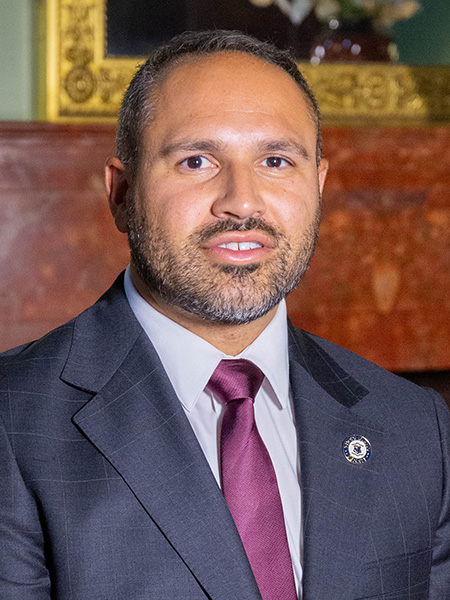
Sen. Stefano Famiglietti
Sponsored bills
Makes it unlawful for anyone under the age of 21 to operate a motor vehicle while knowingly having liquor in any part of the vehicle, except when accompanied by another adult who is 21 years of age or older and related to the operator.
Maddy summarySB 2288 allows probationers serving one year or more to earn time off their probation for compliance with court conditions, but excludes those serving probation for specific offenses including murder, sexual assault, and driving under the influence causing death. Probationers without violations can earn up to 10 days per month off their sentence, with credits calculated after completing any incarceration. Violations of probation conditions stop credit accumulation and may result in the loss of previously earned credits. The bill takes effect upon passage.
Increases the penalties for a first offense of leaving the scene of an accident resulting in death to a minimum 10 years in incarceration, a minimum of $10,000 and a minimum license revocation of 10 years.
Requires that the license plates of a vehicle be confiscated by a police officer if the owner was arrested for driving while their license was suspended, revoked or cancelled for refusing to submit to a chemical test or for operating under the influence.
Maddy summaryThis bill amends state regulations to change the frequency of backflow prevention device inspections from yearly to once every ten years for public water systems. It directly affects community and non-transient non-community public water systems by allowing the state director to set standards for cross-connection control plans and device testing. The legislation maintains requirements for installing specific valves at new and commercial connections while permitting water utilities to cut off service to customers who fail to install required devices. The bill also authorizes the state to establish fees for certifying professionals who perform backflow prevention testing and maintenance.
Maddy summarySB 2526 terminates the Department of Elementary and Secondary Education's extension of the Providence Public Schools (PPSD) turnaround plan, which had been set to continue until October 2027. This bill directly affects Providence Public Schools by ending their current oversight structure under the state's student investment initiative. The key provision nullifies the specific administrative extension issued on August 29, 2024, making it "null and void and terminated." The change takes effect on July 1, 2026, ending the extended oversight period for PPSD. This is a procedural bill that modifies an existing administrative action rather than creating new educational policy.
Repeals daylight savings time in the state and follow the “United States Standard Eastern Time” as provided by an exemption from the advancement of time as provide by the federal Uniform Time Ac of 1966, 15 U.S.C. § 260(a).
Maddy summarySB 2490 allows Rhode Island residents applying for or renewing hunting or fishing licenses to be automatically registered to vote, with the option to decline. The Department of Environmental Management will offer voter registration forms simultaneously with license applications, ensuring the same assistance level as for licenses, and protects privacy by keeping declined registrations confidential. Completed forms must be sent electronically to the state voter system within one business day, and applicants must be U.S. citizens to register. This process mirrors existing automatic voter registration at the Division of Motor Vehicles.
Maddy summaryThis bill amends Rhode Island's Law Enforcement Officers' Due Process, Accountability, and Transparency Act to modify how legal fees are handled during disciplinary hearings. It allows the chairperson of a hearing committee to appoint legal counsel for the committee upon written request from both the law enforcement agency and the accused officer, with each party responsible for paying 50% of the legal fees unless they agree otherwise. The legislation also clarifies definitions for key terms and specifies the composition of hearing committees, which must include a retired judge, a practicing attorney, and three law enforcement officers selected from a certified pool. These changes apply to permanently employed police officers, state police officers, and certain other law enforcement employees, excluding department chiefs and highest-ranking officers.