

Maddy summarySB 184 amends Pennsylvania's Medical Practice Act to extend the duration that visiting team physicians can practice without a full state license. It increases the maximum time for physicians traveling with sports teams from 10 days to 45 days per sporting event, and for physicians certified by national sports governing bodies from 30 days to 45 days. The bill maintains the requirement that physicians must hold a valid license in another state or country. This change directly affects medical professionals providing on-site care to sports teams during events in Pennsylvania.
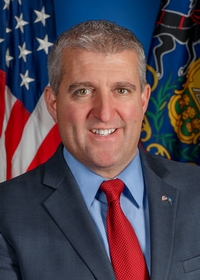
Sen. Frank Farry
Sponsored bills
Maddy summarySB 186 repeals Pennsylvania's CO2 Budget Trading Program regulations (specifically 25 Pa. Code Chapter 145 Subchapter E). This bill directly affects entities previously subject to the program's requirements, such as businesses participating in carbon emissions trading. The key provision is the immediate abrogation of all regulatory provisions under the referenced code section, eliminating the state's CO2 trading framework. The bill takes effect immediately upon enactment.
Maddy summarySB 234 amends Pennsylvania's domestic relations law to clarify procedures for emergency protection orders in domestic violence cases. It specifies that emergency orders issued by local courts expire no later than 10 business days (or when a court hearing occurs, per local rules), requiring courts to schedule hearings promptly and enter orders into a statewide registry. The bill mandates that hearing officers provide victims with clear instructions on next steps, including how to seek a permanent order, report violations, access free legal aid, and connect with domestic violence support services. This directly affects domestic violence victims, local courts, and hearing officers handling emergency protection cases. The changes aim to streamline safety protections while ensuring victims receive timely, actionable guidance.
Maddy summarySB 217 establishes Pennsylvania's Fresh Food Financing Initiative to fund projects improving access to fresh food in underserved communities. It creates a grant program within the Department of Agriculture that provides up to 15% of project costs for eligible grocery stores, farmers markets, regional supermarkets, and retail food establishments operating in USDA-designated food deserts. Applicants must serve underserved communities, derive at least 50% of revenue from food sales, and prioritize Pennsylvania-grown products or diverse business partnerships. Grants require matching private funds for supermarket projects and reserve no more than 10% of funding for program administration.
Maddy summarySB 117 amends Pennsylvania's Tax Reform Code to clarify who qualifies for historic preservation tax credits. It expands the definition of "qualified taxpayer" to explicitly include tax-exempt organizations (like 501(c)(3) nonprofits) that own historic properties, in addition to standard business entities. This change directly affects owners of historic structures seeking to claim existing tax credits under the code. The bill makes no new funding commitments but adjusts eligibility rules for current tax credit programs. It becomes effective 60 days after enactment.
Maddy summarySB 58 establishes the Medicaid Care Transition Program to address delays in moving Medicaid patients from emergency departments to appropriate post-acute care settings. It directly affects Medicaid enrollees stuck in emergency departments, hospitals, and county Medicaid managed care plans (as "responsible entities"). Key provisions require responsible entities to create care transition units that work with hospitals to secure placements within 24 hours (or seek out-of-network options if needed), and notify the Department of Human Services if placement fails after 48 hours. The Department must then convene teams to resolve barriers, collect data, and submit annual reports to legislative committees on program effectiveness.
Maddy summaryThis bill raises the annual spending cap for Pennsylvania's entertainment production tax credits from $100 million to $125 million. It directly affects film and television producers who claim these tax credits by increasing the total amount the state can award each year. The key change is a new annual limit ($125 million) for credits under Section 1716-D, effective July 1, 2025. The bill does not create new credits or alter eligibility rules - only adjusts the spending ceiling. It applies to all entertainment production tax credits awarded in fiscal years beginning on or after July 1, 2025.
Maddy summaryThis is a ceremonial resolution (SR 9), not a substantive bill. It formally honors Virginia "Ginny" Thornburgh on her 85th birthday and recognizes her decades of advocacy work supporting people with disabilities. The resolution highlights her roles as a former Pennsylvania First Lady, her leadership with disability-focused organizations, her co-authorship of advocacy publications, and her personal connection to disability advocacy through her son. It has no policy impact or direct effect on residents or laws.
Maddy summarySB 59 clarifies Pennsylvania's definition of "community college" to explicitly include programs like career training, college-parallel courses, and credit courses for high school students. It grants the State Board of Education authority to set mandatory standards for community college facilities, curriculum, faculty qualifications, student enrollment, and degree requirements. The bill also requires the State Board to prescribe all types of diplomas and certificates awarded by community colleges and permits them to offer nursing bachelor's degrees to students with associate's in nursing. This directly affects community colleges and their students across Pennsylvania.
Maddy summarySB 81 authorizes Pennsylvania to join the Dentist and Dental Hygienist Compact, enabling licensed dentists and dental hygienists from Pennsylvania to practice in other participating states without obtaining separate licenses in each state. The compact establishes a "Compact Privilege" that eliminates redundant licensing requirements while maintaining each state's authority to regulate practice within its borders. It also facilitates sharing of disciplinary information between states and supports workforce mobility for healthcare professionals seeking to work across state lines. This primarily affects licensed dental professionals who wish to practice in multiple participating states.