

Maddy summarySB 440 creates new tax credits under Pennsylvania’s PA EDGE program for semiconductor and biomedical manufacturing and research companies meeting specific criteria. It directly affects businesses that invest at least $200 million (or $20 million for early-stage semiconductor firms) in facilities, create 800 (or 100) permanent jobs, and meet local hiring and wage standards. The bill establishes two credit calculation methods: up to 2.5% of capital investment or up to $20,000 per job (capped at $20 million annually). Eligible companies must apply by March 1 each year, with credits approved by May 1, and the program prioritizes semiconductor projects with a minimum $1 million annual allocation. The tax credits reduce state tax liability for qualifying investments and job creation in these sectors.
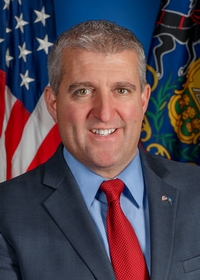
Sen. Frank Farry
Sponsored bills
Maddy summarySB 611 amends Pennsylvania's Hazardous Sites Cleanup Act by updating the definition of "hazardous substance" to explicitly include specific perfluorinated chemicals (like PFOA and PFOS) and their equivalents. This change directly affects entities responsible for cleaning up contaminated sites, as these newly listed chemicals will now trigger the Act's cleanup requirements. The bill also clarifies that petroleum, natural gas, and certain coal combustion wastes remain excluded from the definition. This definition update ensures consistent application of cleanup standards for these chemicals under the Act.
Maddy summarySB 395 establishes a licensing system for plumbers and plumbing contractors in Pennsylvania, requiring them to obtain and maintain licenses from the newly created State Board of Plumbing Contractors. The law sets specific qualifications for different license types (apprentice, journeyman, master), mandates continuing education, and creates fees, fines, and penalties for violations. It directly affects licensed plumbing professionals by governing their qualifications, renewal requirements, and enforcement, while ensuring only licensed individuals perform plumbing work requiring permits. The bill also establishes a dedicated Plumbing Contractors Licensure Account to manage fees and penalties, with no changes to existing local permitting requirements.
Maddy summarySB 173 extends Pennsylvania's veteran benefits and recognition to eligible veterans of the Republic of Korea Armed Forces who served during the Vietnam War (January 9, 1962 - May 7, 1975) and are recognized by the U.S. Department of Veterans Affairs under 38 U.S.C. § 109. It defines "eligible veteran of the Korean Armed Forces" as meeting these criteria and requires proof of service (like discharge papers or VA documentation) for benefits. The bill ensures these veterans receive the same rights, benefits, and privileges as Pennsylvania veterans of U.S. military forces. This policy change directly affects Korean veterans meeting the specific service period and VA recognition requirements.
Maddy summarySB 38 amends Pennsylvania's Human Services Code to adopt the federal False Claims Act's framework, creating new provisions for holding entities accountable for submitting false claims to the state. It directly affects contractors, grantees, and healthcare providers receiving state funds who knowingly submit false information related to payments or property. Key mechanisms include triple damages for the Commonwealth, civil penalties, and "qui tam" lawsuits allowing private citizens to file claims on behalf of the state. The bill defines "false claims" broadly to cover any knowingly submitted false requests for money or property tied to state programs, with penalties applying to violations like concealing false information or failing to report errors.
Maddy summarySB 401 creates a $1,000 tax credit for Pennsylvania employers who hire, have an employee enlist, or have an employee reenlist in the Pennsylvania National Guard. The credit applies against taxes under Articles III or IV of the Tax Reform Code and can be carried over for up to three years if not fully used in the first year. The total annual credit amount is capped at $5 million, with unused credits allocated proportionally if the cap is exceeded. This credit applies to tax years beginning after December 31, 2025, and requires employers to claim it in their first eligible tax year.
Maddy summarySB 393, the Senior Citizens' Property Tax Freeze Act, allows Pennsylvania residents aged 65+ who live on their property for at least five years and earn under $65,000 annually to freeze their real property tax increases. To qualify, applicants must submit a notarized form proving eligibility and submit annual income proof. The exemption ends if the property is sold or transferred (except to another eligible senior), and the state will reimburse local governments for lost tax revenue. The law applies starting January 1, 2026, and replaces conflicting existing laws. This directly affects qualifying seniors owning residential property in Pennsylvania.
Maddy summarySB 363 creates Pennsylvania's Low-Income Household Water Assistance Program, which will help eligible residents facing water or wastewater service disconnection due to unpaid bills. The program, to be established by the Department of Human Services by July 1, 2026, provides grants to cover overdue water/wastewater bills or restore terminated services for low-income households that own/rent homes, are responsible for utility payments, and meet income guidelines. Water and wastewater providers can apply for grants on behalf of qualifying customers, with funds restricted to preventing disconnection, paying arrears, or restoring service. The program requires annual public reporting to the Governor and legislative committees on program participation and spending.
Maddy summarySB 332 amends Pennsylvania's Election Code to change the date of the general primary election in presidential election years. Currently, the primary is held on the third Tuesday of March in such years, but this bill would move it to the fourth Tuesday of April. This change applies to general primaries starting in 2028 and affects how voters select candidates for statewide offices and the presidency. The bill directly impacts election scheduling for voters, candidates, and officials by altering the timing of primary elections.
Maddy summaryThis resolution designates February 17-23, 2025, as "THON Week" in Pennsylvania to honor Penn State student volunteers involved in the IFC/Panhellenic Dance Marathon. It recognizes their work supporting pediatric cancer research and patient care through the Four Diamonds Fund at Penn State Hershey Children's Hospital. The resolution does not create new laws or alter funding; it is a ceremonial acknowledgment of the event's mission and impact. THON, a student-run philanthropy, has raised over $236 million since 1977 for childhood cancer support.