

Maddy summaryThis bill updates Pennsylvania's emergency medical services laws to clarify rules for patient transport and insurance coverage. It defines "receiving facilities" as places where patients need further medical assessment after an ambulance response and requires protocols for handling behavioral health and substance use crises before transport. The legislation also mandates that health insurers cover emergency service payments when patients are treated and transported to these designated facilities, while simultaneously removing an outdated regulation regarding covered services.
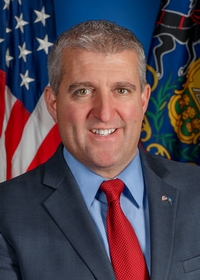
Sen. Frank Farry
Sponsored bills
Maddy summaryThe bill SB 1061 amends Pennsylvania's military affairs statutes to address accreditation requirements for the State Veterans' Commission and the Deputy Adjutant General for Veterans' Affairs. It directly affects state veterans' agencies and their personnel by establishing or modifying accreditation standards. The bill's key provision focuses on "further providing for accreditation," though the specific accreditation process or standards are not detailed in the provided context. This amendment would impact how veterans' services are structured and certified within the state's military affairs framework. The bill is currently in the referral stage with the Veterans Affairs & Emergency Preparedness committee.
Maddy summarySB 1407 amends Pennsylvania's Capital Facilities Debt Enabling Act to update the definition of "redevelopment assistance capital projects" for the purpose of issuing tax-exempt bonds. The bill clarifies that eligible projects must generate significant economic activity, involve substantial non-state funding, and include specific infrastructure like stormwater systems or hospital facilities while excluding general highways and waste disposal sites. Additionally, it allows fire trucks and firefighting equipment to qualify for assistance under certain cost conditions. This legislative change directly affects local governments and organizations seeking state-approved financing for redevelopment initiatives by establishing clearer criteria for what projects can receive funding.
Maddy summarySB 1400 modifies Pennsylvania's sentencing laws for murder to establish a mandatory life imprisonment term for second-degree murder involving unborn children or law enforcement officers. For other second-degree murder cases, the bill sets a standard minimum sentence of 35 years but allows for a reduced minimum of 10 years if the defendant proves they were not the primary actor, did not cause the death, and did not use a deadly weapon. The legislation also creates a specific pathway for courts to impose life imprisonment without parole for second-degree murder if the crime involved a child under 13, rape, a prior violent conviction, or serious injury to another victim. Additionally, the bill updates definitions for motivational boot camps and expands the role of victims in parole hearings for those sentenced to life for second-degree murder.
Maddy summaryThis bill amends Pennsylvania's laws on arson to clarify and strengthen penalties for setting fires that endanger people. It directly affects individuals who intentionally start fires or explosions, particularly those who put firefighters, police officers, or other emergency responders at risk. The key provision reorganizes existing rules to ensure that causing bodily injury to anyone, including first responders, or setting a fire while someone is inside a building results in a first-degree felony. Additionally, the bill maintains that if a fire caused by these actions leads to death, the offender can be charged with second-degree murder, or first-degree murder if the intent was to kill. The changes take effect 60 days after the bill is signed into law.
Maddy summaryThis bill updates Pennsylvania's arson laws to clarify what it means for a first responder to be "actively engaged in fighting the fire." It directly affects firefighters and other emergency personnel by expanding the definition of their duties to include a wider range of actions, such as traffic control and station standby, that support fire suppression efforts. The legislation explicitly excludes fundraising activities from this definition to ensure only operational responses are covered. These changes aim to provide clearer legal standards for determining liability in arson cases involving emergency services. The new provisions will become effective 60 days after the bill is enacted.
Maddy summaryThis bill amends Pennsylvania's Sexual Assault Testing and Evidence Collection Act by updating the legal definition of "awaiting testing" for sexual assault evidence. The change clarifies that evidence awaiting testing includes items collected by law enforcement that have not yet undergone DNA or forensic analysis and are part of an ongoing criminal investigation. This definition update directly affects how law enforcement agencies and the Department of Health classify and manage sexual assault evidence in the state. The amendment ensures consistency in terminology used across the existing evidence collection program without altering other operational procedures.
Maddy summaryThis bill amends Pennsylvania's Wholesale Prescription Drug Distributors License Act to update definitions and application requirements for drug manufacturers. It clarifies the definition of a "virtual manufacturer" as a company that manufactures and distributes drugs without taking physical possession of the products within the state. The bill requires license applicants to disclose their FDA approval status or intent to submit an application within 12 months, while explicitly stating that FDA approval cannot be made a condition for licensure. These changes affect pharmaceutical companies operating in Pennsylvania and streamline the licensing process for manufacturers at various stages of FDA approval.
Maddy summarySB 482 amends Pennsylvania's Human Services Code to improve access to home-based and community-based services for older adults. It directly affects older Pennsylvanians seeking long-term care, LIFE program organizations, and older adult daily living centers by requiring the state department to share eligibility information with these providers and clarifying rules for Medicaid managed care enrollment. Key mechanisms include mandating that applicants receive information about LIFE programs and daily living centers after eligibility assessments, preventing Medicaid managed care assignments until after such assessments, and requiring quarterly enrollment reports by county. The bill also adds definitions for "LIFE program" and "older adult daily living center" to streamline service coordination. These changes aim to enhance transparency and access to care options without altering benefit levels or funding.
Maddy summaryThis bill amends Pennsylvania's tax code to update rules for the historic preservation incentive tax credit program. It expands the definition of eligible taxpayers to include various business entities and tax-exempt organizations that own historic structures. The legislation also increases the maximum annual tax credit amount a single applicant can receive from $500,000 to $1.5 million while setting a new statewide annual cap of $20 million. Additionally, it requires the Department of Community and Economic Development to distribute these credits equitably across different regions of the state.