

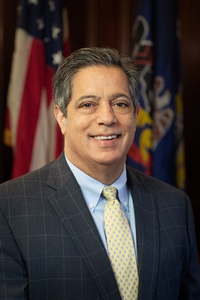
Photo of Jay Costa
D Pennsylvania Senate · District 43

Sen. Jay Costa

Compare
Total votes
5,518
all sessions
Attendance
99%
26 missed
Near the chamber average
With party
97%
of cast votes
Higher than 76% of chamber peers
Bipartisan score
1%
crosses aisle rarely
Near the chamber average
Sponsored
2,436
bills & resolutions
Higher than 98% of chamber peers
Committees
3
assignments
2,436 bills and resolutions

Sponsored bills

Total
2,436
Primary
62
Co-sponsor
2,374
This page
2,436
matching current filters
Co-sponsor SB 926
In committee · Pennsylvania Senate · Co-sponsor
An Act amending Title 23 (Domestic Relations) of the Pennsylvania Consolidated Statutes, in child custody, further providing for factors to consider when awarding custody.

Maddy summarySB 926 amends Pennsylvania's child custody law to add a new factor for courts to consider: a party's or household member's history of drug or alcohol abuse. It specifically clarifies that lawful medical marijuana use under Pennsylvania's Medical Marijuana Act (2016) alone cannot be used as evidence to deny custody or require drug testing. The bill directly affects family courts and parents involved in custody disputes by explicitly protecting medical marijuana users from having their lawful use impact custody decisions. This change updates the existing custody factors list in Title 23 of Pennsylvania law to ensure medical marijuana use is not unfairly treated as evidence of abuse. The law takes effect 60 days after enactment.

In committee Jul 17, 2025 1 co-sponsor
Co-sponsor SB 811
In committee · Pennsylvania Senate · Co-sponsor
An Act establishing the Pennsylvania SBIR/STTR Matching Funds Program to provide technology grants to small businesses.

Maddy summarySB 811 establishes Pennsylvania's SBIR/STTR Matching Funds Program to support small businesses with federal research grants. It provides state matching funds (up to $50,000) to Pennsylvania-based businesses that receive Phase I awards under the federal Small Business Innovation Research (SBIR) or Small Business Technology Transfer (STTR) programs. To qualify, businesses must conduct at least 51% of their Phase II research in Pennsylvania, submit a Phase I report, and avoid duplicate state funding. The program aims to foster economic growth by helping small businesses advance federal-funded research projects.

In committee Jul 17, 2025 1 co-sponsor
Co-sponsor SB 934
In committee · Pennsylvania Senate · Co-sponsor
An Act amending the act of March 10, 1949 (P.L.30, No.14), known as the Public School Code of 1949, in cyber charter schools, further providing for enrollment and notification.

Maddy summarySB 934 requires cyber charter schools and parents to notify a student's school district of residence within 10 days of enrollment and provide proof of residency by November 1 and March 1 each school year using a standardized form. If a school district disputes residency, the department must review the case within 15 days, and cyber charter schools must return funds to the district if a student is confirmed not to reside there. Homeless students are exempt from providing home address information under federal guidelines. This bill directly affects cyber charter schools, parents, and school districts in Pennsylvania by clarifying enrollment rules and dispute resolution processes.

In committee Jul 17, 2025 1 co-sponsor
Co-sponsor SB 398
Passed · Pennsylvania Senate · Co-sponsor
An Act amending the act of December 19, 1988 (P.L.1262, No.156), known as the Local Option Small Games of Chance Act, in games of chance, providing for online raffles by fire companies.

Maddy summarySB 398 allows Pennsylvania fire companies with existing small games of chance licenses to conduct online raffles. It requires tickets to be purchased only via debit or credit card and limits fire companies to two online raffles per year. The provision expires on December 31, 2026, and applies specifically to fire companies already authorized to host raffles under the 1988 law. This bill directly affects fire companies seeking to expand fundraising methods while maintaining payment and frequency restrictions.

Passed Jul 17, 2025 1 co-sponsor
Co-sponsor SB 416
Passed · Pennsylvania Senate · Co-sponsor
An Act amending the act of December 19, 1988 (P.L.1262, No.156), known as the Local Option Small Games of Chance Act, in games of chance, providing for payment; and abrogating a regulation.

Maddy summarySB 416 allows licensed organizations in Pennsylvania (like charities or community groups) to accept electronic payments - such as credit cards, debit cards, or mobile payments - for raffle tickets. It requires these organizations to verify buyers are at least 18 years old and comply with federal gambling laws. The bill specifically prohibits mobile payment services for certain gaming licensees under Chapter 9. It also removes an outdated regulation (61 Pa. Code § 901.506) that conflicted with these new payment rules.

Passed Jul 17, 2025 1 co-sponsor
Co-sponsor SB 812
In committee · Pennsylvania Senate · Co-sponsor
An Act amending the act of June 3, 1937 (P.L.1333, No.320), known as the Pennsylvania Election Code, in electronic voting systems, further providing for examination and approval of electronic voting systems by the Secretary of the Commonwealth and providing for malfunction and certification reporting; and making an editorial change.

Maddy summarySB 812 amends Pennsylvania's Election Code to strengthen oversight of electronic voting systems. It requires the Secretary of the Commonwealth to review these systems for security, functionality, and accessibility, including publicly demonstrating them 30 days before approval. Counties must report voting system malfunctions (e.g., ballot delays or tabulation issues) to the state within 60 days of elections, detailing causes and impacts. The bill also mandates that all review reports and public demonstration recordings be posted on the state’s website for public access.

In committee Jul 16, 2025 1 co-sponsor
Co-sponsor SB 932
In committee · Pennsylvania Senate · Co-sponsor
An Act amending the act of May 1, 1933 (P.L.103, No.69), known as The Second Class Township Code, in election of officers and vacancies in office, further providing for vacancies in general.

Maddy summarySB 932 amends Pennsylvania's Second Class Township Code to clarify procedures for filling vacancies on township boards of supervisors. It requires boards to fill vacancies within 30 days, or the vacancy board (composed of supervisors plus one appointed registered elector) must act within 15 days. If the vacancy board fails to fill the position, the chairperson or remaining members must petition the court of common pleas. The bill also specifies that if a majority of board seats become vacant, the court can fill vacancies upon petition by remaining supervisors or 15 registered electors. These changes apply directly to second-class townships across Pennsylvania.

In committee Jul 14, 2025 1 co-sponsor
Co-sponsor SB 930
In committee · Pennsylvania Senate · Co-sponsor
An Act amending the act of March 10, 1949 (P.L.30, No.14), known as the Public School Code of 1949, in student supports, further providing for definitions; in school safety and security, further providing for definitions, for School Safety and Security Committee, for school safety and security assessment providers, for School Safety and Security Grant Program, for school safety and security coordinator, for school safety and security training and for reporting and memorandum of understanding; in school security, further providing for training, for school resource officers, for school security guards and for duties of commission; in Safe2Say Program, further providing for intent, for definitions, for Safe2Say Program and for annual report; in threat assessment, further providing for definitions, for threat assessment teams and for threat assessment guidelines, training and information materials; and making editorial changes.

Maddy summarySB 930 amends Pennsylvania's Public School Code to strengthen school safety and security systems. It establishes a School Safety and Security Committee, requires schools to appoint coordinators for safety planning, and mandates annual training for staff on topics like cyber safety, active shooter drills, and mental health awareness. The bill creates a grant program funding mental health services and cyber security measures (e.g., preventing data breaches), with funds restricted to these purposes. Schools must report safety meeting attendance and security personnel details annually, starting in 2026, to their boards of directors. These changes directly affect public school districts, charter schools, and their administrators.

In committee Jul 10, 2025 1 co-sponsor
Co-sponsor SR 130
In committee · Pennsylvania Senate · Co-sponsor
A Resolution condemning the antisemitic firebombing attack on June 1, 2025, in Boulder, Colorado, against peaceful demonstrators and calling for the Commonwealth to combat the continued rise of antisemitism.

Maddy summaryThis resolution (SR 130) condemns the antisemitic firebombing attack that occurred on June 1, 2025, in Boulder, Colorado, during a Run for Their Lives demonstration supporting Jewish hostages. It calls on Pennsylvania (referred to as "the Commonwealth") to address the rising trend of antisemitism, citing statistics showing Jewish people face 67% of religious hate crimes in the U.S. and a 344% increase in antisemitic incidents over five years. The resolution expresses solidarity with the Jewish community, thanks law enforcement for responding to hate incidents, and urges action to combat antisemitism statewide. As a symbolic resolution, it does not create new laws or funding but formally condemns the attack and advocates for community support.

In committee Jul 10, 2025 1 co-sponsor
Co-sponsor SR 133
In committee · Pennsylvania Senate · Co-sponsor
A Resolution designating the week of July 21 through 25, 2025, as "Construction Opioid Awareness Week" in Pennsylvania.

Maddy summarySR 133 is a symbolic resolution designating July 21-25, 2025, as "Construction Opioid Awareness Week" in Pennsylvania. It directly encourages Pennsylvania's construction industry - including contractors, unions, and organizations like the Keystone Contractors Association - to promote awareness of opioid dangers and facilitate discussions during that week. The resolution references high overdose rates in construction (130.9 deaths per 100,000 workers in 2020) and urges existing efforts like educational toolkits, naloxone access, and "Drug Take Back" events. As a non-binding resolution, it does not create new laws or funding but formally recognizes the industry’s ongoing awareness initiatives.

In committee Jul 10, 2025 1 co-sponsor
Showing 391 to 400 of 2,436 bills
Previous 1 … 39 40 41 … 244 Next