

Maddy summarySB 443 requires Pennsylvania employers to grant eligible employees up to two hours of paid time off on election days to vote. It applies to all employers in the state and directly affects registered voters who need to cast ballots during work hours. The bill mandates that employers must permit this leave without penalty, though they may specify the exact hours during which the time off can be taken. The policy aims to reduce barriers to voting by ensuring workers can access polling places without losing work time. The bill is currently pending in the State Government committee.
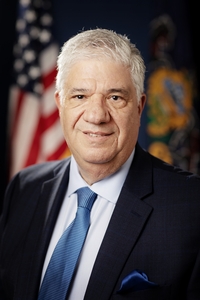
Sen. Wayne Fontana
Sponsored bills
Maddy summarySB 441 redirects revenue from table game taxes (like those paid by casinos) from the General Fund to the Property Tax Relief Fund. This change affects table game operators who pay the tax and Pennsylvania residents who benefit from the Property Tax Relief Fund. The bill amends Section 13A62(b)(3) of the state code to require this new deposit method. It also repeals a conflicting section of the Tax Reform Code of 1971 to implement the change, effective 60 days after enactment.
Maddy summaryThis resolution (SR 41) formally recognizes March 2025 as "Irish-American Heritage Month" in Pennsylvania, aligning with the federal designation made by the U.S. President. It acknowledges the historical contributions of Irish Americans to Pennsylvania and the United States, including their roles in founding the nation, cultural impact, and service in government and the military. As a ceremonial resolution, it has no binding policy changes or direct effects on legislation or funding - it serves solely to honor Irish-American heritage. The resolution also expresses support for the Good Friday Agreement and peace in Ireland.
Maddy summarySB 442 allows eligible Pennsylvania voters to register on election day at their polling place by providing proof of residence (such as a driver's license, approved document, or a sworn statement from another registered voter). It requires election judges to process registrations separately from voting, maintain records of attempted registrations, and forward completed forms to county election offices. County boards must verify 25% of new election-day registrations by mail within 10 days and report ineligible registrations to prosecutors. The bill prohibits fraudulent registrations (e.g., registering someone ineligible or in multiple districts) as a misdemeanor offense. This law applies to all future primary, municipal, and general elections after its effective date.
Maddy summarySB 420 amends Pennsylvania's Osteopathic Medical Practice Act to limit when complaints against osteopathic physicians must be disclosed to the public. It prevents physicians from having to share complaint details with patients or others if the state board determines no disciplinary action is needed and the complaint is closed without any penalty. This applies specifically to osteopathic physicians licensed under the Act in Pennsylvania, affecting how complaint records are handled. The bill takes effect 60 days after enactment.
Maddy summarySB 415 creates new criminal penalties for ransomware attacks targeting Pennsylvania state government systems. It prohibits possessing, using, or threatening to use ransomware (defined as software blocking access or encrypting data for payment demands) with penalties ranging from misdemeanors to felonies based on the ransom amount ($10,000+ triggers felony charges). The law requires managed IT service providers to notify state agencies within one hour of detecting ransomware, and agencies to report attacks to police within two hours. These provisions aim to prevent, detect, and respond to cyberattacks on Commonwealth agencies while mandating public notification after incidents.
Maddy summarySB 421 amends Pennsylvania's Medical Practice Act to limit when physicians must disclose complaints filed against them. It requires the State Board of Medicine to close complaint files without disciplinary action before physicians are not required to share those complaints with patients or others. The bill applies directly to physicians (who gain privacy for closed, non-disciplinary complaints) and patients (who may not learn about such complaints). The policy change takes effect 60 days after enactment.
Maddy summaryThis bill allows state legislators' offices and approved organizations (like nonprofits) to directly issue temporary disability parking placards to eligible individuals. Applicants must submit a signed statement confirming disability qualifications and provide medical verification, with the issuing office electronically submitting the application to the state agency. Temporary placards are valid for up to six months, and no fees can be charged beyond actual postage costs. The change streamlines access to temporary disability parking for people with qualifying conditions.
Maddy summaryThis resolution designates April 2025 as "Community College Month" in Pennsylvania. It is a symbolic gesture recognizing community colleges' role in providing affordable higher education, workforce training, and access to students from diverse backgrounds. The resolution does not create new policies, funding, or direct impacts on individuals or institutions. It serves only to highlight community colleges' contributions through a designated month of recognition.
Maddy summaryThis is a commemorative resolution (SR 36), not a law with policy changes. It formally recognizes March 2025 as "National Social Work Month" in Pennsylvania. The resolution honors social workers for their roles in crisis response, mental health care, supporting students during the pandemic, and advocating for policies like minimum wage and social safety nets. It does not create new laws, allocate funding, or directly affect specific groups - it simply urges Pennsylvanians to join in celebrating the profession.