

Maddy summarySB 35 removes seven specific Pennsylvania counties from the enhanced vehicle emission inspection program based on their population ranges (e.g., third-class counties with 215,000-216,000 residents). The bill requires the Department of Environmental Protection to initiate this removal within 60 days and submit revised state plans to the EPA by January 2026, proving these counties can maintain air quality standards without the inspection program. It also mandates notifying key legislative committees about the plan submissions. The bill directly affects vehicle owners in those counties by ending their requirement for annual emissions inspections under the enhanced program.
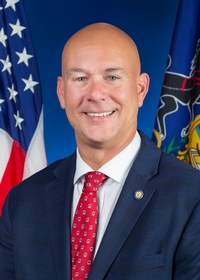
Sen. Pat Stefano
Sponsored bills
Maddy summarySB 187 establishes Pennsylvania's Independent Energy Office as a nonpartisan state agency to develop comprehensive energy plans covering all energy sources (coal, natural gas, renewables, efficiency, etc.). The office must analyze energy policies, produce annual reports for the legislature, and track energy data, directly affecting how the state oversees energy development and services for businesses, communities, and homeowners. It requires a legislative committee to appoint a politically neutral director by May 2025, with $1.25 million annually allocated from the Alternative Fuels Incentive Fund starting July 2025 to fund operations. The bill mandates that state agencies provide the office with energy data upon request while ensuring public access to its records under Pennsylvania's Right-to-Know Law.
Maddy summarySB 230 would require Pennsylvania public and private schools to obtain parental permission before providing students with instructional materials containing sexually explicit content. Schools must develop policies identifying such materials (defined as including visual depictions of specific sexual acts) and implement an opt-in form for parents to approve access. If parents do not approve or submit the form, students must receive alternative non-explicit materials. The bill applies to all Pennsylvania school entities (including charter and cyber schools) and mandates school boards to adopt these policies by August 2025 after public input. The bill is pending in the Education committee.
Maddy summaryThis resolution designates February 3, 2025, as "Four Chaplains Day" in Pennsylvania to commemorate the sacrifice of four Army chaplains (George Fox, Alexander Goode, John Washington, and Clark Poling) during WWII. It honors their selfless actions when the ship Dorchester was torpedoed in 1943, as they gave up life jackets to save others. The resolution has no policy impact - it is purely ceremonial recognition of historical events. It does not affect any laws, rights, or government programs.
Maddy summaryThis resolution designates January 26-February 1, 2025, as "Catholic Schools Week" in Pennsylvania. It expresses the state Senate's formal congratulations and appreciation to Catholic elementary and secondary schools across the Commonwealth. The resolution acknowledges these schools educate over 100,000 students and highlights their low dropout rate and high college enrollment. As a ceremonial resolution, it does not create new laws or affect funding or regulations.
Maddy summarySB 221 prohibits lobbyists from holding certain government positions in Pennsylvania, directly affecting individuals working as lobbyists who might seek new roles as public officials, agency employees, or board members of state universities. The bill amends lobbying disclosure law (Title 65, §13A07(f)(1.1)) to explicitly ban lobbyists from being appointed or employed in roles defined under 2 Pa.C.S. §101, including Commonwealth agency employees or members of state university governing boards. This restriction applies only to new appointments or employment beginning after the bill's effective date (60 days after enactment), not to current positions. The measure aims to prevent conflicts of interest by separating lobbying activities from direct government service.
Maddy summarySB 220 amends Pennsylvania's teacher certification rules under the Public School Code by establishing specific grade spans and age ranges for instructional certificates. It creates five defined certificate types: Early Childhood (pre-K-grade 4/ages 3-9), Elementary (K-grade 6/ages 4-11), Middle (grades 6-9/ages 11-15), Secondary (grades 7-12/ages 11-21), and Specialized (pre-K-grade 12/ages 3-21). These changes apply to new certificates issued after December 31, 2025, while existing certificates remain valid. Teachers with current Elementary/Middle certificates may expand their scope through continuing education or PRAXIS assessments.
Maddy summarySB 216 modifies Pennsylvania's Second Class Township Code to establish rules for storm water management fees. It allows townships to charge property owners fees based on benefits from storm water systems, with strict limits tied to federal water laws. The bill specifically protects agricultural properties: fees for farms with under 30% covered surfaces cannot exceed twice the township's median fee, and additional reductions apply for conservation costs tied to water quality plans. All collected fees must fund storm water management, and property owners must submit annual documentation to qualify for agricultural fee reductions.
Maddy summarySB 224 extends the cooling-off period for former Pennsylvania public officials and employees from one year to two years before they can represent clients on matters previously handled by their former government body. This change directly affects individuals who leave state government positions, restricting their ability to lobby or advocate for clients on specific issues within two years of departure. The bill amends Section 1103(g) of Pennsylvania’s ethics law to require this longer waiting period for any compensated representation. The policy aims to prevent potential conflicts of interest by limiting immediate post-employment lobbying on prior matters. The bill takes effect 60 days after enactment.
Maddy summarySB 218 amends Pennsylvania's Housing Authorities Law to clarify tenant selection rules and expand veteran preferences for low-income housing. It requires housing authorities to rent only to low-income tenants (with income ≤ six times annual rent, including utility costs) and prohibits renting to non-citizens or those violating immigration laws. The bill also adds a provision ensuring veteran preferences apply to all qualifying housing programs, not just specific ones. These changes directly affect Pennsylvania housing authorities and applicants seeking subsidized housing.