

Maddy summarySB 302 creates a $100 fee for defendants when a protection order is granted without their agreement. The fee is distributed as follows: $25 to the Pennsylvania State Police for the protection order registry, $25 to the law enforcement agency that served the order, $25 to the county sheriff for related costs, and $25 to the Department of Human Services for domestic violence victim services. This bill directly affects individuals subject to protection orders and impacts how courts handle service of these orders. It became law on June 30, 2025 (Act No. 23 of 2025), modifying Pennsylvania’s domestic relations code to fund victim services and registry maintenance.
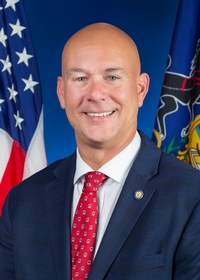
Sen. Pat Stefano
Sponsored bills
Maddy summarySB 838 amends Pennsylvania's definition of "private licensed school" in the 1986 Private Licensed Schools Act. It explicitly includes schools offering distance education in a field of study, while clarifying that the definition excludes religious schools, barber/cosmetology schools, employer-run training, and hospital-based programs. This update directly affects for-profit schools teaching skilled trades or business skills through distance learning, requiring them to comply with licensing rules they previously might not have faced. The change ensures these schools fall under the State Board of Private Licensed Schools' oversight, excluding them from existing exemptions.
Maddy summarySB 255 classifies "sexual assault by sports official, volunteer or employee of nonprofit association" (18 Pa.C.S. § 3124.3) as a Tier II sexual offense under Pennsylvania sentencing law. This change directly affects individuals convicted of this specific type of sexual assault who work in sports organizations or nonprofit settings. Tier II classification requires longer mandatory registration periods and stricter supervision for offenders. The bill amends Title 42 of Pennsylvania law to add this offense to the existing Tier II list, effective immediately upon the Governor's approval on June 30, 2025.
Maddy summaryThis bill changes Pennsylvania's fishing license fees for specific veterans and military members. Disabled veterans with a 100% service-connected disability (certified by the VA) receive free resident fishing licenses, while those with 60-99% disability pay $1. Deployed Pennsylvania National Guard members (with proof of 60+ days overseas deployment in the last 24 months) also get a $1 annual license. It repeals a prior section that provided similar $1 licenses to reserve component military members. The law took effect 60 days after the governor signed it on June 30, 2025.
Maddy summarySB 202 updates Pennsylvania's 1965 Money Transmission Business Licensing Law to include virtual currency transmission under the same regulatory framework as traditional money transmission. It requires businesses transmitting virtual currency (via money orders, checks, or digital methods) to obtain a license, meet a $500,000 tangible net worth requirement, and post a $1 million security bond. The law exempts personal virtual currency transfers using self-hosted wallets (where users control their digital records) and transactions between businesses for commercial purposes. This bill, signed into law on June 27, 2025, directly affects money transmission businesses and virtual currency service providers operating in Pennsylvania.
Maddy summarySB 665 creates a state-funded program allowing Pennsylvania municipalities to establish "Safe Exchange Zones" for two specific purposes: exchanging online purchases and conducting child custody exchanges. Municipalities apply for one-time grants to set up zones within 100 feet of police stations, sheriff's offices, or public areas with active presence, requiring clear signage, video surveillance, and emergency contact displays. The program mandates that participating police departments or sheriff's offices monitor zones for safety without interfering unless a clear danger exists, and it protects municipalities, law enforcement, and the state from liability for participant conduct. This bill, pending in committee, aims to provide designated safe locations through local grant funding.
Maddy summarySB 635 amends Pennsylvania sentencing law to impose stricter penalties for certain drug-related offenses committed within 1,000 feet of a drug and alcohol recovery house. Specifically, it requires the Pennsylvania Commission on Sentencing to create enhanced penalties for offenses under the Controlled Substance Act (sections 13(a)(12), (14), or (30)) when committed near these facilities. The bill defines "drug and alcohol recovery house" using existing law (Section 2311-A of the Administrative Code). This policy change directly affects individuals convicted of targeted drug offenses near recovery centers, increasing potential sentencing severity. The bill passed final passage on June 25, 2025.
Maddy summarySB 844 amends Pennsylvania's Fiscal Code to simplify the process for claiming small-value unclaimed property held by the state. It raises the threshold from $500 to $10,000 for the State Treasurer to automatically pay or deliver unclaimed property (or its proceeds) to a person identified as the sole owner in required reports, without requiring a formal claim. This directly affects individuals or entities with small-value unclaimed assets, such as forgotten bank accounts or checks under $10,000. The change streamlines the process for these smaller claims while maintaining existing reporting requirements under the law.
Maddy summarySB 780 creates new rules for managing encampments in Pennsylvania. It defines an "unauthorized encampment" as a temporary structure housing three or more unrelated people on property without consent, where conditions like garbage, drug activity, or unsafe sanitation exist (an "indication of nuisance"). Property owners must remove such encampments within 30 days or face civil penalties up to $250 per day, while municipalities can enforce removal after a nuisance determination. This law directly affects property owners, local governments, and individuals living in encampments, focusing on public health and safety without creating new housing programs.
Maddy summarySB 205 creates two new funding streams for Pennsylvania highway maintenance: a $5 million annual appropriation from the Motor License Fund to counties starting in 2025, and a 55-mill tax on liquid fuels. Counties can use these funds specifically for constructing and maintaining bridges owned by municipalities within their counties. The bill directly affects local governments by providing dedicated resources for bridge infrastructure, a key need for many communities. It amends Pennsylvania’s vehicle code to redirect existing transportation revenue toward this purpose without changing overall tax rates.