

Maddy summarySB 302 creates a $100 fee for defendants when a protection order is granted without their agreement. The fee is distributed as follows: $25 to the Pennsylvania State Police for the protection order registry, $25 to the law enforcement agency that served the order, $25 to the county sheriff for related costs, and $25 to the Department of Human Services for domestic violence victim services. This bill directly affects individuals subject to protection orders and impacts how courts handle service of these orders. It became law on June 30, 2025 (Act No. 23 of 2025), modifying Pennsylvania’s domestic relations code to fund victim services and registry maintenance.
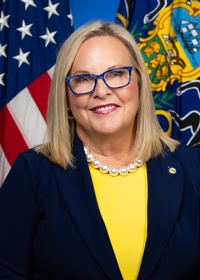
Sen. Judy Ward
Sponsored bills
Maddy summarySB 255 classifies "sexual assault by sports official, volunteer or employee of nonprofit association" (18 Pa.C.S. § 3124.3) as a Tier II sexual offense under Pennsylvania sentencing law. This change directly affects individuals convicted of this specific type of sexual assault who work in sports organizations or nonprofit settings. Tier II classification requires longer mandatory registration periods and stricter supervision for offenders. The bill amends Title 42 of Pennsylvania law to add this offense to the existing Tier II list, effective immediately upon the Governor's approval on June 30, 2025.
Maddy summaryThis bill changes Pennsylvania's fishing license fees for specific veterans and military members. Disabled veterans with a 100% service-connected disability (certified by the VA) receive free resident fishing licenses, while those with 60-99% disability pay $1. Deployed Pennsylvania National Guard members (with proof of 60+ days overseas deployment in the last 24 months) also get a $1 annual license. It repeals a prior section that provided similar $1 licenses to reserve component military members. The law took effect 60 days after the governor signed it on June 30, 2025.
Maddy summarySB 129 creates 15-member advisory councils for each Pennsylvania veterans' home to provide input on resident care, operations, and compliance. Each council includes 10 veterans appointed by the Governor from local nominations, 3 members (including a family member) from residents, 2 legislators, and 1 member selected by residents. Councils must meet quarterly, submit annual reports assessing care quality, and make recommendations to the state Department of Military and Veterans Affairs. The bill directly affects all Pennsylvania veterans' homes and their residents by establishing formal channels for community input into facility management.
Maddy summaryThis resolution designates September 12, 2025, as "The Day of the Bible" in Pennsylvania. It commemorates the 1782 publication of the Aitken Bible in Philadelphia during the Revolutionary War, highlighting the Bible's historical role in Pennsylvania's founding. The resolution encourages schools, civic groups, and community organizations to observe the day with educational programs about the Bible's cultural and historical significance in the Commonwealth. As a symbolic measure, it does not create new laws or affect any legal rights.
Maddy summarySB 850 amends Pennsylvania's Childhood Blood Lead Test Act to require all children under 72 months to receive at least one blood lead test by age 2 (or by 72 months if never tested), and mandates confirmatory testing if initial results indicate elevated lead levels. It directly affects children under 72 months and pregnant women, ensuring no out-of-pocket costs (like copays or deductibles) for covered blood lead tests. The bill updates testing requirements to be mandatory (replacing "encourage" with "require") and clarifies that health insurance must cover these tests without cost-sharing. These changes aim to improve early detection of lead exposure, a preventable health risk linked to developmental issues in young children.
Maddy summarySB 689 amends Pennsylvania's Milk Marketing Law to establish a new "board-established premium" fee on Class 1 fluid milk, directly affecting dairy producers and milk dealers through pricing changes. The bill allows the Pennsylvania Milk Board to set these premiums based on cost of production, price received, and return on equity, with a requirement for legislative review by the Agriculture Committees. If committees fail to disapprove within 30 days (or six session days), the premium is deemed approved. The law also modifies how premiums are collected (via the Department of Revenue), distributed, and exempt from standard administrative review processes, while updating cooperative marketing rules.
Maddy summaryThis resolution (SR 129) honors the late Pennsylvania State Representative Matthew R. Gergely and expresses condolences to his family following his death. It formally recognizes his life, career in McKeesport (including roles as City Administrator and Chief Revenue Officer), and service as a state representative for the 35th district. The resolution, adopted on June 23, 2025, directs the Senate to convey these condolences to his wife, children, and other surviving family members. It does not create any new policy or affect any laws.
Maddy summarySB 436 amends Pennsylvania's child protective services laws to specifically address cases involving military families. It adds definitions for "military family" (including service members, spouses, and children) and requires reports of suspected child abuse to note if they involve military families. The bill mandates that when a report concerns a military family, the state must notify both the Pennsylvania Family Advocacy Program and the military installation's representative. These changes update reporting procedures, database entries, and information-sharing rules to better coordinate with military child protection services.
Maddy summarySB 700 requires Pennsylvania public schools to adopt research-backed reading curricula aligned with the science of reading, beginning with the 2026-2027 school year. It mandates schools to use approved reading screeners to identify early literacy struggles, develop intervention plans for struggling students, and notify parents about their child’s reading progress. The bill creates a state list of approved curricula and screeners, overseen by a 20-member Reading Leadership Council including teachers and specialists, and requires schools to report adoption and screening data. Schools must also provide free, required professional development for educators on evidence-based reading instruction and intervention methods. This directly affects all K-3 public school students, their teachers, and parents through updated curriculum, screening, and intervention requirements.