

Maddy summarySB 840 establishes a new Office of Alzheimer's, Dementia and Related Disorders within the Pennsylvania Department of Aging to coordinate state efforts for individuals affected by these conditions. The office is tasked with developing a state plan, managing grants to improve dementia care capabilities, and conducting regular reviews of service gaps and scientific advancements. To guide these initiatives, the bill creates an advisory committee composed of representatives from healthcare providers, patient advocates, legal experts, and other stakeholders to provide input on policy and implementation. This committee meets to review progress, approve plan amendments, and ensure the state's approach remains responsive to emerging needs in Alzheimer's and dementia care.
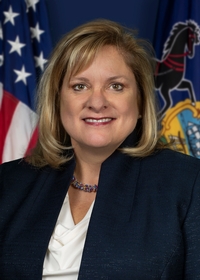
Sen. Tracy Pennycuick
Sponsored bills
Maddy summarySB 1147 updates Pennsylvania vehicle laws to require annual safety inspections for motorcycles, a change that specifically affects motorcycle owners. The bill also introduces additional parking regulations and prohibits the use of hearing impairment devices while driving. Furthermore, it establishes a motorcycle safety education program to promote rider awareness. These measures aim to improve road safety and vehicle compliance without altering other existing traffic rules.
Maddy summaryThis bill directs Pennsylvania's Department of General Services to create a plan for selling three specific state-owned properties in White Haven, Hamburg, and Polk. The required plan must outline a three-year timeline for transferring ownership, detail past sales discussions, and estimate future costs for maintenance, demolition, and necessary repairs. The department is mandated to submit this comprehensive report to the Senate and House State Government Committees within six months of the bill taking effect.
Maddy summaryThis resolution designates August 4, 2024, as "BAPS Day" in Pennsylvania to honor the 50th anniversary of the BAPS Swaminarayan Sanstha's presence in the United States. The measure recognizes the organization's history of building temples, supporting community services, and helping immigrants integrate into American civic life. By adopting this symbolic date, the Pennsylvania Senate formally acknowledges the group's contributions to the state's religious and cultural diversity.
Maddy summaryThis bill establishes a new chapter in Pennsylvania law to regulate the decommissioning of solar energy facilities, primarily affecting facility owners and the property owners who lease land for these projects. It requires solar facility operators to submit detailed decommissioning plans and provide financial assurance, such as an escrow account or bond, to cover the estimated costs of removing the facility after it stops producing electricity. The law mandates that this financial guarantee be updated every five years and fully funded within 25 years, with specific percentages required at different stages of the facility's life. Additionally, the bill ensures that these financial obligations remain tied to the facility even if ownership changes, preventing new owners from avoiding the decommissioning costs.
Maddy summaryThis bill requires schools and athletic associations in Pennsylvania to accept cash as a valid form of payment for admission to school-sponsored activities. While the law mandates that cash must be accepted, it also allows these entities to charge admission fees and to accept other payment methods, provided they can refuse payments in denominations that are significantly larger than the fee amount. The legislation clarifies definitions for terms like "school entity," "nonpublic school," and "cash" to ensure consistent application across public and private institutions.
Maddy summaryThis Senate Resolution directs the Legislative Budget and Finance Committee to study the funding gap between state-approved budgets and actual contract rates for private providers of child welfare and juvenile justice services. The study will analyze financial disparities, insurance costs, and workforce compensation across all Pennsylvania counties to understand why some providers are withdrawing from the market. The committee is required to submit a report with specific recommendations to the Senate within nine months to address these issues and improve service delivery.
Maddy summaryThis bill amends Pennsylvania's Local Option Small Games of Chance Act to update regulations regarding raffle ticket sales. It requires organizations selling raffle tickets to verify that buyers are at least 18 years old and prohibits them from accepting payment from minors. Additionally, the legislation mandates that organizations must not violate federal laws concerning unlawful Internet gambling. By removing references to online raffle sales, the bill clarifies the scope of allowed activities under the existing state law.
Maddy summaryThis bill establishes the Pennsylvania Child Learning Investment Tax Credit Program, which provides a tax benefit to parents of school-age children who are not currently enrolled in public schools. The program allows eligible taxpayers to claim an $8,000 credit per child for qualified learning expenses, such as tuition at nonpublic schools, tutoring, educational software, and standardized testing fees. The credit can be claimed when filing annual tax returns or through advance installments, with options for direct deposit or mailed checks if the credit amount exceeds the taxpayer's tax liability. The legislation also includes provisions for prorating the credit if a child attends both public and nonpublic schools during the same taxable year.
Maddy summaryThis bill establishes the Keystone National Finance Authority within Pennsylvania to support economic development through financing. It requires the authority's financial statements to be audited by a professional accountant following standard auditing practices. Additionally, the bill changes how major decisions are made, requiring approval from two-thirds of the board members, including at least four who were appointed by the governor. These changes aim to ensure stricter financial oversight and a higher level of consensus for significant actions taken by the new authority.