

Maddy summarySB 854 requires owners or managers of certain public buildings (like stadiums, airports, or large shopping centers), State-owned buildings, and health care facilities to install and maintain at least one accessible adult changing station. These stations must include a height-adjustable table meeting specific size and weight capacity standards (25x72 inches, 400-pound capacity) and be accessible to all genders. The requirement applies to new construction or major renovations (costing $20,000+) starting four years after the law's effective date, with immediate implementation for new buildings. The bill defines "public buildings" as those serving 1,500+ people daily (e.g., convention centers, movie theaters over 40,000 sq ft) and "health care facilities" as hospitals, nursing homes, or hospices.
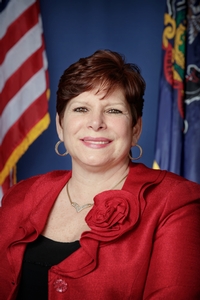
Sen. Tina Tartaglione
Sponsored bills
Maddy summarySB 865 requires emergency departments in Pennsylvania hospitals to test patient urine samples for fentanyl, medetomidine, and xylazine when conducting drug screenings for diagnosis, provided such testing is available. It mandates reporting positive results (meeting department-set thresholds) to the Department of Health, with deidentified data used for awareness efforts. The bill also creates a new requirement for the Department of Drug and Alcohol Programs to develop educational materials about the dangers of human medetomidine use - highlighting its veterinary origins, health effects, and how to discuss risks with others. These provisions directly affect emergency departments, patients receiving screenings, and residents through public health education. The law takes effect 60 days after enactment.
Maddy summaryThis bill requires Pennsylvania's Department of Human Services to establish a dental benefit package for medical assistance recipients aged 21 and older by 2025-2026. It mandates that the dental coverage must maintain all existing services provided before 2011 and cannot remove any current benefits, though it may add new coverages. The department must seek federal approval via a waiver or State plan amendment to implement this dental coverage. The bill also requires the department to publish notices in the Pennsylvania Bulletin detailing the benefit package, which will remain in effect until updated by regulation.
Maddy summaryThis bill requires all Pennsylvania public schools (including school districts, charter schools, and cyber charters) to develop written comprehensive school counseling plans. Each plan must ensure 80% of a school counselor's time is spent on direct student services (like individual counseling, classroom instruction) or indirect services (like parent consultations), with annual reviews and grade-level planning. The plans must address academic, career, and social-emotional needs for all students, including those with special needs, and align with state guidance. School counselors must hold valid Pennsylvania certification to implement these requirements.
Maddy summarySB 506 establishes Pennsylvania's Child Care Staff Recruitment and Retention Program within the Human Services Code. It provides qualified child care providers (like certified centers, family homes, or children's institutions with active subsidy agreements) with annual lump-sum payments to fund retention bonuses ($1,000 max per staff member) and recruitment bonuses ($1,000 max per new hire) for staff who directly supervise children. The program requires providers to apply within 45 days of posting, prohibits using funds to replace existing wages, and mandates annual reporting to the legislature on payments, locations, and applications. Providers must use funds strictly for staff bonuses within the fiscal year and maintain records for audits.
Maddy summarySB 870 amends Pennsylvania's military education programs to clarify eligibility and repayment rules for National Guard members and their families. It updates the definition of "approved program of education" to include more training options and refines eligibility criteria, such as requiring six years of service for full-time grants and adding specific rules for members discharged due to service-connected disabilities. The bill also revises recoupment (repayment) procedures, allowing proportional repayment if service obligations aren't met and expanding forgiveness for certain circumstances like medical discharge. These changes directly affect Pennsylvania National Guard members and their families using the Educational Assistance Program and Military Family Education Program. The bill focuses on streamlining program administration without altering benefit amounts or funding.
Maddy summarySB 853 creates a tax credit for small Pennsylvania businesses (with 50 or fewer full-time equivalent employees) affected by minimum wage increases. It allows employers to claim a credit equal to 50% of the wage increase cost in the first year after a minimum wage hike, and 25% in the second year, against their state tax liability. Unused credit can be carried over for up to three years but cannot be refunded or carried back. Pass-through businesses may also transfer unused credits to owners in proportion to their share of business income.
Maddy summarySB 795 imposes a new fee on transportation network companies (like Uber or Lyft) operating in Pennsylvania. Companies must pay 4.6% of total ride fares in Philadelphia (a city of the first class) and 6% elsewhere, remitted quarterly to the Public Transportation Trust Fund. These fees will directly fund transportation programs, including operating costs for public transit systems, as specified in the bill’s fund allocation provisions. The law takes effect immediately upon enactment.
Maddy summarySB 828 creates a program that reimburses Pennsylvania local governments (like cities, counties, and school districts) for up to 20% of the cost of purchasing "union-made" vehicles. A vehicle is "union-made" if it was assembled in the U.S. at a facility operating under a collective bargaining agreement. The program, administered by the Department of Community and Economic Development, uses a state fund financed by state appropriations and other sources, with grants awarded on a first-come, first-served basis until funds run out. Local governments must apply for reimbursement and provide proof the vehicles meet the "union-made" definition.
Maddy summaryThis resolution formally recognizes the 250th anniversary of the founding of the United States Army (established June 14, 1775, as the Continental Army). It commemorates the Army as the nation's oldest fighting force and first national institution, highlighting historical milestones like the Battle of Bunker Hill and George Washington's appointment as Commander in Chief. The resolution serves solely as a ceremonial tribute with no policy changes or direct impact on individuals or programs. It does not create new laws, allocate funds, or affect veterans' benefits.