

Maddy summaryThis bill amends Pennsylvania's Public School Code to change how intermediate school service agencies (like regional education providers) handle facility acquisitions and state funding. It grants intermediate unit boards the power to buy, lease, or accept gifts of land/buildings (Section 914-A(11)) but requires pre-approval from the Secretary of Education for all lease/loan agreements involving facilities (Section 919.1-A(a)). The state will provide capital subsidies based on a formula: student enrollment multiplied by average district spending per student, then multiplied by 0.03% (using the latest available data). This directly affects intermediate units and school districts using their services, as it alters facility financing rules and state funding calculations.
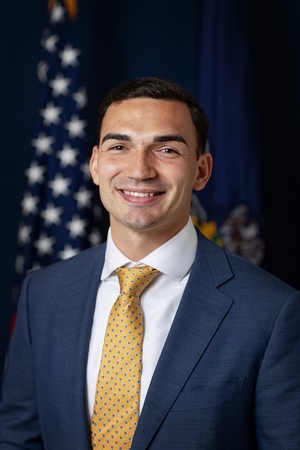
Sen. Nick Miller
Sponsored bills
Maddy summaryThis resolution (SR 42) symbolically recognizes March 2025 as "National Nutrition Month®" in Pennsylvania, aligning with a national campaign led by the Academy of Nutrition and Dietetics. It does not create new laws or funding; instead, it encourages all Pennsylvanians to participate in the campaign focused on healthy eating habits and the theme "Food Connects Us." The resolution serves as a ceremonial acknowledgment of the importance of nutrition education, referencing the Academy's role and the health benefits of informed food choices. It has no direct legal effect on individuals or policies.
Maddy summarySB 426 establishes the Legislative Youth Advisory Council within Pennsylvania's Administrative Code, creating a 50-member advisory body composed of youth aged 14-18 (one from each senatorial district) to address youth-focused issues like education, health, employment, and policy. The council will advise the General Assembly on legislation and budget matters related to youth, hold at least three meetings annually, and submit annual reports starting in 2026. Members serve two-year terms and may apply for reappointment, with the Lieutenant Governor overseeing appointments and providing administrative support. The bill does not change substantive laws but creates a formal structure for youth input into state government processes.
Maddy summarySR 38 is a symbolic resolution designating March 2025 as "Music in Our Schools Month," "Theater in Our Schools Month," "Dance in Our Schools Month," and "Youth Art Month" in Pennsylvania. It does not create new laws or funding but formally recognizes the value of arts education for students in grades K-12. The resolution highlights research showing arts education improves academic performance, social skills, and student engagement. It aims to raise public awareness about the importance of accessible arts programs, particularly for underserved students. This is a procedural resolution with no direct policy impact on school curricula or budgets.
Maddy summarySB 434 repeals a specific section (§ 1704) of Pennsylvania's domestic relations law that previously declared marriage between same-sex couples void in the state and stated marriage must be between one man and one woman. The bill removes this legal provision but does not change current marriage laws or rights for same-sex couples in Pennsylvania. It directly affects the state's statutory code by eliminating an outdated policy statement about marriage. The bill is currently referred to the Judiciary committee for further consideration.
Maddy summarySB 407 amends Pennsylvania's disabled veterans' real estate tax exemption law to clarify eligibility rules. It establishes an automatic exemption for disabled veterans with annual household income of $75,000 or less (adjusted every two years using the Consumer Price Index), while requiring additional proof of need for applicants earning above this threshold. The bill defines "annual income" broadly to include pensions, disability payments, and other sources, while excluding certain benefits like Medicare or food assistance. The state commission must publish updated income thresholds biennially in the Pennsylvania Bulletin. This directly affects disabled veterans seeking property tax relief by standardizing income-based eligibility.
Maddy summaryThis resolution designates April 2025 as "Community College Month" in Pennsylvania. It is a symbolic gesture recognizing community colleges' role in providing affordable higher education, workforce training, and access to students from diverse backgrounds. The resolution does not create new policies, funding, or direct impacts on individuals or institutions. It serves only to highlight community colleges' contributions through a designated month of recognition.
Maddy summaryThis is a commemorative resolution (SR 36), not a law with policy changes. It formally recognizes March 2025 as "National Social Work Month" in Pennsylvania. The resolution honors social workers for their roles in crisis response, mental health care, supporting students during the pandemic, and advocating for policies like minimum wage and social safety nets. It does not create new laws, allocate funding, or directly affect specific groups - it simply urges Pennsylvanians to join in celebrating the profession.
Maddy summarySB 423 creates $1 annual fishing and hunting licenses for volunteer firefighters, volunteer special fire police officers, and volunteer emergency medical service technicians in Pennsylvania. It requires applicants to provide documentation proving 12 months of active, good-standing service in one of these roles. The bill amends existing statutes to establish these specific license exemptions, replacing standard fees with a flat $1 cost for qualifying residents. This directly affects volunteers in these emergency response roles who would otherwise pay higher standard license fees.
Maddy summaryThis resolution designates October 1, 2025, as "Pennsylvania Latino and Latina Physician Day" to recognize the underrepresentation of Latino and Latina physicians in Pennsylvania (only 4% as of 2021) and highlight their importance in improving healthcare access and outcomes for the state's growing Latino population. It does not create new laws or policies but formally acknowledges the value of physician diversity through a symbolic observance. The resolution aims to raise awareness about healthcare disparities faced by Latino communities and the benefits of culturally aligned medical care, building on a national observance established in 2022.