

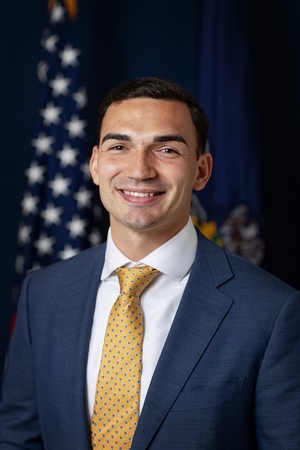
Photo of Nick Miller
D Pennsylvania Senate · District 14 On the 2026 ballot

Sen. Nick Miller

Compare
Total votes
1,656
all sessions
Attendance
100%
4 missed
Near the chamber average
With party
94%
of cast votes
Lower than 92% of chamber peers
Bipartisan score
3%
crosses aisle rarely
Higher than 90% of chamber peers
Sponsored
613
bills & resolutions
Near the chamber average
Committees
5
assignments
613 bills and resolutions

Sponsored bills

Total
613
Primary
24
Co-sponsor
589
This page
613
matching current filters
Co-sponsor SB 500
In committee · Pennsylvania Senate · Co-sponsor
An Act amending the act of March 4, 1971 (P.L.6, No.2), known as the Tax Reform Code of 1971, in Pennsylvania Economic Development for a Growing Economy (PA EDGE) Tax Credits, repealing provisions relating to local resource manufacturing, providing for Reliable Energy Investment Tax Credit, repealing provisions relating to Pennsylvania milk processing and providing for Pennsylvania milk processing; in regional clean hydrogen hubs, further providing for definitions, for eligibility, for application and approval of tax credit, for use of tax credits and for applicability; in semiconductor manufacturing and biomedical manufacturing and research, further providing for definitions and for application and approval of tax credit and providing for geothermal energy and for sustainable aviation fuel; and, in application of Prevailing Wage Act, further providing for definitions.

Maddy summarySB 500 repeals outdated tax credits for Pennsylvania petrochemical and fertilizer manufacturing projects and creates new tax credits for clean energy and advanced manufacturing sectors. It establishes tax credits for reliable energy investments, regional clean hydrogen hubs, semiconductor and biomedical manufacturing/research, geothermal energy, and sustainable aviation fuel. Businesses must meet specific eligibility criteria (like capital investment thresholds and job creation targets) to apply for these credits through the Department of Revenue, with annual funding limits and application deadlines outlined. The bill directly affects qualifying companies in these emerging industries seeking tax incentives for new investments.

In committee Jul 8, 2025 1 co-sponsor
Co-sponsor SB 900
In committee · Pennsylvania Senate · Co-sponsor
An Act providing for Commonwealth support for a Mental Health and Intellectual Disability Staff Member Loan Forgiveness Program and an Alcohol and Drug Addiction Counselor Loan Forgiveness Program; and imposing duties on the Pennsylvania Higher Education Assistance Agency.

Maddy summaryThis bill establishes a loan forgiveness program in Pennsylvania to help recruit and retain workers in mental health, intellectual disability, and addiction counseling fields. It directly affects full-time employees at county mental health agencies, private providers, and licensed addiction treatment facilities who have student loans and agree to work in these professions for at least four years. Under the program, eligible workers can receive up to $25,000 in loan forgiveness over four years, with a maximum of $6,250 forgiven each year, provided they remain employed in qualifying positions. The Pennsylvania Higher Education Assistance Agency is tasked with administering the program and determining compliance with employment requirements.

In committee Jul 8, 2025 1 co-sponsor
Co-sponsor SB 649
Signed into law · Pennsylvania Senate · Co-sponsor
An Act amending Title 18 (Crimes and Offenses) of the Pennsylvania Consolidated Statutes, in forgery and fraudulent practices, providing for the offense of digital forgery.

Maddy summaryPennsylvania's SB 649 (now Act No. 35 of 2025) creates a new criminal offense for "digital forgery," targeting individuals who create and distribute fake digital images or audio recordings of real people without consent, intending to defraud or cause harm. It defines a "forged digital likeness" as a computer-generated representation that materially changes a person's appearance, speech, or behavior to deceive others, with penalties ranging from a misdemeanor to a felony for fraud schemes. The law explicitly excludes satire, political commentary, law enforcement activities, and technology providers from prosecution, and allows a defense if the creator clearly disclosed the content as fake. This law directly affects creators of deceptive digital content and aims to protect individuals from identity-based fraud or harm.

Signed into law Jul 7, 2025 1 co-sponsor
Co-sponsor SB 896
In committee · Pennsylvania Senate · Co-sponsor
An Act amending the act of November 24, 1998 (P.L.882, No.111), known as the Crime Victims Act, in compensation, further providing for determination of claims and for awards.

Maddy summarySB 896 amends Pennsylvania's Crime Victims Act to expand how victims can prove a crime occurred for compensation claims, allowing medical records, protection orders (like those under 23 Pa.C.S. §61), or sexual violence orders (42 Pa.C.S. §62A) instead of requiring police reports. It requires hospitals, funeral homes, and crime scene cleaners to stop billing victims while claims are processed, with a 45-day window after a claim decision. The bill also increases the cap for crime scene cleanup costs from $500 to $1,500 and maintains a $35,000 total award limit. This directly affects victims filing claims and service providers waiting for payment under the compensation program.

In committee Jun 30, 2025 1 co-sponsor
Co-sponsor SB 898
In committee · Pennsylvania Senate · Co-sponsor
An Act amending the act of March 4, 1971 (P.L.6, No.2), known as the Tax Reform Code of 1971, in Waterfront Development Tax Credit, further providing for waterfront development organizations, for waterfront development projects, for tax credit and for limitations.

Maddy summarySB 898 amends Pennsylvania's Waterfront Development Tax Credit program under the Tax Reform Code. It establishes 60-day timelines for the Department of Revenue to approve or renew waterfront development organizations' applications and projects. The bill increases the maximum tax credit from 75% to 90% of a business's annual contribution and raises the annual cap on total tax credits from $5 million to $10 million. These changes directly affect waterfront development organizations and businesses making qualifying contributions to eligible projects.

In committee Jun 30, 2025 1 co-sponsor
Co-sponsor SB 897
In committee · Pennsylvania Senate · Co-sponsor
An Act amending Title 66 (Public Utilities) of the Pennsylvania Consolidated Statutes, in restructuring of electric utility industry, further providing for definitions and for duties of electric distribution companies.

Maddy summarySB 897 amends Pennsylvania's electric utility laws to change how distribution companies ensure reliable power supply. It directly affects electric utilities and their customers by creating a new process for addressing "resource inadequacy" (when power supply falls below safety buffers). The bill allows utilities to petition the state commission to invest in new generation resources (like natural gas, nuclear, battery storage, or renewables) if a resource shortage is proven, requiring them to first issue requests for proposals and obtain commission approval within nine months. Utilities may then use long-term agreements or direct ownership to fund these projects, with costs passed to customers via nonbypassable surcharges.

In committee Jun 30, 2025 1 co-sponsor
Co-sponsor SB 842
Passed · Pennsylvania Senate · Co-sponsor
An Act amending the act of May 1, 1933 (P.L.216, No.76), known as The Dental Law, further providing for definitions, for general powers of the State Board of Dentistry, for penalties and for restricted faculty license.

Maddy summarySB 842 amends Pennsylvania's Dental Law to clarify what constitutes "practice of dentistry" and establish a new "restricted faculty license" for dental educators. It specifically defines this license for individuals teaching in dental schools or accredited advanced education programs, allowing them to practice dentistry only within approved dental school facilities. The bill directly affects dental school faculty, students in clinical training, and dental hygienists by updating licensing rules and scope-of-practice boundaries. Key provisions include defining permitted teaching-related dental activities and prohibiting restricted faculty license holders from practicing outside designated educational settings.

Passed Jun 30, 2025 1 co-sponsor
Co-sponsor SB 719
Signed into law · Pennsylvania Senate · Co-sponsor
An Act amending the act of May 26, 1947 (P.L.318, No.140), known as the CPA Law, further providing for definitions, for general powers of the board, for examination and for requirements for issuance of certificate; repealing provisions relating to practice in this Commonwealth by individuals under substantial equivalency; further providing for practice outside this Commonwealth under substantial equivalency and for practice by firms and unlicensed entities under substantial equivalency; providing for practice in this Commonwealth by individuals under automatic mobility; and further providing for licenses to practice, for licensing of firms, for grounds for discipline, for reinstatement and for unlawful acts.

Maddy summarySB 719 amends Pennsylvania's CPA Law to update licensing requirements for certified public accountants (CPAs) and accounting firms. It raises the required education credits from 120 to 150 semester credits for exam eligibility, revises exam retake rules to use a rolling 30-month window for passing all sections, and creates "automatic mobility" allowing out-of-state CPAs in good standing to practice in Pennsylvania without a new license. The bill also repeals outdated provisions about "substantial equivalency" for out-of-state practice and clarifies disciplinary procedures. This law, signed by the governor on June 30, 2025 (Act No. 27 of 2025), directly affects CPAs, accounting firms, and individuals seeking licensure in Pennsylvania.

Signed into law Jun 30, 2025 1 co-sponsor
Co-sponsor SB 129
Signed into law · Pennsylvania Senate · Co-sponsor
An Act amending Title 51 (Military Affairs) of the Pennsylvania Consolidated Statutes, in Department of Military and Veterans Affairs, further providing for advisory councils for veterans' homes.

Maddy summarySB 129 creates 15-member advisory councils for each Pennsylvania veterans' home to provide input on resident care, operations, and compliance. Each council includes 10 veterans appointed by the Governor from local nominations, 3 members (including a family member) from residents, 2 legislators, and 1 member selected by residents. Councils must meet quarterly, submit annual reports assessing care quality, and make recommendations to the state Department of Military and Veterans Affairs. The bill directly affects all Pennsylvania veterans' homes and their residents by establishing formal channels for community input into facility management.

Signed into law Jun 30, 2025 1 co-sponsor
Co-sponsor SB 665
In committee · Pennsylvania Senate · Co-sponsor
An Act amending Title 53 (Municipalities Generally) of the Pennsylvania Consolidated Statutes, providing for Safe Exchange Zone Program.

Maddy summarySB 665 creates a state-funded program allowing Pennsylvania municipalities to establish "Safe Exchange Zones" for two specific purposes: exchanging online purchases and conducting child custody exchanges. Municipalities apply for one-time grants to set up zones within 100 feet of police stations, sheriff's offices, or public areas with active presence, requiring clear signage, video surveillance, and emergency contact displays. The program mandates that participating police departments or sheriff's offices monitor zones for safety without interfering unless a clear danger exists, and it protects municipalities, law enforcement, and the state from liability for participant conduct. This bill, pending in committee, aims to provide designated safe locations through local grant funding.

In committee Jun 25, 2025 1 co-sponsor
Showing 151 to 160 of 613 bills
Previous 1 … 15 16 17 … 62 Next