

Maddy summaryHB 1193 proposes a constitutional amendment to update voter qualifications in Pennsylvania. It would lower the voting age from 21 to 18, reduce residency requirements to 30 days for state and local election districts (from 90 and 60 days), and require government-issued ID for in-person voting and mail-in ballots (with signature matching). Voters must also register at least 30 days before an election, with registration requiring pre-confirmation of eligibility. The amendment must be approved by the General Assembly and then by voters in a statewide election.
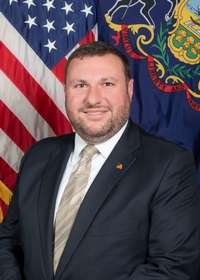
Rep. Chad Reichard
Sponsored bills
Maddy summaryThis Pennsylvania House Resolution designates April 14-18, 2025, as "Local Government Week" and April 16, 2025, as "Local Government Day" within the state. It formally recognizes the role of local government units - such as counties, cities, townships, boroughs, and municipal authorities - by commending officials and employees who provide essential services to residents. The resolution highlights that Pennsylvania's local governments serve over 13 million people through nearly 166,000 employees and thousands of volunteer officials. It has no binding policy effect and serves solely as a symbolic acknowledgment of local government contributions.
Maddy summaryHB 1183 amends Pennsylvania's Tax Reform Code to exempt adoption fees charged by qualifying nonprofit animal shelters from sales tax. The bill specifically excludes fees paid to nonprofit "releasing agencies" (as defined by Pennsylvania's Dog Law) that do not charge more than the actual costs of caring for the animal. This change directly affects nonprofit shelters meeting both criteria: (1) being a registered releasing agency under the Dog Law, and (2) charging fees covering only care expenses. The tax exclusion takes effect 60 days after enactment.
Maddy summaryThis is a House Resolution (not a bill), urging Pennsylvania State University (Penn State) leadership to be transparent about any potential closure of its 12 Commonwealth campuses. It asks the university president to publicly share criteria for closures, demonstrate alignment with Penn State’s land-grant mission, and detail plans to maintain educational access for affected students and communities. The resolution emphasizes that campus closures would disproportionately impact rural and underserved areas, reduce local economic activity, and undermine public trust. It does not create new laws or funding but formally requests Penn State to engage communities and provide clear, open communication before making closure decisions.
Maddy summaryHB 1152 requires insurance companies to directly reimburse non-network emergency medical services (EMS) agencies for 911 emergency calls within 45 days at 350% of the Medicare ambulance rate for the same service in the same area. EMS agencies must register with the state annually to qualify for direct payments, and insurers cannot demand contracts to facilitate this reimbursement. The insurer's payment covers the full service cost (excluding the patient's copay, coinsurance, or deductible), so EMS agencies cannot bill patients for the remaining amount. This law applies only to non-network EMS providers offering 911 emergency medical services, unless preempted by federal law.
Maddy summaryThis Pennsylvania House Resolution (HR 2) designates March 25, 2025, as "National Medal of Honor Day" within the state. It symbolically recognizes the Medal of Honor - the military's highest award for valor - as first presented on March 25, 1863, and highlights Pennsylvania's 379 Medal of Honor recipients (second-highest in the U.S.). The resolution has no binding effect or new policy requirements; it solely serves to honor recipients and their service through a ceremonial designation. It does not directly affect any individuals or alter existing laws.
Maddy summaryHR 147 designates May 21, 2025, as "Emergency Medical Services for Children Day" in Pennsylvania. The resolution recognizes the Emergency Medical Services for Children (EMSC) Program - a federal initiative focused on improving emergency care for infants, children, and teens - and honors the healthcare professionals, EMS providers, and families involved in pediatric emergency services. It does not create new laws or alter funding but serves as a symbolic acknowledgment of efforts to enhance pediatric emergency care systems across the state.
Maddy summaryHB 1031 amends Pennsylvania's nuisance laws to increase penalties for scattering rubbish or illegally dumping trash. It directly affects individuals who litter or dump waste, imposing stricter fines and community service requirements based on offense frequency. For a first offense, penalties include fines up to $2,000 and 5-30 hours of cleanup; repeat offenses escalate to fines up to $5,000 (second offense) or $20,000 (subsequent offenses), with mandatory community service up to 5 years. The bill updates existing penalties under Title 18, Criminal Code, without changing the core definition of the offense. It is scheduled to take effect six months after enactment.
Maddy summaryThis resolution designates April 13-19, 2025, as "National Public Safety Telecommunicators Week" in Pennsylvania. It honors 911 dispatchers (also called public safety telecommunicators) who serve as the first point of contact during emergencies and support emergency responders. The resolution recognizes their critical role in ensuring community safety through their professionalism and dedication during high-pressure situations. As a ceremonial resolution, it does not create new laws or policies.
Maddy summaryHB 962 allows eligible organizations, such as charities and non-profits, to conduct virtual raffles and drawings using electronic payments like credit cards or mobile apps. The bill requires organizations to verify that participants are physically in Pennsylvania, are at least 18 years old, and provide accurate identity information through methods like government ID checks. It also restricts how winners are announced - only simple internet-based conferencing (e.g., Zoom) without animations, images, or slot machine technology can be used. These rules aim to modernize virtual game operations while ensuring compliance with state and federal gambling laws.