

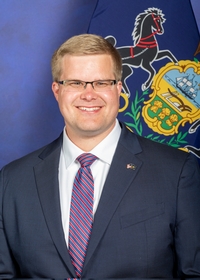
Photo of Thomas Kutz
R Pennsylvania House · District 87 On the 2026 ballot

Rep. Thomas Kutz

Compare
Total votes
4,535
all sessions
Attendance
100%
1 missed
Near the chamber average
With party
96%
of cast votes
Near the chamber average
Bipartisan score
2%
crosses aisle rarely
Near the chamber average
Sponsored
209
bills & resolutions
Near the chamber average
Committees
6
assignments
209 bills and resolutions

Sponsored bills

Total
209
Primary
29
Co-sponsor
180
This page
209
matching current filters
Co-sponsor HB 2370
In committee · Pennsylvania House · Co-sponsor
An Act amending the act of March 4, 1971 (P.L.6, No.2), known as the Tax Reform Code of 1971, in personal income tax, further providing for imposition of tax and for requirement of withholding tax.

Maddy summaryThis bill amends Pennsylvania's personal income tax law to establish a temporary lower tax rate of 2.99% for six months starting in 2026, before reverting to the standard rate of 3.07%. It applies this reduced rate to income earned by residents and nonresidents from sources within the state. Additionally, the legislation requires employers to withhold taxes from employee paychecks in a way that accounts for this temporary rate change. The changes are set to take effect on July 1, 2026, or later if the law is not signed into effect sooner.

In committee Apr 9, 2026 1 co-sponsor
Co-sponsor HB 2372
In committee · Pennsylvania House · Co-sponsor
An Act amending Title 66 (Public Utilities) of the Pennsylvania Consolidated Statutes, in restructuring of electric utility industry, further providing for declaration of policy, for standards for restructuring of electric industry and for duties of electric distribution companies.

Maddy summaryThis bill requires hyperscale data centers in Pennsylvania to build their own baseload power generation and pay for all costs to connect that power to the grid, regardless of distance. It mandates that electric distribution companies cooperate with these data centers by planning for their energy needs and prohibiting cross-subsidization of their rates with other customers. Additionally, the bill sets specific rules for long-term power contracts used by default service providers and gives the state commission authority to define what qualifies as a hyperscale data center.

In committee Apr 9, 2026 1 co-sponsor
Co-sponsor HB 2335
In committee · Pennsylvania House · Co-sponsor
An Act amending the act of May 22, 1951 (P.L.317, No.69), known as The Professional Nursing Law, further providing for definitions and for scope of practice for certified registered nurse anesthetists.

Maddy summaryThis bill amends Pennsylvania's Professional Nursing Law to update the legal definitions and scope of practice for certified registered nurse anesthetists (CRNAs). It allows CRNAs to perform anesthesia services under the overall direction of a physician, podiatrist, or dentist who is present and available onsite during the procedure. The legislation grants CRNAs expanded authority to prescribe and administer certain medications, order and interpret diagnostic tests, and manage patient care throughout the anesthesia process, including preoperative preparation, induction, maintenance, and post-anesthesia care. These changes formalize the professional responsibilities of CRNAs within the state's nursing regulatory framework without altering the requirement for collaborative oversight by licensed medical professionals.

In committee Mar 30, 2026 1 co-sponsor
Co-sponsor HB 2308
In committee · Pennsylvania House · Co-sponsor
An Act amending the act of March 10, 1949 (P.L.30, No.14), known as the Public School Code of 1949, in institutions of higher education, establishing the PA WORKS Scholarship Grant Program and the trade career-incentive tax credit.

Maddy summaryThis bill creates the PA WORKS Scholarship Grant Program and a trade career-incentive tax credit for Pennsylvania residents pursuing specific skilled trade careers in higher education. The scholarship provides up to $5,000 per academic year to students enrolled in approved courses such as carpentry, welding, plumbing, or electrical work, provided they maintain satisfactory academic progress and have not yet earned a bachelor's degree. Recipients must agree to live and work in Pennsylvania for 36 months in an in-demand occupation after completing their degree, with the scholarship amount prorated based on years of service and requiring repayment if they fail to meet these requirements. Additionally, the bill establishes a tax credit for business firms that hire graduates from these trade programs, though specific credit amounts and eligibility details are not fully detailed in the provided text.

In committee Mar 23, 2026 1 co-sponsor
Co-sponsor HB 2279
In committee · Pennsylvania House · Co-sponsor
An Act amending Title 42 (Judiciary and Judicial Procedure) of the Pennsylvania Consolidated Statutes, in limitation of time relating to criminal proceedings, further providing for other offenses.

Maddy summaryThis bill updates Pennsylvania's criminal law by establishing a five-year statute of limitations for prosecuting specific serious offenses. It directly affects prosecutors and defendants by setting a deadline within which these cases must be filed after the alleged crime occurs. The law covers a wide range of crimes including murder-related attempts and conspiracies, violent offenses like kidnapping and robbery, financial crimes such as fraud and bribery, and other serious violations like arson and drug delivery resulting in death. The changes apply to all listed offenses regardless of whether the crime was completed or attempted, ensuring that serious allegations can still be pursued within a defined timeframe.

In committee Mar 11, 2026 1 co-sponsor
Co-sponsor HB 2280
In committee · Pennsylvania House · Co-sponsor
An Act amending the act of June 3, 1937 (P.L.1333, No.320), known as the Pennsylvania Election Code, in nomination of candidates, further providing for affidavits of candidates and providing for ascertaining residence of candidates.

Maddy summaryThis bill amends Pennsylvania's Election Code to require candidates for state, local, and federal offices to file affidavits confirming their eligibility, campaign expense compliance, and party affiliation when submitting nomination petitions. It also adds a separate affidavit specifically for verifying candidate residence and post office address, which will be kept confidential and not subject to public disclosure under state right-to-know laws. The changes apply to a wide range of offices including state representatives, judges, party delegates, and federal candidates, though U.S. presidential candidates would only need to provide their post office address without filing the full affidavit. The bill takes effect 60 days after passage and aims to streamline candidate verification while protecting personal address information from public records.

In committee Mar 11, 2026 1 co-sponsor
Co-sponsor HR 427
In committee · Pennsylvania House · Co-sponsor
A Resolution recognizing the week of May 10 through 16, 2026, as "National Police Week" and recognizing May 15, 2026, as "Peace Officers Memorial Day" in Pennsylvania.

Maddy summaryThis Pennsylvania House Resolution designates the week of May 10 through 16, 2026, as "National Police Week" and May 15, 2026, as "Peace Officers Memorial Day" within the state. The measure formally acknowledges the service and sacrifice of police officers who have died in the line of duty and aligns Pennsylvania with the federal observance dates established by Congress. It does not create new laws, funding, or operational requirements but serves as a symbolic recognition of law enforcement contributions.

In committee Mar 10, 2026 1 co-sponsor
Co-sponsor HB 2213
In committee · Pennsylvania House · Co-sponsor
An Act providing for skill video gaming; imposing duties on the Department of Revenue; providing for issuance of licenses for skill video gaming; imposing a fee and criminal and civil penalties; and providing for zoning.

Maddy summaryHB 2213 establishes a regulatory framework for "skill video gaming" in Pennsylvania, directly affecting businesses that operate or distribute gaming systems. The bill requires licenses from the Department of Revenue for operators, distributors, and establishments, imposes fees, and mandates a central reporting system to track transactions like "coin in/out" and jackpots. Key provisions include banning access for people under 18, prohibiting "miniature casinos," requiring security measures for players, and creating criminal penalties for operating unlicensed systems or distributing to minors. It aims to eliminate illegal gambling devices disguised as skill-based games while leveraging the State Lottery's existing experience in retail gaming oversight.

In committee Feb 11, 2026 1 co-sponsor
Co-sponsor HB 2201
In committee · Pennsylvania House · Co-sponsor
An Act amending the act of March 4, 1971 (P.L.6, No.2), known as the Tax Reform Code of 1971, in personal income tax, further providing for definitions and providing for physical health improvement tax credit.

Maddy summaryHB 2201 creates a new tax credit for Pennsylvania residents who pay qualified fitness expenses, such as gym memberships or in-person exercise classes at eligible facilities. It defines "qualified sports and fitness expenses" to exclude virtual instruction (unless live), books, and one-on-one training, and specifies that fitness facilities must not offer golf/hunting/sailing and must comply with anti-discrimination laws. The credit allows single filers to claim up to $500 and joint filers up to $1,000 annually, but it is non-refundable and cannot be carried forward to future tax years. This provision applies to taxable years beginning after December 31, 2024, directly affecting residents who incur qualifying physical health-related expenses.

In committee Feb 9, 2026 1 co-sponsor
Co-sponsor HB 2196
In committee · Pennsylvania House · Co-sponsor
An Act amending Title 66 (Public Utilities) of the Pennsylvania Consolidated Statutes, providing for consumer choice billing; imposing penalties; and making repeals.

Maddy summaryHB 2196 requires electric and natural gas suppliers in Pennsylvania to provide consolidated billing, replacing separate bills from utilities and suppliers with a single bill showing all charges. This directly affects residential and commercial customers who choose alternative energy suppliers (currently only 23% of residential electric and 11.3% of natural gas customers). The key mechanism mandates that suppliers must consolidate all electric and natural gas charges onto one bill, using smart meter data to enable more tailored pricing options like time-of-use rates. The bill also includes penalties for non-compliance with these billing requirements.

In committee Feb 5, 2026 1 co-sponsor
Showing 41 to 50 of 209 bills
Previous 1 … 4 5 6 … 21 Next