

Maddy summaryThis bill designates the week of April 12 through 18, 2026, as "National Public Safety Telecommunicators Week" in Pennsylvania. It directly honors 911 dispatchers and public safety telecommunicators who coordinate emergency responses for medical, fire, and police services. The resolution acknowledges the critical role these professionals play as the first point of contact for residents during emergencies. This is a commemorative measure that recognizes the diligence and professionalism of these workers without changing any laws or policies.
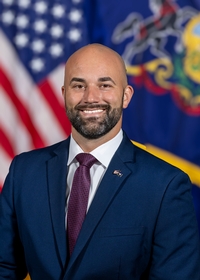
Rep. David Rowe
Sponsored bills
Maddy summaryThis Pennsylvania House Resolution designates the week of May 10 through 16, 2026, as "National Police Week" and May 15, 2026, as "Peace Officers Memorial Day" within the state. The measure formally acknowledges the service and sacrifice of police officers who have died in the line of duty and aligns Pennsylvania with the federal observance dates established by Congress. It does not create new laws, funding, or operational requirements but serves as a symbolic recognition of law enforcement contributions.
Maddy summaryHB 2240 amends Pennsylvania's Public School Code to require charter school applications to include detailed information about each physical facility, such as its address, ownership, and lease arrangements. The bill specifies that every facility must be located entirely within a single school district's boundaries. Charter schools must also provide this facility information to the relevant school district and notify them of any changes within 10 days. This applies to all new charter school applications and updates to existing school locations.
Maddy summaryHB 2248 designates May 20 as "Jimmy Stewart Day" in Pennsylvania to honor the late actor, who was born in Indiana, Pennsylvania, and starred in iconic films like *It's a Wonderful Life* and *Mr. Smith Goes to Washington*. The bill is purely commemorative, with no requirement for employers to grant paid leave or treat the day as a legal holiday. It includes legislative findings about Stewart's life, career, military service, and legacy, including his 1985 Presidential Medal of Freedom. The designation applies annually without imposing new obligations on individuals or organizations.
Maddy summaryHB 2221 designates Bridge Key 52427 on Pennsylvania Route 970 over the West Branch of the Susquehanna River in Bradford Township, Clearfield County, as the Ashley E. Woolridge Memorial Bridge. The bill requires the Pennsylvania Department of Transportation to install and maintain signs displaying the new name on the bridge. This commemorative measure honors Ashley E. Woolridge, a WWII pilot and local community member, as documented in the bill's findings. The designation takes effect 60 days after enactment.
Maddy summaryHB 2209 requires all state-funded institutions of higher education in Pennsylvania to implement a mandatory one-credit course on "the dangers and realities of communism and socialism" starting in the 2027-2028 school year. The course must cover specific topics including definitions of capitalism, communism, and socialism; historical examples like China, Cuba, and the Soviet Union; comparisons between free markets and communist systems; and the impact on civil liberties. It applies to all public universities, community colleges, and state-funded private institutions as defined in the bill. The law mandates this curriculum for all students at these institutions, with no exemption for existing courses. The bill takes effect 60 days after enactment.
Maddy summaryHB 2213 establishes a regulatory framework for "skill video gaming" in Pennsylvania, directly affecting businesses that operate or distribute gaming systems. The bill requires licenses from the Department of Revenue for operators, distributors, and establishments, imposes fees, and mandates a central reporting system to track transactions like "coin in/out" and jackpots. Key provisions include banning access for people under 18, prohibiting "miniature casinos," requiring security measures for players, and creating criminal penalties for operating unlicensed systems or distributing to minors. It aims to eliminate illegal gambling devices disguised as skill-based games while leveraging the State Lottery's existing experience in retail gaming oversight.
Maddy summaryThe provided context does not include the specific policy language or provisions of HB 17. While the bill's title references amendments to the Public School Code of 1949 regarding "subjects of instruction and flag code," the details of what changes are proposed - such as which subjects would be added or modified, or specific flag-related requirements - are not described in the given information. Without these concrete details, a factual summary of the bill's mechanisms, affected parties, or policy changes cannot be created. The procedural history (e.g., committee referrals) does not substitute for the bill's substantive content. For an accurate summary, the full text of the bill or detailed explanatory materials would be required.
Maddy summaryHB 2208 removes counties with populations between 168,000 and 169,000 (based on the latest census) from Pennsylvania’s enhanced vehicle emission inspection program. It requires the Department of Environmental Protection to submit a revised state plan to the EPA by January 1, 2026, proving these counties can meet air quality standards without the inspection program. The plan must comply with federal requirements and avoid negatively impacting air quality goals or funding. The department must also notify specific legislative committees about the EPA submission.
Maddy summaryHB 2201 creates a new tax credit for Pennsylvania residents who pay qualified fitness expenses, such as gym memberships or in-person exercise classes at eligible facilities. It defines "qualified sports and fitness expenses" to exclude virtual instruction (unless live), books, and one-on-one training, and specifies that fitness facilities must not offer golf/hunting/sailing and must comply with anti-discrimination laws. The credit allows single filers to claim up to $500 and joint filers up to $1,000 annually, but it is non-refundable and cannot be carried forward to future tax years. This provision applies to taxable years beginning after December 31, 2024, directly affecting residents who incur qualifying physical health-related expenses.