

Maddy summaryThis Pennsylvania bill, HB 2457, amends the state's Tax Reform Code to temporarily exempt individuals from paying sales and use tax on tools purchased for home or auto repair. The change applies only during a six-month window starting on July 1, 2026, and covers both handheld and stationary tools along with necessary accessories. To implement this, the Department of Revenue will publish online guidance, and the tax exemption applies to purchases made within the six-month period even if delivery occurs afterward.
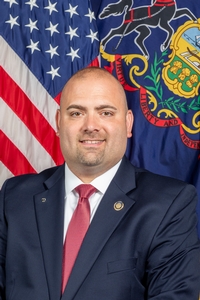
Rep. Joe Hamm
Sponsored bills
Maddy summaryThis Pennsylvania bill creates a temporary tax exemption for the sale and use of flags, flag poles, and related accessories. The exclusion applies only to individual buyers purchasing these items for personal, non-business purposes during a six-month window starting on July 1, 2026. The law defines a purchaser as someone who places an order and pays by cash or credit within that six-month period, even if the item is delivered later. The Department of Revenue will publish online guidance to help the public understand how to claim this exemption.
Maddy summaryThis Pennsylvania House resolution (HR 157) urges the U.S. Congress to pass H.R. 3023 (or similar legislation) during the 119th Congress, which would require the Department of Veterans Affairs and Department of Defense to provide stellate ganglion block (SGB) therapy to veterans and military members with PTSD. SGB is a low-risk neck injection procedure that targets nerves controlling stress responses, potentially alleviating symptoms like anxiety and hyperarousal. The resolution cites that 23% of recent veterans and 12-15% of older veterans have PTSD diagnoses, with current treatments helping only 40% of patients. It emphasizes SGB's decades-long use and support from veterans' organizations as a potential treatment option.
Maddy summaryThis bill modifies Pennsylvania's sales tax code to temporarily exempt the purchase of firearm safety devices from sales tax. The exemption applies to items such as gun safes, vaults, lockers, and various types of locks, but only during a six-month window starting when the law takes effect. To qualify for the tax break, an individual must place their order and pay for the device within that six-month period, regardless of when the item is actually delivered. The Department of Revenue is required to publish online guidance to help consumers understand how to use this exclusion. The changes are scheduled to become effective on July 1, 2026, or immediately if enacted sooner.
Maddy summaryHB 2442 amends Pennsylvania's Safe Drinking Water Act to allow the Department of Agriculture to issue temporary operating licenses to applicants seeking retail food facility permits. To qualify, applicants must prove they have submitted a complete public water system permit application and provide certified lab tests showing their water system meets federal standards. The temporary license remains valid only while the permit application is pending and automatically expires if the permit is issued, denied, or if the applicant fails to submit required compliance tests every six months.
Maddy summaryHouse Bill 2395 amends Pennsylvania's Tax Reform Code to temporarily exempt individuals from paying sales and use tax on lumber purchased for personal, non-business use. The bill defines 'lumber' as processed hardwood or softwood intended for construction and sets a six-month window starting July 1, 2026, during which this tax break applies. To ensure clarity, the Department of Revenue is required to publish online guidance explaining how to implement this temporary exclusion.
Maddy summaryThis bill requires individuals applying for or receiving public assistance in Pennsylvania to participate in an identification program that includes placing their photograph on electronic benefit cards and may involve fingerprinting. County officials would be tasked with verifying this photographic identification before issuing any aid to ensure proper recipient verification. The law aims to update administrative procedures within the Human Services Code by mandating these specific identification methods for all assistance recipients.
Maddy summaryThis bill amends Pennsylvania vehicle laws to provide temporary fuel price relief by reducing specific taxes on gasoline and fees for electric vehicle road users. For the first six months after it takes effect, the state will eliminate certain fuel taxes, and for the following six months, it will cut those fees by half. To ensure consumers benefit directly, the law requires fuel dealers to pass these savings on by lowering sale prices and prohibits them from keeping the tax reduction as extra profit. The Department of Revenue must estimate the resulting loss in state revenue, and the State Treasurer is then required to transfer that amount from a budget reserve fund to maintain highway maintenance financing.
Maddy summaryHB 2102 amends Pennsylvania's Amber Alert law to create a new "Pennsylvania Purple Alert System" for missing individuals with specific conditions, including autism, Alzheimer's (under age 60), dementia (under age 60), traumatic brain injury, or similar impairments. The Pennsylvania State Police will establish and maintain this system to provide public alerts and coordinate with law enforcement for faster recovery of these vulnerable individuals. The bill updates the law's title to include the Purple Alert System and expands existing immunity protections for good Samaritans who assist in Amber Alert, MEPAS, or Purple Alert cases. This change adds a targeted alert system without altering the existing Amber Alert procedures.
Maddy summaryHB 2371 modifies Pennsylvania's tax code to temporarily exempt mobile telecommunications services from sales and gross receipts taxes for six months starting in 2026. The bill requires providers to report these services separately and mandates that the tax savings be passed directly to consumers through lower bills, with penalties for non-compliance. Additionally, the legislation ensures that a specific transfer of funds from the Alternative Fuels Incentive Act remains consistent with the previous fiscal year.