

Maddy summaryHB 1156 amends Pennsylvania's Human Services Code to strengthen eligibility verification for medical assistance and food stamp programs. The bill requires the state department to regularly review data from other agencies, including monthly checks for gambling winnings over $3,000 (via the Gaming Control Board), death records (from the Department of Health), and residency changes (via out-of-state EBT), plus quarterly checks for employment and income changes (from Labor and Revenue). It also prohibits the department from accepting eligibility determinations from health insurance exchanges without verification and bans self-attestation for key factors like income, residency, or household composition without prior verification. These changes update the verification process to align with current data-sharing capabilities.
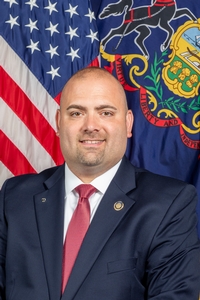
Rep. Joe Hamm
Sponsored bills
Maddy summaryHB 1162 amends Pennsylvania's Election Code to clarify election procedures, primarily affecting county election boards, election officials, and voters. The bill specifically changes when provisional ballots can be counted (they cannot be counted if an absentee or mail-in ballot was received), updates definitions of "canvass" and "pre-canvass," and sets requirements for election materials handling. It also clarifies that county boards must ensure election materials are delivered on time or face penalties for judges of elections who fail to comply. These procedural changes aim to standardize election administration and prevent duplicate voting across in-person, absentee, and mail-in voting methods. The bill focuses on technical adjustments to election processes rather than substantive policy changes.
Maddy summaryHB 1160 requires Pennsylvania county election boards to conduct post-election verification of electronic voting systems. Specifically, it mandates a random statistical sample recount of at least 2% of votes cast (or 2,000 votes, whichever is smaller) using different devices than those used in the election. Additionally, county boards must randomly select three precincts per election for a full hand count of all ballots. These requirements apply to all general, primary, and municipal elections in Pennsylvania.
Maddy summaryHB 1167, titled the Clean Air Preservation Act, bans cloud seeding, solar radiation modification, and other polluting atmospheric interventions within Pennsylvania. It directly affects any person or organization (including government agencies, corporations, or individuals) conducting such activities. The law requires Pennsylvania State Police or sheriffs to issue immediate cease-and-desist orders for suspected violations, treating these orders as court-enforceable. Violators face felony charges with penalties of at least $500,000 fines or two years in prison per violation, plus potential additional penalties under Pennsylvania’s existing Air Pollution Control Act.
Maddy summaryHB 1164 authorizes Pennsylvania's Department of Environmental Protection (DEP) to propose a carbon dioxide emissions tax or fee after following a strict public process. It requires the DEP to hold 180 days of public comment, conduct four public hearings across the state, and submit detailed reports to lawmakers on economic impacts, facility-level emissions, and electricity price effects before any such tax can be considered. The bill directly affects electric generation facilities (like power plants) and electricity consumers by mandating transparency and analysis of how a carbon tax would impact costs and operations. Crucially, it does not impose a tax itself but creates the procedural framework for future legislative action on carbon emissions regulation.
Maddy summaryHB 1152 requires insurance companies to directly reimburse non-network emergency medical services (EMS) agencies for 911 emergency calls within 45 days at 350% of the Medicare ambulance rate for the same service in the same area. EMS agencies must register with the state annually to qualify for direct payments, and insurers cannot demand contracts to facilitate this reimbursement. The insurer's payment covers the full service cost (excluding the patient's copay, coinsurance, or deductible), so EMS agencies cannot bill patients for the remaining amount. This law applies only to non-network EMS providers offering 911 emergency medical services, unless preempted by federal law.
Maddy summaryHB 1105 requires Pennsylvania state agencies to undergo regular zero-based budget reviews, mandating that every program be justified from scratch at least once every five years. Starting in 2026, the Secretary of the Budget must review approximately one-fifth of the state budget annually, with agencies required to submit detailed plans explaining each program's legal basis, estimated impacts if discontinued, and itemized costs for maintaining services at both minimum and current levels. This directly affects all state agencies and the Budget Secretary, shifting budget decisions away from incremental adjustments to past spending. The bill aims to eliminate outdated programs by requiring agencies to prove the necessity and cost-effectiveness of each activity through specific documentation, not just historical spending patterns. It takes effect 60 days after enactment.
Maddy summaryHB 1092 establishes a program to refund a portion of Pennsylvania's state budget surplus directly to eligible taxpayers. It requires the State Treasurer and Department of Revenue to identify resident individuals who filed 2024 tax returns and paid their liabilities, then calculate payments based on the General Fund surplus (capped at the June 2024 surplus amount) and the Budget Stabilization Reserve Fund (capped at the fund balance minus 6% of 2024-2025 General Fund revenues). The bill specifies that payments must be made within 45 days of a funding appropriation, with any unused funds returned to the Budget Stabilization Reserve Fund. This program directly affects Pennsylvania residents who filed 2024 individual income tax returns and paid their tax liability.
Maddy summaryThis Pennsylvania House resolution (HR 160) urges Congress to amend the PACT Act to include veterans exposed to toxic substances at Camp Carroll military base in South Korea. It specifically seeks to extend the PACT Act's health benefits - which currently cover veterans exposed to toxins at other sites - to veterans who served at Camp Carroll during the Vietnam War era and developed related illnesses like cancer or diabetes. The resolution cites a 2011 report confirming chemical burial at Camp Carroll and notes these veterans remain excluded from PACT Act benefits despite documented health impacts. It does not create new law but formally requests congressional action to correct this exclusion.
Maddy summaryHB 1078 updates Pennsylvania's school health requirements to strengthen vision screening and eye health examinations for students. It mandates annual vision screenings by trained school personnel for all school-aged children, with comprehensive eye exams by licensed professionals required if screenings fail. The bill specifies that students must receive eye health exams upon school admission, in fourth grade, and eighth grade, and adds requirements for exams related to special education evaluations. Schools must notify parents of failed screenings and provide resources, but are not responsible for covering exam costs or treatment. This directly affects all public and nonpublic school students in Pennsylvania.