

Maddy summaryHB 1162 amends Pennsylvania's Election Code to clarify election procedures, primarily affecting county election boards, election officials, and voters. The bill specifically changes when provisional ballots can be counted (they cannot be counted if an absentee or mail-in ballot was received), updates definitions of "canvass" and "pre-canvass," and sets requirements for election materials handling. It also clarifies that county boards must ensure election materials are delivered on time or face penalties for judges of elections who fail to comply. These procedural changes aim to standardize election administration and prevent duplicate voting across in-person, absentee, and mail-in voting methods. The bill focuses on technical adjustments to election processes rather than substantive policy changes.
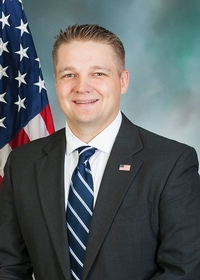
Rep. Aaron Bernstine
Sponsored bills
Maddy summaryHB 1160 requires Pennsylvania county election boards to conduct post-election verification of electronic voting systems. Specifically, it mandates a random statistical sample recount of at least 2% of votes cast (or 2,000 votes, whichever is smaller) using different devices than those used in the election. Additionally, county boards must randomly select three precincts per election for a full hand count of all ballots. These requirements apply to all general, primary, and municipal elections in Pennsylvania.
Maddy summaryHB 1152 requires insurance companies to directly reimburse non-network emergency medical services (EMS) agencies for 911 emergency calls within 45 days at 350% of the Medicare ambulance rate for the same service in the same area. EMS agencies must register with the state annually to qualify for direct payments, and insurers cannot demand contracts to facilitate this reimbursement. The insurer's payment covers the full service cost (excluding the patient's copay, coinsurance, or deductible), so EMS agencies cannot bill patients for the remaining amount. This law applies only to non-network EMS providers offering 911 emergency medical services, unless preempted by federal law.
Maddy summaryHB 1092 establishes a program to refund a portion of Pennsylvania's state budget surplus directly to eligible taxpayers. It requires the State Treasurer and Department of Revenue to identify resident individuals who filed 2024 tax returns and paid their liabilities, then calculate payments based on the General Fund surplus (capped at the June 2024 surplus amount) and the Budget Stabilization Reserve Fund (capped at the fund balance minus 6% of 2024-2025 General Fund revenues). The bill specifies that payments must be made within 45 days of a funding appropriation, with any unused funds returned to the Budget Stabilization Reserve Fund. This program directly affects Pennsylvania residents who filed 2024 individual income tax returns and paid their tax liability.
Maddy summaryHB 1035 amends Pennsylvania's Solid Waste Management Act by adding specific definitions for "advanced recycling" and related terms. It clarifies that plastic waste and waste tires processed through advanced recycling (using methods like pyrolysis) are no longer classified as "municipal waste" or "residual waste" under the law. This change directly affects facilities using advanced recycling technology, reducing their regulatory burden under existing waste management rules. The bill takes effect 60 days after enactment.
Maddy summaryHB 981 standardizes Pennsylvania voter registration forms and creates a new process for sharing applicant information with state agencies. It requires election commissions to send voter registration details (name, residence/mailing addresses) to the Department of Transportation, Human Services, Revenue, and local governments within 30 days. The bill mandates that all registration forms include a notice explaining this data sharing, which agencies will use to verify residency and connect applicants with eligible services. This directly affects voters completing registration forms, election offices handling applications, and state/local agencies providing services tied to residency.
Maddy summaryHB 975 creates a new state crime in Pennsylvania for trafficking undocumented immigrants. It makes it a third-degree felony to encourage or induce an undocumented immigrant to enter or remain in the state by concealing, harboring, or shielding them from law enforcement or federal immigration authorities, which violates federal law. The offense becomes a second-degree felony if it creates a substantial risk of serious harm, death, involves a minor, or involves knowledge of forced labor or sex work. This law directly affects individuals who facilitate undocumented immigrants' presence in Pennsylvania through concealment, clarifying that such actions are punishable under state law.
Maddy summaryThis resolution designates March 19, 2025, as "The Pennsylvania State University IFC/Panhellenic Dance Marathon (THON) Day" in Pennsylvania. It honors THON for raising over $17 million during its 2025 event to support the Four Diamonds Fund at Penn State Hershey Children's Hospital, which provides financial and emotional aid for pediatric cancer patients and funds cancer research. The resolution recognizes THON's role as the world's largest student-run philanthropy event, which has raised over $200 million since 1977 for childhood cancer care.
Maddy summaryHB 1010 proposes a constitutional amendment to reduce Pennsylvania's state House districts from 203 to 151 while maintaining 50 Senate districts. It requires all districts to be compact, contiguous, and as equal in population as possible, with minimal division of counties or municipalities. The amendment must pass both legislative chambers and be approved by voters in the next general election. If ratified, new district maps would take effect for the 2040 legislative session.
Maddy summaryThis is a ceremonial resolution, not a law with policy changes. It officially recognizes March 9-15, 2025, as "Multiple Sclerosis Awareness Week" in Pennsylvania. The resolution highlights the impact of multiple sclerosis (affecting over 24,000 Pennsylvanians) and acknowledges the work of the National Multiple Sclerosis Society. It has no binding effect or funding provisions - it simply encourages public awareness and support for the cause.