

Maddy summaryHB 1171 amends Pennsylvania's Liquor Code to modify rules for businesses holding "wine expanded permits." It allows these permit holders to sell up to 3,000 milliliters (about 101 ounces) of wine per transaction for off-premises consumption during their regular operating hours. The bill also clarifies that wine sales for take-home use cannot occur after 11:00 PM until the business's next permitted operating hours, including Sundays if authorized. This directly affects existing licensed businesses (like wineries or restaurants) with wine expanded permits seeking to sell wine for customers to take away.
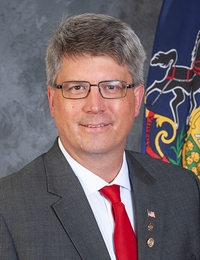
Rep. Brian Smith
Sponsored bills
Maddy summaryHB 1172 defines "utility terrain vehicle" (UTV) as a four-wheel off-road vehicle with specific size and weight limits (max 64 inches wide or 1,700 pounds), excluding ATVs, snowmobiles, and other vehicle types. The bill clarifies that state, local, and county authorities can designate roads for UTVs, snowmobiles, and ATVs, including whether these roads may share space with regular traffic. It requires helmets for snowmobile and ATV operators and passengers on shared roads but exempts UTVs equipped with bucket seats, seat belts, and roll cages. The law also directs the Department of Transportation to specify approved helmet types through regulations.
Maddy summaryHB 541 amends Pennsylvania's vehicle registration law to expand who can verify lost, stolen, damaged, or illegible license plates. It allows trained staff in state legislators' district offices (after department-approved training) and contracted messenger service employees to serve as authorized representatives for this purpose. The bill directly affects vehicle owners needing to replace plates by adding these new verification options. It does not change fees, timelines, or the core registration process, only specifying who may complete the verification step.
Maddy summaryHB 1085 amends Pennsylvania's Motor License Fund allocation rules for the Pennsylvania State Police. It sets a 2025-2026 funding cap at 68% of the 2016-2017 level ($125 million) and eliminates all future appropriations for this purpose starting in fiscal year 2026-2027. The bill directly affects the State Police budget and the Motor License Fund, which is funded by vehicle registration fees. This is a procedural budget adjustment with no new policy changes, solely modifying existing funding levels.
Maddy summaryHB 1164 authorizes Pennsylvania's Department of Environmental Protection (DEP) to propose a carbon dioxide emissions tax or fee after following a strict public process. It requires the DEP to hold 180 days of public comment, conduct four public hearings across the state, and submit detailed reports to lawmakers on economic impacts, facility-level emissions, and electricity price effects before any such tax can be considered. The bill directly affects electric generation facilities (like power plants) and electricity consumers by mandating transparency and analysis of how a carbon tax would impact costs and operations. Crucially, it does not impose a tax itself but creates the procedural framework for future legislative action on carbon emissions regulation.
Maddy summaryHB 1152 requires insurance companies to directly reimburse non-network emergency medical services (EMS) agencies for 911 emergency calls within 45 days at 350% of the Medicare ambulance rate for the same service in the same area. EMS agencies must register with the state annually to qualify for direct payments, and insurers cannot demand contracts to facilitate this reimbursement. The insurer's payment covers the full service cost (excluding the patient's copay, coinsurance, or deductible), so EMS agencies cannot bill patients for the remaining amount. This law applies only to non-network EMS providers offering 911 emergency medical services, unless preempted by federal law.
Maddy summaryHB 1086 prohibits the government from taking land or property used for cemeteries, burying grounds, or places of public worship - including land owned by religious or cemetery institutions but not currently used for those purposes - through eminent domain under Pennsylvania's current laws. The bill directly affects property owners and institutions operating cemeteries or places of worship by adding a legal barrier to government acquisition. It amends Title 16 of Pennsylvania law to explicitly restrict eminent domain actions targeting these specific properties, with no exception provided in the cited text. The law takes effect 60 days after enactment.
Maddy summaryThis bill amends Pennsylvania's Cosmetology Law to clarify definitions and update licensing procedures. It specifically defines "mobile unit" as a self-contained, at least 24-foot-long vehicle that must be licensed and meet health/safety rules, and expands "salon" to include such mobile units. The bill also requires salon owners changing their physical location (excluding mobile units) to obtain a new license, with the fee for this new license to be set by the licensing board. These changes directly affect cosmetology businesses, particularly those operating mobile services or relocating fixed locations.
Maddy summaryHB 1083 updates Pennsylvania's 1931 Barbers' License Law to clarify definitions and modernize regulations. It specifically defines "mobile unit" as a self-contained barber establishment at least 24 feet long that must be licensed by the board and meet health/safety standards. The bill requires the Department of State to maintain public records of licensed barber shops (including addresses of mobile unit owners) and allows a reasonable fee for copies. It also mandates that shops display a visible notice with a consumer complaint phone number and requires inspections to be conducted by authorized agents (not board members), with approved premises displaying a seal or sticker. These changes primarily affect barber shops, mobile barber units, and their operators.
Maddy summaryThis Pennsylvania House resolution (HR 146) urges Congress to cooperate with efforts to eliminate the U.S. Department of Education. It argues that education policy should be managed by states like Pennsylvania, citing federal funding mandates and claims that the Department has not improved student outcomes (referencing NAEP data). The resolution does not change any laws or funding but formally requests federal action to transfer education authority to states. It reaffirms Pennsylvania's constitutional duty to manage its public education system for 1.7 million students across 500 school districts.