

Maddy summaryHB 182 designates Bridge Key 8377 on Pennsylvania Route 53 over Bear Rock Run in Lilly Borough, Cambria County, as the Corporal James D. Sloan Memorial Bridge. The bill requires the Pennsylvania Department of Transportation to install and maintain signs on the bridge, based on the General Assembly's findings that Corporal James D. Sloan, a Marine Corps veteran who died by suicide in 1971 due to post-traumatic stress disorder after serving in the Vietnam War, received multiple military medals including the Purple Heart and Combat Action Medal. This is a naming resolution with no direct policy changes or affected populations beyond the bridge signage.
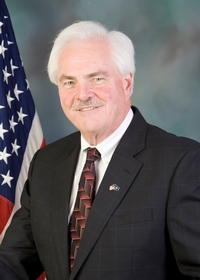
Rep. Lee James
Sponsored bills
Maddy summaryHB 164 requires health care facilities in Pennsylvania to handle fetal remains (from a fetal death) through cremation or burial per existing vital records rules, without needing a name on permits. Parents must cover costs if they choose a disposal location outside the facility’s usual practice, but facilities must provide disposition services if parents don’t claim remains. The bill ensures parent information remains confidential and clarifies that facilities aren’t required to issue stillbirth certificates. It does not change the definition of fetal death or mandate cremation/burial unless requested by the parent.
Maddy summaryHB 196 amends Pennsylvania's Election Code to increase the number of valid signatures required on nomination petitions for school director candidates in primary elections, from 10 to 100. This change directly affects candidates seeking nomination for school board positions within their political party. The bill modifies Section 912.1(35) of the Election Code to mandate these 100 signatures from registered and enrolled party members. The law takes effect 60 days after enactment.
Maddy summaryThis bill removes the requirement for non-motorized boats (like kayaks, canoes, and paddleboards) to obtain permits or register when used in Pennsylvania state parks, forests, or public waters. It specifically prohibits state agencies from creating new rules for these vessels, affecting all owners of non-motorized watercraft using state-managed areas. The change modifies existing boating regulations under Pennsylvania's Fish Code to eliminate administrative burdens for non-motorized boaters. The bill takes effect 60 days after enactment.
Maddy summaryHB 153 amends Pennsylvania's 1887 time law to automatically adopt year-round daylight saving time if Congress authorizes it. Currently, Pennsylvania observes daylight saving time from the last Sunday in April to the last Sunday in October. The bill would change this to year-round daylight saving time without further state action if federal law permits it. This affects all Pennsylvanians, businesses, and public institutions that rely on standardized time for daily operations, schedules, and legal compliance. The change would take effect 60 days after the bill is signed, but only if Congress passes legislation allowing year-round daylight saving time.
Maddy summaryHB 119 permanently prohibits Pennsylvania from observing daylight saving time, requiring all timekeeping in the state to follow Eastern Standard Time year-round. The bill amends an 1887 law to remove the existing provision allowing daylight saving time (which previously shifted clocks forward between April and October) and declares Eastern Standard Time as the sole legal standard. This directly affects all residents, businesses, and government operations across Pennsylvania, eliminating the need for biannual clock changes. The policy change would take effect 60 days after the bill's passage.
Maddy summaryHB 163 amends Pennsylvania's 1980 law to prohibit entities from "countries of concern" (including China, Russia, Iran, North Korea, Belarus, and Venezuela) and foreign governments from acquiring agricultural land, except through inheritance or as security for debt. It requires title companies to verify compliance with the law, imposing a $1,000 civil penalty for willful failure to do so, and authorizes the Attorney General to investigate violations. Violating entities must forfeit the land to the Commonwealth, which will sell it at auction; proceeds cover sale costs, reimburse the Attorney General for investigation expenses, pay lienholders, and then fund the General Fund. The law defines agricultural land broadly (including cropland and livestock operations) but excludes mineral rights and non-farm zoning.
Maddy summaryHB 127 amends Pennsylvania's Unfair Trade Practices and Consumer Protection Law to require businesses to accept cash payments for in-person retail transactions under $500. This directly affects Pennsylvania retailers (like stores and service providers) and consumers who pay with cash for qualifying purchases. The bill defines refusing such cash payments as an unfair or deceptive practice, unless the business has a visible written policy stating it won't accept cash above a specific denomination (e.g., $100 bills) and posts this policy before the transaction. Exceptions allow businesses to set high-denomination cash limits if properly disclosed, but they cannot refuse cash outright for transactions under $500.
Maddy summaryHB 189 amends Pennsylvania's vehicle registration law to exempt multipurpose agricultural vehicles from registration requirements. This change directly affects farmers who use such vehicles exclusively on their own farms or on highways connecting parts of a single farm or between two farms within 10 miles of each other. The bill specifies that these vehicles cannot be used for general public road travel outside of farm-related activities. The exemption applies only to vehicles owned or operated by the farm owner, not to commercial or non-agricultural vehicles. The law takes effect 60 days after enactment.
Maddy summaryThis bill (HB 122) prevents Pennsylvania state and local government entities from enforcing any rules, fees, taxes, or mandates issued by the World Health Organization (WHO), United Nations (UN), or World Economic Forum (WEF). It directly affects all Pennsylvania agencies, municipalities, and government bodies by prohibiting them from implementing or enforcing any requirements from these international organizations. The law explicitly states these organizations "shall have no jurisdiction or power" within Pennsylvania, blocking enforcement of their policies by any state or local entity. The bill takes effect 60 days after enactment.