

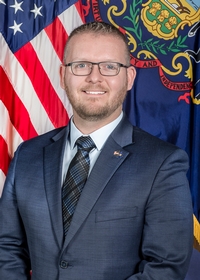
Photo of Josh Bashline
R Pennsylvania House · District 63 On the 2026 ballot

Rep. Josh Bashline

Compare
Total votes
1,457
all sessions
Attendance
100%
of floor votes
Near the chamber average
With party
92%
of cast votes
Lower than 90% of chamber peers
Bipartisan score
4%
crosses aisle rarely
Higher than 88% of chamber peers
Sponsored
44
bills & resolutions
Lower than 83% of chamber peers
Committees
4
assignments
44 bills and resolutions

Sponsored bills

Total
44
Primary
8
Co-sponsor
36
This page
44
matching current filters
Co-sponsor HB 1172
In committee · Pennsylvania House · Co-sponsor
An Act amending Title 75 (Vehicles) of the Pennsylvania Consolidated Statutes, in snowmobiles and all-terrain vehicles, further providing for definitions, for designation of snowmobile and ATV roads and for operation in safe manner.

Maddy summaryHB 1172 defines "utility terrain vehicle" (UTV) as a four-wheel off-road vehicle with specific size and weight limits (max 64 inches wide or 1,700 pounds), excluding ATVs, snowmobiles, and other vehicle types. The bill clarifies that state, local, and county authorities can designate roads for UTVs, snowmobiles, and ATVs, including whether these roads may share space with regular traffic. It requires helmets for snowmobile and ATV operators and passengers on shared roads but exempts UTVs equipped with bucket seats, seat belts, and roll cages. The law also directs the Department of Transportation to specify approved helmet types through regulations.

In committee Apr 9, 2025 1 co-sponsor
Co-sponsor HB 1164
In committee · Pennsylvania House · Co-sponsor
An Act authorizing the Department of Environmental Protection to conduct a public comment process on and submit to the General Assembly a measure or action intended to abate, control or limit carbon dioxide emissions by imposing a revenue-generating tax or fee on carbon dioxide emissions; and abrogating regulations.

Maddy summaryHB 1164 authorizes Pennsylvania's Department of Environmental Protection (DEP) to propose a carbon dioxide emissions tax or fee after following a strict public process. It requires the DEP to hold 180 days of public comment, conduct four public hearings across the state, and submit detailed reports to lawmakers on economic impacts, facility-level emissions, and electricity price effects before any such tax can be considered. The bill directly affects electric generation facilities (like power plants) and electricity consumers by mandating transparency and analysis of how a carbon tax would impact costs and operations. Crucially, it does not impose a tax itself but creates the procedural framework for future legislative action on carbon emissions regulation.

In committee Apr 7, 2025 1 co-sponsor
Co-sponsor HB 1152
In committee · Pennsylvania House · Co-sponsor
An Act amending the act of May 17, 1921 (P.L.682, No.284), known as The Insurance Company Law of 1921, in casualty insurance, further providing for billing.

Maddy summaryHB 1152 requires insurance companies to directly reimburse non-network emergency medical services (EMS) agencies for 911 emergency calls within 45 days at 350% of the Medicare ambulance rate for the same service in the same area. EMS agencies must register with the state annually to qualify for direct payments, and insurers cannot demand contracts to facilitate this reimbursement. The insurer's payment covers the full service cost (excluding the patient's copay, coinsurance, or deductible), so EMS agencies cannot bill patients for the remaining amount. This law applies only to non-network EMS providers offering 911 emergency medical services, unless preempted by federal law.

In committee Apr 4, 2025 1 co-sponsor
Co-sponsor HB 1082
In committee · Pennsylvania House · Co-sponsor
An Act amending the act of May 3, 1933 (P.L.242, No.86), referred to as the Cosmetology Law, further providing for definitions and for fees.

Maddy summaryThis bill amends Pennsylvania's Cosmetology Law to clarify definitions and update licensing procedures. It specifically defines "mobile unit" as a self-contained, at least 24-foot-long vehicle that must be licensed and meet health/safety rules, and expands "salon" to include such mobile units. The bill also requires salon owners changing their physical location (excluding mobile units) to obtain a new license, with the fee for this new license to be set by the licensing board. These changes directly affect cosmetology businesses, particularly those operating mobile services or relocating fixed locations.

In committee Apr 1, 2025 1 co-sponsor
Co-sponsor HB 1083
In committee · Pennsylvania House · Co-sponsor
An Act amending the act of June 19, 1931 (P.L.589, No.202), referred to as the Barbers' License Law, further providing for definitions, for rules and regulations and for records.

Maddy summaryHB 1083 updates Pennsylvania's 1931 Barbers' License Law to clarify definitions and modernize regulations. It specifically defines "mobile unit" as a self-contained barber establishment at least 24 feet long that must be licensed by the board and meet health/safety standards. The bill requires the Department of State to maintain public records of licensed barber shops (including addresses of mobile unit owners) and allows a reasonable fee for copies. It also mandates that shops display a visible notice with a consumer complaint phone number and requires inspections to be conducted by authorized agents (not board members), with approved premises displaying a seal or sticker. These changes primarily affect barber shops, mobile barber units, and their operators.

In committee Apr 1, 2025 1 co-sponsor
Co-sponsor HB 569
In committee · Pennsylvania House · Co-sponsor
An Act amending the act of June 24, 1976 (P.L.424, No.101), referred to as the Emergency and Law Enforcement Personnel Death Benefits Act, further providing for title of act; and adding provisions relating to coroners.

Maddy summaryHB 569 amends Pennsylvania's Emergency and Law Enforcement Personnel Death Benefits Act to expand eligibility for death benefits. It explicitly includes coroners (and medical examiners) as covered personnel and adds a presumption that fatal heart attacks or strokes occurring during duty or within 24 hours of physical training/emergency response are work-related. This change directly affects surviving spouses, children, or parents of coroners, firefighters, ambulance/rescue personnel, law enforcement officers, and National Guard members who die in the line of duty. The bill updates the act's definition of "coroner" and ensures benefits are granted for these new circumstances.

In committee Mar 25, 2025 1 co-sponsor
Co-sponsor HB 685
In committee · Pennsylvania House · Co-sponsor
An Act amending the act of March 10, 1949 (P.L.30, No.14), known as the Public School Code of 1949, in duties and powers of boards of school directors, providing for admission fees for school-sponsored activities.

Maddy summaryHB 685 requires Pennsylvania schools to accept U.S. currency as payment for admission to school-sponsored activities, such as athletic events, assemblies, or field trips. It applies to all school entities, including public school districts, charter schools, and private schools participating in school activities. The bill mandates that cash must be accepted when fees are charged, while allowing schools to also accept other payment methods like credit cards. It defines "cash" as U.S. coins and paper money recognized as legal tender and clarifies that schools may refuse payments in large denominations that exceed the fee amount.

In committee Mar 18, 2025 1 co-sponsor
Co-sponsor HB 762
In committee · Pennsylvania House · Co-sponsor
An Act amending the act of March 4, 1971 (P.L.6, No.2), known as the Tax Reform Code of 1971, in sales and use tax, further providing for definitions and for exclusions from tax.

Maddy summaryHB 762 amends Pennsylvania's Tax Reform Code to exempt volunteer emergency service organizations from paying state sales and use tax on protective equipment. The bill specifically covers volunteer EMS companies, fire companies, and rescue companies - defined as nonprofit groups providing emergency medical, fire, or rescue services. It excludes purchases like helmets, turnout gear, boots, gloves, and respiratory protection units from taxation when bought for members performing their duties. This tax exemption will apply to sales occurring on or after July 1, 2025.

In committee Mar 3, 2025 1 co-sponsor
Primary HB 546
In committee · Pennsylvania House · Lead sponsor
An Act amending Title 75 (Vehicles) of the Pennsylvania Consolidated Statutes, in licensing of drivers, further providing for learners' permits.

Maddy summaryHB 546 creates a military exception for minors under 18 seeking a junior driver's license in Pennsylvania. It allows the state to count time spent with a learner's permit and driving practice hours completed in another state toward eligibility requirements. This applies specifically to minors who are family members of active duty military members living in Pennsylvania with them, hold a valid out-of-state learner's permit, and have received a Pennsylvania learner's permit. The Pennsylvania Department of Transportation must credit this prior experience if all conditions are met.

In committee Feb 11, 2025 0 co-sponsors
Primary HB 548
In committee · Pennsylvania House · Lead sponsor
An Act amending Titles 18 (Crimes and Offenses) and 53 (Municipalities Generally) of the Pennsylvania Consolidated Statutes, in firearms and other dangerous articles, further providing for limitation on the regulation of firearms and ammunition; and, in preemptions, providing for regulation of firearms and ammunition.

Maddy summaryHB 548 strengthens Pennsylvania's state preemption of local firearm regulations by declaring that all aspects of firearm regulation - including purchase, sale, possession, and transportation - must follow state law, invalidating any conflicting local ordinances. It directly affects counties, municipalities, and townships that previously enacted stricter gun rules, as well as residents, gun dealers, or organizations challenging such local laws. Key provisions include creating legal remedies for those harmed by illegal local regulations (allowing lawsuits for damages, attorney fees, and injunctions) and explicitly stating that state law supersedes all local efforts. The bill takes effect in 90 days for its core preemption rules, requiring local governments to align with state firearm laws immediately.

In committee Feb 11, 2025 0 co-sponsors
Showing 31 to 40 of 44 bills
Previous 1 3 4 5 Next