

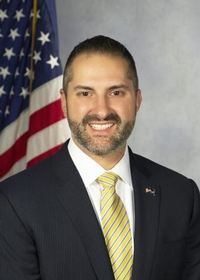
Photo of Steve Malagari
D Pennsylvania House · District 53 On the 2026 ballot

Rep. Steve Malagari

Compare
Total votes
7,497
all sessions
Attendance
99%
33 missed
Near the chamber average
With party
98%
of cast votes
Higher than 87% of chamber peers
Bipartisan score
1%
crosses aisle rarely
Lower than 93% of chamber peers
Sponsored
1,414
bills & resolutions
Higher than 87% of chamber peers
Committees
5
assignments
1,414 bills and resolutions

Sponsored bills

Total
1,414
Primary
79
Co-sponsor
1,335
This page
1,414
matching current filters
Co-sponsor HB 729
In committee · Pennsylvania House · Co-sponsor
An Act amending Title 75 (Vehicles) of the Pennsylvania Consolidated Statutes, in licensing of drivers, further providing for duplicate and substitute drivers' licenses and learners' permits.

Maddy summaryHB 729 eliminates fees for one duplicate Pennsylvania identification card (including required photos) during the term of an initial or renewal card for individuals already exempt from license fees under Section 1901(b.1) of the law. This directly affects Pennsylvania residents who qualify for fee exemptions (such as low-income or disabled individuals) when replacing lost or damaged ID cards. The bill amends Section 1513(c) of Title 75 (Vehicles) to prohibit charging fees for a single duplicate ID card during the active period of their primary card. The change applies only to the first duplicate replacement needed within the card's validity period.

In committee Feb 25, 2025 1 co-sponsor
Co-sponsor HB 736
In committee · Pennsylvania House · Co-sponsor
An Act amending Title 53 (Municipalities Generally) of the Pennsylvania Consolidated Statutes, in consolidated county assessment, further providing for exemptions from taxation.

Maddy summaryHB 736 amends Pennsylvania's property tax exemption rules for charitable institutions, clarifying that tax-exempt status applies only when property is used for the institution's primary purposes (e.g., hospitals, universities, charities). It specifies that property used for commercial activities or not regularly essential to the institution's mission loses exemption eligibility. The bill directly affects qualifying nonprofit institutions and local governments collecting property taxes. Key provisions require all revenue from exempt property to support the institution's core mission, not commercial ventures, and explicitly deny exemptions for commercial use. The changes take effect 60 days after enactment.

In committee Feb 25, 2025 1 co-sponsor
Co-sponsor HB 737
In committee · Pennsylvania House · Co-sponsor
An Act amending the act of May 22, 1933 (P.L.853, No.155), known as The General County Assessment Law, in subjects of taxation and exemptions, further providing for exemptions from taxation.

Maddy summaryHB 737 clarifies tax exemption rules for charitable institutions under Pennsylvania's General County Assessment Law. It specifies that hospitals, universities, and charitable organizations (including residential housing providers receiving federal low-income subsidies) retain tax exemption only if their property isn't used commercially and all revenue supports their charitable mission. The bill adds that subsidized housing units must have at least 95% federal funding to maintain exemption, with any surplus monitored and used solely for charitable purposes. This directly affects institutions relying on tax-exempt status for property ownership and operations.

In committee Feb 25, 2025 1 co-sponsor
Co-sponsor HR 90
In committee · Pennsylvania House · Co-sponsor
A Resolution directing the Joint State Government Commission to conduct a study on the projected costs in Pennsylvania of climate change adaptation and resilience measures needed to mitigate the projected impacts of certain climate-change-related events.

Maddy summaryHR 90 is a resolution directing Pennsylvania's Joint State Government Commission to study the projected costs of climate change adaptation and resilience measures needed to address climate-related events. The study must use IPCC climate modeling tools to analyze costs for mid-century, late-century, and end-of-century scenarios (using 2024 dollars), covering impacts on Pennsylvania's natural environment (water, air, biodiversity), built environment (infrastructure, buildings), and social environment (including demographic differences in vulnerability). It requires examining costs linked to hazards like flooding, drought, heat, and wildfires, while specifically analyzing how these costs affect low-income, rural, and other vulnerable communities. The resolution aims to provide data for informed decision-making about climate risk mitigation, not to enact funding or policy changes.

In committee Feb 24, 2025 1 co-sponsor
Co-sponsor HB 698
In committee · Pennsylvania House · Co-sponsor
An Act providing for bisphenol A-free container products.

Maddy summaryHB 698 would require all food and beverage containers sold in Pennsylvania to contain no more than 0.1 parts per billion of bisphenol A (BPA), directly affecting manufacturers, sellers, and distributors of such containers. The bill prohibits containers with BPA above this level and mandates that manufacturers replace BPA with the least toxic alternative, while banning substitutions with known carcinogens or reproductive toxicants identified by the EPA. Violations would be enforced under Pennsylvania’s existing Unfair Trade Practices and Consumer Protection Law, and the law would take effect 60 days after enactment. This focuses on setting a measurable safety standard for consumer products without advocating for specific outcomes.

In committee Feb 21, 2025 1 co-sponsor
Co-sponsor HB 688
In committee · Pennsylvania House · Co-sponsor
An Act amending the act of March 10, 1949 (P.L.30, No.14), known as the Public School Code of 1949, in charter schools, providing for cyber charter school moratorium.

Maddy summaryHB 688 imposes a 13-year freeze on new cyber charter school approvals in Pennsylvania, effective July 1, 2025, through June 30, 2038. The bill prohibits the Pennsylvania Department of Education from reviewing or approving any new applications for cyber charter schools during this period, regardless of when the application was submitted. This directly affects organizations or entities seeking to establish new cyber charter schools in the state. The policy change specifically targets new school applications while leaving existing cyber charter schools unaffected.

In committee Feb 21, 2025 1 co-sponsor
Co-sponsor HB 659
In committee · Pennsylvania House · Co-sponsor
An Act updating and expanding the storm water planning requirements to be undertaken by counties; authorizing counties to regulate storm water within a watershed-based planning area; authorizing the formation of water resources management authorities; enabling counties, municipalities and water resources management authorities to develop integrated water resources management plans; imposing duties and conferring powers on the Department of Environmental Protection, the Environmental Quality Board, counties, municipalities and water resources management authorities; providing for financing and for waiver of use for certain grant or loan funds; establishing the Integrated Water Resources Management Account; and making repeals.

Maddy summaryHB 659 creates a new statewide framework for managing water resources by requiring counties and municipalities to develop watershed-based storm water and integrated water management plans. It authorizes counties to regulate storm water within specific watersheds, allows for the formation of water resources management authorities, and mandates coordinated planning across local governments. The bill establishes the Integrated Water Resources Management Account to fund these efforts and provides new mechanisms for grants, loans, and fee collection to support implementation. This replaces outdated storm water planning rules with a unified system aimed at addressing flooding, erosion, and water quality issues through coordinated local action.

In committee Feb 20, 2025 1 co-sponsor
Co-sponsor HB 682
In committee · Pennsylvania House · Co-sponsor
An Act amending the act of March 10, 1949 (P.L.30, No.14), known as the Public School Code of 1949, in grounds and buildings, providing for air conditioning in student-occupied areas.

Maddy summaryHB 682 requires all Pennsylvania public school entities (including districts, charter schools, and career schools) to install functioning air conditioning in every student-occupied area - like classrooms, cafeterias, and libraries - by the start of the 2028-2029 school year. Schools unable to meet this deadline must submit a compliance plan to the Department of Education by August 1, 2028. Until AC is installed, schools must implement a temperature control plan ensuring indoor temperatures stay between 72°F and 79°F when heating isn't needed, and close areas if temperatures exceed 88°F. This plan must be updated annually and submitted to the Department of Education until installation is complete. The bill directly affects all public schools in Pennsylvania, aiming to improve student comfort and safety during hot weather.

In committee Feb 20, 2025 1 co-sponsor
Co-sponsor HB 98
In committee · Pennsylvania House · Co-sponsor
An Act providing for licensure of electrical contractors, electricians and apprentice electricians; establishing the State Board of Electrical Licensure; providing for powers and duties of the board; establishing fees, fines and penalties; and making an appropriation.

Maddy summaryHB 98 creates a licensing system for electrical contractors, electricians, and apprentice electricians in Pennsylvania. It establishes the State Board of Electrical Licensure to set qualifications, require continuing education, mandate liability insurance, and enforce standards. The bill directly affects individuals and businesses performing electrical work in buildings, including installation, repair, and maintenance of electrical systems. Key provisions include setting licensing fees, imposing fines for violations, and creating enforcement mechanisms for the Board to suspend or revoke licenses. The bill also includes an appropriation for the Board's operations.

In committee Feb 20, 2025 1 co-sponsor
Co-sponsor HB 673
In committee · Pennsylvania House · Co-sponsor
An Act providing for protection of existing riparian buffers, for restoration of impaired riparian buffers, for exemptions, for municipal authority, for powers and duties of Department of Environmental Protection, for property inspections, for delegation to a municipality, for municipal action appeals, for penalties, civil action and liability for costs and for effect on other Commonwealth laws or regulations and municipal ordinances.

Maddy summaryHB 673, the Riparian Buffer Protection Act, requires property owners and developers to protect existing natural vegetation buffers along rivers and streams and restore damaged buffers. It defines "natural riparian buffers" as vegetation providing ecosystem benefits (like filtering pollution, preventing erosion, and supporting wildlife) and prohibits land development that creates impervious cover (such as roads, driveways, or concrete) within these buffer zones. Municipalities gain authority to issue permits for development, inspect properties, and enforce rules, with penalties for violations. The law also clarifies how it interacts with existing state environmental regulations and local ordinances.

In committee Feb 20, 2025 1 co-sponsor
Showing 501 to 510 of 1,414 bills
Previous 1 … 50 51 52 … 142 Next