

Maddy summaryThis Pennsylvania House Resolution designates October 2026 as "Agent Orange Awareness Month" to honor Vietnam War veterans who were exposed to herbicides like Agent Orange. The bill highlights the health risks faced by these service members, including those who served on ships in offshore waters known as Blue Water Navy Veterans. By officially recognizing this month, the resolution aims to raise awareness about the long-term health effects of herbicide exposure among veterans and their families.
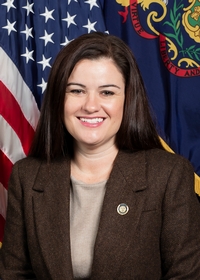
Rep. Charity Krupa
Sponsored bills
Maddy summaryThis Pennsylvania bill repeals the existing tax incentive program for computer data center equipment and replaces it with a new system that transfers taxes collected from the sale of such equipment into a restricted account within the Motor License Fund. The legislation defines specific equipment and facilities that qualify for the transfer, including servers, cooling systems, and power management infrastructure used in data centers. By redirecting these funds, the bill aims to support the Motor License Fund without providing direct tax breaks to businesses or individuals.
Maddy summaryThis bill directs Pennsylvania municipalities to update their planning and zoning laws to specifically regulate large commercial data centers, which are defined as facilities with a peak power demand of 25 megawatts or more. It requires local comprehensive plans to identify suitable sites near existing infrastructure while explicitly protecting prime agricultural land and areas under conservation easements from such development. Additionally, the legislation establishes minimum standards for any data center zoning, including mandatory setbacks of 2,500 feet from residential areas and 300 feet from public roads, along with rules for noise, lighting, water usage, and site restoration. Local governments retain the authority to adopt stricter regulations but must follow these baseline requirements if they choose to permit these facilities.
Maddy summaryThis bill, known as the Commercial Data Center Transparency Act, requires large data centers in Pennsylvania to publicly disclose their energy, water, and noise impacts. It specifically targets facilities with a peak power demand of 25 megawatts or more, mandating that applicants reveal details in their permit applications regarding water usage, wastewater, air quality, and transportation needs. The law also obligates these facilities to report specific water consumption data to the Department of Environmental Protection if they use more than 100,000 gallons per day or consume 20,000 gallons daily. To ensure compliance, the bill imposes civil penalties on entities that knowingly fail to make required disclosures or submit false information.
Maddy summaryThis resolution designates May 5, 2026, as "The Blessing of the Balers Day" in Pennsylvania. It commemorates a story about a farmer whose equipment was fixed after a priest prayed over it. The bill has no legal effect beyond naming the date and expressing good wishes to farmers. It is a ceremonial measure that does not change laws or policies.
Maddy summaryHR 195 is a symbolic resolution designating April 2025 as "Child Abuse Prevention Month" in Pennsylvania. It does not create new laws or policies but formally recognizes the month for raising awareness about child abuse prevention efforts across the state. The resolution directly affects Pennsylvania residents and organizations focused on child welfare by encouraging community observances and educational activities during April 2025. As a procedural resolution, it has no binding effect and serves solely as a formal acknowledgment.
Maddy summaryHB 910 amends Pennsylvania's criminal code to elevate "dealing in infant children" from a misdemeanor to a first-degree felony. It makes it a crime to trade, buy, sell, or deal with infants under one year old, directly targeting individuals involved in illegal infant trafficking. The bill explicitly excludes legal surrogacy and adoption from this offense. This law takes effect 60 days after enactment, focusing on criminalizing the commercial exchange of very young children.
Maddy summaryThis House Resolution designates 2025 as "The Year of the Catholic War Veterans of the United States of America" in Pennsylvania to honor the organization's 90-year history of service to faith, family, and country. It is a ceremonial measure expressing the state's recognition of the Catholic War Veterans' contributions, including their work with Pennsylvania's veterans community and their national service since 1935. The resolution does not create new laws or alter existing policies - it is purely symbolic, with no direct impact on legislation or funding.
Maddy summaryThis Pennsylvania House resolution (HR 157) urges the U.S. Congress to pass H.R. 3023 (or similar legislation) during the 119th Congress, which would require the Department of Veterans Affairs and Department of Defense to provide stellate ganglion block (SGB) therapy to veterans and military members with PTSD. SGB is a low-risk neck injection procedure that targets nerves controlling stress responses, potentially alleviating symptoms like anxiety and hyperarousal. The resolution cites that 23% of recent veterans and 12-15% of older veterans have PTSD diagnoses, with current treatments helping only 40% of patients. It emphasizes SGB's decades-long use and support from veterans' organizations as a potential treatment option.
Maddy summaryThis Pennsylvania bill creates a new criminal offense for interfering with religious worship, which would apply to individuals who intentionally disrupt religious services or block access to places of worship. The law defines interference as knowingly entering or remaining in a religious building after being asked to leave and disrupting activities, or using force, threats, or physical obstruction to harm or impede people exercising their religion. Violations would be classified as third-degree misdemeanors for simple disruption and second-degree misdemeanors for actions involving force or threats. The bill takes effect 60 days after passage and defines religious worship locations as buildings or grounds regularly used for religious activities.