

Maddy summaryThis bill would create a state-funded paid family and medical leave program for eligible workers needing time off for health issues, childbirth, or family care. It establishes a dedicated state fund to cover leave costs, creates an advisory board to guide implementation, and assigns oversight to the Department of Labor. The program would directly affect employees in the state who qualify for these leave types, requiring employers to provide the benefits. The bill also specifies penalties for businesses failing to comply with the new requirements.
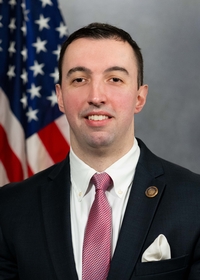
Rep. Brandon Markosek
Sponsored bills
Maddy summaryHB 1834 requires commercial data centers in Pennsylvania to pay fees to the state. These fees fund a new Data Center LIHEAP Enhancement Fund, which boosts assistance for low-income households struggling with energy costs. The bill also mandates that data centers meet specific renewable energy targets and allows them to recover certain operational costs through regulated rates. The Pennsylvania Public Utility Commission (PUC) and Department of Human Services are tasked with implementing these requirements and managing the fund.
Maddy summaryHB 1191 strengthens railroad safety in Pennsylvania by prohibiting railroads from blocking highway crossings for more than five minutes (with $10,000 penalties), limiting freight train lengths to 8,500 feet, and requiring two-person crews for freight trains (with limited exceptions for smaller railroads). The bill authorizes union representatives to monitor safety practices and operations, mandates functional wayside detector systems on higher-risk tracks, and creates a reporting system for hazardous materials transportation. It directly affects all railroads operating in Pennsylvania, including their safety protocols, staffing, and infrastructure maintenance. Penalties for violations range from $1,000 to $25,000 for crew-related breaches, with enforcement handled by the Public Utility Commission.
Maddy summaryHB 1260 would allow businesses owning warehouses or distribution centers to install solar energy systems by providing tax exemptions for "solar-ready" projects. It directly affects commercial property owners in the state by reducing their tax burden for qualifying solar installations. Key provisions include authorizing special tax breaks, requiring the Department of Environmental Protection to establish guidelines for these projects, and imposing fines for non-compliance with solar-ready construction standards. The bill aims to incentivize renewable energy adoption in large commercial facilities through concrete tax policy changes.
Maddy summaryHB 1750 regulates cremation services for deceased pets and companion animals. It requires service providers to disclose details about cremation processes, maintain facility standards, keep records, and provide notices to pet owners. The bill also establishes enforcement mechanisms and penalties for non-compliance. This directly affects pet cremation businesses and pet owners who use these services.
Maddy summaryHB 501 amends Pennsylvania's Alternative Energy Portfolio Standards Act to update definitions and clarify requirements for renewable energy compliance. It specifically adds "advanced reactor" (including small modular reactors) to eligible energy sources, refines criteria for low-impact hydropower, and updates definitions for biomass, biogas, and alternative energy credits. The bill affects electric utilities required to meet portfolio standards by specifying which energy sources count toward compliance and how credits are calculated. These changes aim to modernize the framework for renewable energy reporting and incentives without altering current percentage targets. The bill is currently in committee review (Environmental & Natural Resource Protection).
Maddy summaryHB 80 would authorize Pennsylvania to join the Audiology and Speech-Language Pathology Interstate Compact. This compact allows licensed audiologists and speech-language pathologists to practice in other participating states without obtaining separate licenses for each state. The bill directly affects these healthcare professionals and their patients, streamlining cross-state practice for providers. It creates a standardized process for reciprocity among member states, eliminating redundant licensing requirements.
Maddy summaryThis bill prohibits payment card networks (like Visa or Mastercard) from charging fees based on the full transaction amount that includes Pennsylvania's sales tax. It specifically bans interchange fees that calculate charges using the total amount (including tax) and prevents networks from raising fees to circumvent this rule. Merchants who accept credit/debit cards and payment networks are directly affected, as they can no longer impose these tax-inclusive fees. Violations of these provisions could result in penalties under the new law.
Maddy summaryHB 670 would protect access to abortion clinics in Pennsylvania by creating a legal right for people to enter reproductive health services facilities and allowing lawsuits against individuals or entities that block access. It amends criminal and judicial statutes to define "blocking access" as a violation and imposes penalties for such actions. The bill directly affects patients seeking abortion care, clinic staff, and anyone attempting to obstruct facility access. Key provisions include enabling civil lawsuits for damages and establishing specific criminal penalties for interference with facility access.
Maddy summaryHB 1957 is a proposed constitutional amendment that would add a right to "personal reproductive liberty" to Pennsylvania's state constitution. This would directly affect all Pennsylvanians by guaranteeing legal protection for decisions related to reproductive health care, including access to abortion, contraception, and related services. The key mechanism is amending the state constitution to explicitly protect these rights, rather than creating new laws. This is a procedural step requiring voter approval after legislative passage, as constitutional amendments in Pennsylvania must be ratified by voters.