

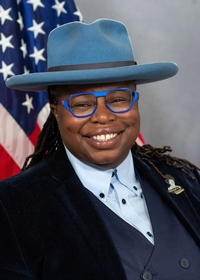
Photo of La'Tasha Mayes
D Pennsylvania House · District 24 On the 2026 ballot

Rep. La'Tasha Mayes

Compare
Total votes
4,925
all sessions
Attendance
100%
of floor votes
Near the chamber average
With party
99%
of cast votes
Higher than 98% of chamber peers
Bipartisan score
0%
crosses aisle rarely
Among the lowest in the chamber
Sponsored
967
bills & resolutions
Higher than 91% of chamber peers
Committees
5
assignments
967 bills and resolutions

Sponsored bills

Total
967
Primary
20
Co-sponsor
947
This page
967
matching current filters
Co-sponsor HB 717
In committee · Pennsylvania House · Co-sponsor
An Act amending Title 62 (Procurement) of the Pennsylvania Consolidated Statutes, in source selection and contract formation, further providing for debarment or suspension.

Maddy summaryHB 717 amends Pennsylvania's procurement law to add wage law violations as a specific reason for barring state contractors from future government contracts. It directly affects state contractors who fail to pay wages owed to workers under the 1961 Wage Payment and Collection Law. The bill adds a new subsection (531(b)(6.1)) to the debarment rules, requiring state agencies to suspend or debar contractors found in violation of wage payment laws. This change creates a direct link between wage compliance and eligibility for state contracts. The bill takes effect 60 days after enactment.

In committee Feb 24, 2025 1 co-sponsor
Co-sponsor HB 716
In committee · Pennsylvania House · Co-sponsor
An Act amending the act of July 14, 1961 (P.L.637, No.329), known as the Wage Payment and Collection Law, further providing for notification; providing for duty of employer; and imposing criminal and civil penalties.

Maddy summaryHB 716 amends Pennsylvania's Wage Payment and Collection Law to require employers to provide employees with specific pay details (including rate, time of payment, and fringe benefits) at hiring and to post a summary of the law in a visible workplace location. Employers who fail to meet these notification or posting requirements face a $500 fine per violation. The bill also extends the time limit for employees to file legal claims for unpaid wages: if an employer didn't provide required notice or post the summary, the deadline becomes the later of three years after wages were due or the day the requirements were satisfied. This affects all employers in Pennsylvania subject to the Wage Payment and Collection Law.

In committee Feb 24, 2025 1 co-sponsor
Co-sponsor HB 700
In committee · Pennsylvania House · Co-sponsor
An Act amending the act of April 9, 1929 (P.L.343, No.176), known as The Fiscal Code, in general budget implementation, further providing for Department of Human Services.

Maddy summaryHB 700 creates a new, non-lapsing "Home and Community-Based Services for Individuals with Intellectual Disabilities Augmentation Account" within Pennsylvania's General Fund. It directs funds from the sale of former state centers for intellectual disabilities, annual transfers from the General Fund (based on prior-year funding levels), and operational cost savings from closed centers into this account. The money must be used by the Department of Human Services to provide home and community-based supports, housing assistance, and emergency waiting list services for individuals with intellectual disabilities. This bill directly affects people with intellectual disabilities receiving these services and the Department of Human Services managing the funds.

In committee Feb 24, 2025 1 co-sponsor
Co-sponsor HB 637
In committee · Pennsylvania House · Co-sponsor
An Act establishing the Youth Summer Employment Grant Program and the Youth Summer Employment Fund; and authorizing regulations.

Maddy summaryHB 637 establishes Pennsylvania's Youth Summer Employment Grant Program, administered by the Department of Labor and Industry. The program provides grants to eligible employers (including businesses, nonprofits, and municipalities) who hire residents aged 15-18 for at least eight weeks during summer, pay at least $15/hour or the state minimum wage, and offer work or educational experiences. Grants amount to $5,000 for 10-20 youth, $10,000 for over 20 youth, with an additional $5,000 if 50% of hired youth live in historically disadvantaged communities (defined as areas with ≥20% poverty for 30+ years). Funding comes from a new nonlapsing Youth Summer Employment Fund in the State Treasury, with the department required to advertise the program to employers and schools.

In committee Feb 20, 2025 1 co-sponsor
Co-sponsor HB 682
In committee · Pennsylvania House · Co-sponsor
An Act amending the act of March 10, 1949 (P.L.30, No.14), known as the Public School Code of 1949, in grounds and buildings, providing for air conditioning in student-occupied areas.

Maddy summaryHB 682 requires all Pennsylvania public school entities (including districts, charter schools, and career schools) to install functioning air conditioning in every student-occupied area - like classrooms, cafeterias, and libraries - by the start of the 2028-2029 school year. Schools unable to meet this deadline must submit a compliance plan to the Department of Education by August 1, 2028. Until AC is installed, schools must implement a temperature control plan ensuring indoor temperatures stay between 72°F and 79°F when heating isn't needed, and close areas if temperatures exceed 88°F. This plan must be updated annually and submitted to the Department of Education until installation is complete. The bill directly affects all public schools in Pennsylvania, aiming to improve student comfort and safety during hot weather.

In committee Feb 20, 2025 1 co-sponsor
Co-sponsor HR 83
In committee · Pennsylvania House · Co-sponsor
A Resolution directing the Joint State Government Commission to study and issue a report on the feasibility and implementation of methods and criteria for expanding construction requirements to use more sustainable building products in State-funded and private construction projects.

Maddy summaryHR 83 is a resolution directing Pennsylvania's Joint State Government Commission to study how to require sustainable building materials in state-funded and private construction projects. The study will examine feasible methods, implementation criteria, and projected cost impacts (both savings and increases) for expanding such requirements. The Commission must submit a report to relevant House committees within 180 days of the resolution's adoption. This resolution does not create new requirements but seeks to inform future policy decisions.

In committee Feb 20, 2025 1 co-sponsor
Co-sponsor HB 588
In committee · Pennsylvania House · Co-sponsor
An Act amending the act of May 22, 1951 (P.L.317, No.69), known as The Professional Nursing Law, further providing for continuing nursing education.

Maddy summaryHB 588 amends Pennsylvania's Professional Nursing Law to require registered nurses and licensed practical nurses to complete one hour of mandatory continuing education focused on older adult abuse recognition and reporting during each biennial license renewal period. This requirement applies to all license renewals (except initial licensure) and includes specific documentation rules, such as retaining certificates for five years and submitting them upon request. Failure to complete this hour may delay license renewal, trigger disciplinary action under existing penalties, or require remediation within six months. The bill directly affects nursing license holders in Pennsylvania seeking renewal, reinstatement, or reactivation of their licenses.

In committee Feb 12, 2025 1 co-sponsor
Co-sponsor HB 580
In committee · Pennsylvania House · Co-sponsor
An Act amending Title 35 (Health and Safety) of the Pennsylvania Consolidated Statutes, providing for public health; imposing duties on the Department of Environmental Protection relating to lead levels in soil; and imposing penalties.

Maddy summaryThis bill establishes new limits for lead in soil at playgrounds and adjacent areas in Pennsylvania. It requires that bare soil on playgrounds must not exceed 200 parts per million (ppm) of lead, and soil in the surrounding yard must not exceed 1,200 ppm. The Department of Environmental Protection will enforce these limits and can issue compliance orders or penalties for violations involving owners or operators of playgrounds, schools, child care centers, and other entities maintaining such areas. These requirements directly affect public and private facilities where children play, aiming to reduce lead exposure risks.

In committee Feb 12, 2025 1 co-sponsor
Co-sponsor HB 584
In committee · Pennsylvania House · Co-sponsor
An Act amending Title 27 (Environmental Resources) of the Pennsylvania Consolidated Statutes, providing for lead abatement assistance; establishing the Lead Abatement Grant Program and the Lead Abatement Assistance Fund; and imposing an architectural paint surcharge.

Maddy summaryHB 584 creates a program to help Pennsylvania homeowners address lead paint hazards in older homes. It establishes a Lead Abatement Grant Program, where municipalities receive competitive grants to fund lead hazard control work (like paint removal or soil cleanup) for single-family homes and rental properties. The program prioritizes low-income households (under 50% of median income) and homes with children under six. Funding comes from a 50¢ surcharge on each gallon of architectural paint sold to consumers, deposited into a dedicated Lead Abatement Assistance Fund. The surcharge applies to standard interior/exterior paint for homeowners or businesses, not industrial or aerosol products.

In committee Feb 12, 2025 1 co-sponsor
Co-sponsor HB 574
In committee · Pennsylvania House · Co-sponsor
An Act amending the act of October 18, 1988 (P.L.756, No.108), known as the Hazardous Sites Cleanup Act, in preliminary provisions, further providing for definitions and providing for disaster emergency declaration and for testing requirement, duty to report and public access; in powers and duties, further providing for powers and duties of department; and, in liability and settlement procedures, further providing for responsible person.

Maddy summaryHB 574 amends Pennsylvania's Hazardous Sites Cleanup Act to update definitions and establish emergency water protections. It specifically adds PFAS chemicals (like PFOA and PFOS) to the definition of "hazardous substance" and creates a new designation for "special drinking water resource-impacted communities" when groundwater or surface water exceeds 10 parts per trillion of PFAS over a 12-month average or contains other pollutants threatening public water supplies. The bill grants the Governor authority to declare such communities and set immediate emergency water standards and cleanup requirements without waiting for full site remediation. This directly affects municipalities with contaminated water sources, particularly those dealing with PFAS contamination requiring urgent public health responses. The changes aim to streamline emergency actions for communities facing immediate drinking water risks from hazardous substances.

In committee Feb 12, 2025 1 co-sponsor
Showing 601 to 610 of 967 bills
Previous 1 … 60 61 62 … 97 Next