

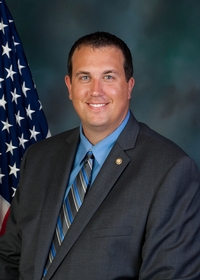
Photo of Seth Grove
R Pennsylvania House · District 196

Rep. Seth Grove

Compare
Total votes
8,575
all sessions
Attendance
99%
103 missed
Among the lowest in the chamber
With party
97%
of cast votes
Lower than 79% of chamber peers
Bipartisan score
1%
crosses aisle rarely
Higher than 75% of chamber peers
Sponsored
1,462
bills & resolutions
Near the chamber average
Committees
0
assignments
1,462 bills and resolutions

Sponsored bills

Total
1,462
Primary
238
Co-sponsor
1,224
This page
1,462
matching current filters
Primary HB 278
In committee · Pennsylvania House · Lead sponsor
An Act amending Title 65 (Public Officers) of the Pennsylvania Consolidated Statutes, in lobbying disclosure, further providing for registration, for reporting, for exemption from registration and reporting and for administration; and making an editorial change.

Maddy summaryHB 278 amends Pennsylvania's lobbying disclosure laws to increase transparency. It updates the definition of "personnel expense" to include all lobbying-related compensation (salaries, benefits, travel, etc.) for lobbyists, staff, and exempt individuals. The bill lowers the reporting threshold from $2,500 to $1 for expenses related to lobbying, requiring electronic reports for any amount above zero. It also establishes biennial registration for lobbyists (with automatic renewal) and mandates additional reporting when lobbyists work with entities exempt from standard registration. These changes directly affect lobbyists, lobbying firms, and principals who engage in lobbying activities within Pennsylvania.

In committee Jan 22, 2025 0 co-sponsors
Co-sponsor HB 236
In committee · Pennsylvania House · Co-sponsor
An Act amending Title 18 (Crimes and Offenses) of the Pennsylvania Consolidated Statutes, in public indecency, further providing for the offense of obscene and other sexual materials and performances.

Maddy summaryHB 236 amends Pennsylvania's obscenity law to explicitly exempt public libraries, school/university libraries, and state or municipal archives from the offense of displaying obscene materials. The bill updates Section 5903(j) of Title 18 to clarify that recognized historical societies, museums, public libraries, and educational institution libraries are not subject to these restrictions. This change directly affects libraries and archives operating under educational or governmental supervision by removing ambiguity about their legal protections. The amendment does not create new offenses but ensures these institutions can legally display materials as part of their public service.

In committee Jan 22, 2025 1 co-sponsor
Co-sponsor HB 125
In committee · Pennsylvania House · Co-sponsor
A Joint Resolution proposing an amendment to the Constitution of the Commonwealth of Pennsylvania, further providing for sessions of the General Assembly.

Maddy summaryHB 125 proposes a constitutional amendment to change when the Pennsylvania General Assembly must convene, moving the regular session start date from the first Tuesday in January to December 1 each year. The amendment would require the legislature to meet annually on December 1, unless the Governor calls a special session under existing rules. The bill also outlines the approval process: after two legislative votes, the amendment must be advertised and then submitted to voters at the next applicable primary, general, or municipal election. If approved by voters, the change would take effect, altering the annual meeting schedule for the state legislature.

In committee Jan 16, 2025 1 co-sponsor
Co-sponsor HB 163
In committee · Pennsylvania House · Co-sponsor
An Act amending the act of April 6, 1980 (P.L.102, No.39), referred to as the Agricultural Land Acquisition by Aliens Law, further prohibiting certain entities from acquiring an interest in agricultural land; providing for investigation by Attorney General and for responsibilities of purchaser and Attorney General; further providing for forfeiture of lands; providing for real estate auction; and further providing for definitions.

Maddy summaryHB 163 amends Pennsylvania's 1980 law to prohibit entities from "countries of concern" (including China, Russia, Iran, North Korea, Belarus, and Venezuela) and foreign governments from acquiring agricultural land, except through inheritance or as security for debt. It requires title companies to verify compliance with the law, imposing a $1,000 civil penalty for willful failure to do so, and authorizes the Attorney General to investigate violations. Violating entities must forfeit the land to the Commonwealth, which will sell it at auction; proceeds cover sale costs, reimburse the Attorney General for investigation expenses, pay lienholders, and then fund the General Fund. The law defines agricultural land broadly (including cropland and livestock operations) but excludes mineral rights and non-farm zoning.

In committee Jan 16, 2025 1 co-sponsor
Co-sponsor HB 160
In committee · Pennsylvania House · Co-sponsor
An Act amending the act of August 15, 1961 (P.L.987, No.442), known as the Pennsylvania Prevailing Wage Act, further providing for definitions.

Maddy summaryHB 160 amends Pennsylvania's prevailing wage law by raising the cost threshold for public construction projects subject to prevailing wage requirements from $25,000 to $257,000 (adjusted annually for inflation). The new threshold uses the Consumer Price Index for urban wage earners in Pennsylvania, New Jersey, Delaware, and Maryland to account for inflation each March. This change exempts smaller public projects (under $257,000) from prevailing wage rules, while larger projects remain covered. The amendment applies to contracts entered into 60 days after the law's effective date.

In committee Jan 16, 2025 1 co-sponsor
Primary HB 115
In committee · Pennsylvania House · Lead sponsor
An Act providing for ballot access; and imposing duties on the Department of State.

Maddy summaryHB 115 establishes new ballot access rules for candidates running for specific offices in Pennsylvania, including U.S. President, U.S. Congress, statewide positions, state legislature, judgeships, and local offices. To appear on the ballot, candidates must either submit a petition with signatures or pay a set filing fee, with amounts ranging from $3,000 for state House candidates to $38,500 for presidential candidates. The bill requires the Department of State to collect these fees and distribute a portion to counties while retaining a fixed amount for administrative costs. This policy directly affects candidates seeking these offices by changing how they qualify for ballot placement.

In committee Jan 14, 2025 0 co-sponsors
Primary HB 2657
In committee · Pennsylvania House · Lead sponsor
An Act providing for ballot access; and imposing duties on the Department of State.

Maddy summaryThis bill, known as the Ballot Access Improvement Act, establishes a new option for candidates in Pennsylvania to gain access to the ballot by paying a filing fee instead of submitting a traditional nomination petition. It applies to a wide range of offices, including federal positions, statewide roles, and local judgeships, allowing candidates to choose between the standard petition process or a direct fee payment. The legislation sets specific fee amounts based on the office sought, ranging from $3,000 for state representatives to $38,500 for the presidency, and outlines how these funds will be distributed to counties and the Department of State for election administration. Additionally, the bill defines strict deadlines for fee payment, mandates the issuance of receipts to candidates, and clarifies that these fees are non-refundable even if a candidate withdraws.

In committee Oct 28, 2024 0 co-sponsors
Primary HB 2656
In committee · Pennsylvania House · Lead sponsor
An Act amending the act of April 9, 1929 (P.L.177, No.175), known as The Administrative Code of 1929, in Commonwealth budget procedures, further providing for submission of budget to General Assembly.

Maddy summaryThis bill updates Pennsylvania's budget rules by requiring the state to submit a seven-year financial plan to the General Assembly. The new requirement mandates that the budget include actual spending from the previous year, current available funds, the proposed budget for the next year, and estimated accounts for the following four years. This change directly affects how the executive branch prepares and presents financial information to lawmakers. The law will become active 60 days after it is signed.

In committee Oct 28, 2024 0 co-sponsors
Primary HB 2653
In committee · Pennsylvania House · Lead sponsor
An Act amending Title 18 (Crimes and Offenses) of the Pennsylvania Consolidated Statutes, in assault, providing for the offense of masked intimidation; and imposing penalties.

Maddy summaryThis bill creates a new crime called masked intimidation in Pennsylvania, which occurs when someone wearing a facial covering intentionally harasses, intimidates, or threatens another person or group with the goal of making them fear for their physical safety. The offense is classified as a third-degree misdemeanor, but the law includes specific exceptions that allow individuals to wear masks for purposes such as costumes, religious reasons, occupational safety, weather protection, or health measures like limiting the spread of illness. The legislation explicitly states that it does not infringe upon First Amendment rights and defines key terms like harassment and intimidation to focus on conduct based on protected characteristics such as race, religion, or gender identity.

In committee Oct 23, 2024 0 co-sponsors
Co-sponsor HB 2629
In committee · Pennsylvania House · Co-sponsor
An Act amending Title 25 (Elections) of the Pennsylvania Consolidated Statutes, in registration system, providing for verification of citizenship; in voter registration, further providing for methods of voter registration; in penalties, further providing for duties under part; and, in provisions contingent on Federal Law, further providing for removal of electors.

Maddy summaryThis bill amends Pennsylvania's election laws to require that all voter registration applicants provide documentary proof of U.S. citizenship. It specifies acceptable documents, such as a valid passport, military ID, or a birth certificate paired with other supporting evidence, and mandates that election officials verify this information during the registration process. The legislation also establishes penalties for officials who fail to perform these duties and creates a legal pathway for individuals to sue if they believe their citizenship verification rights were violated. Additionally, it updates the rules for removing voter registration records, allowing for cancellation only when an elector is confirmed to be non-citizen or has moved away.

In committee Oct 9, 2024 1 co-sponsor
Showing 121 to 130 of 1,462 bills
Previous 1 … 12 13 14 … 147 Next