

Maddy summaryHB 479 allows Pennsylvania voters to register to vote on election day at their polling place by presenting valid ID and submitting a registration form. It requires voters to show a government-issued ID (like a driver's license, passport, or military ID) and provides a temporary ballot that won't be counted until the state approves the registration within 10 days. The bill mandates that all polling places receive same-day registration forms and instructions for voters. This directly affects qualified Pennsylvania voters who maintain residence in an election district and need to register on election day.
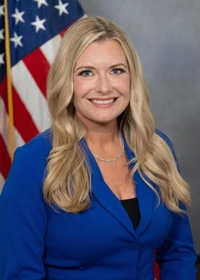
Rep. Missy Cerrato
Sponsored bills
Maddy summaryHB 471 allocates $1,000,000 from the General Fund to fund veterans' service officer programs in Pennsylvania. This bill directly affects veterans' service organizations that assist military veterans in accessing benefits and services. The key provision transfers the specified funds to the relevant department to support these programs under Title 51 of Pennsylvania law. The bill takes effect 60 days after enactment.
Maddy summaryHB 470 requires employers with 15 or more employees in Pennsylvania to provide a paid 30-minute meal break or rest period after five consecutive hours of work. This applies to all covered employees, with exemptions for union contracts that already provide equivalent or better break rights and during workplace emergencies. Employers violating the law face penalties of $100-$500 per affected employee per missed break, with additional recovery of lost wages for workers. The bill takes effect 90 days after enactment.
Maddy summaryHB 201 amends Pennsylvania's Public School Code to update how intermediate units (regional education agencies) manage facilities and receive state funding. It expands boards' authority to acquire land/buildings through purchase, lease, or gift (Section 914-A(11)), and requires pre-approval from the Secretary of Education for lease/loan agreements involving office, classroom, or warehouse space (Section 919.1-A(a)). The bill revises the capital subsidy calculation: the state will allocate funds based on each intermediate unit's student enrollment multiplied by the median per-student instructional cost across all districts, then applying a 0.03% rate. This directly affects intermediate units and school districts using their facilities, changing both facility management rules and state funding distribution.
Maddy summaryHB 442 establishes a new Pharmaceutical Collection Sites Educational Program within Pennsylvania's Department of State to help pharmacies understand how to modify their federal Drug Enforcement Administration (DEA) registrations. The program will assist pharmacies in learning to accept mail-back packages for prescription drugs and install collection receptacles for safe disposal, as requested by the State Board of Pharmacy. This bill directly affects pharmacies that dispense prescription medications and the State Board of Pharmacy, which will coordinate with the program. The key provision adds this educational role as a specific duty for the Department of State under the Administrative Code of 1929.
Maddy summaryHB 444 requires most health insurance policies covering hospital or medical/surgical services to include coverage for postacute neurorehabilitation following an acquired brain injury. This includes specific therapies like cognitive rehabilitation, neurobehavioral treatment, and community reintegration services, with no arbitrary limits on the number of covered days if medically necessary. Insurers must verify providers are accredited through recognized programs (e.g., Commission on Accreditation of Rehabilitation Facilities) and cannot apply stricter deductibles or copays than other covered benefits. The requirement does not apply to policies like dental, vision, workers’ compensation, or accident-only coverage.
Maddy summaryHB 443 modifies Pennsylvania's sentencing for second-degree murder convictions, including murder of an unborn child or a law enforcement officer. It reduces maximum sentences: for adults, from life imprisonment to 50 years; for offenders under 18, it sets a maximum of 40 years for those 15+ at the time of crime and 30 years for those under 15. The bill also establishes new parole timelines - 25 years for standard life sentences under this section, 20 years for those under 18 aged 15+, and 15 years for those under 15 - requiring the parole board to prioritize public safety, victim safety, and consider the offender's culpability before granting parole. Additionally, it mandates that victims be notified and given a chance to be heard before parole decisions for these cases.
Maddy summaryHB 429 amends Pennsylvania's Fiscal Code to direct specific transfers from the Budget Stabilization Reserve Fund to address pension obligations. It requires $670 million to be transferred to the Public School Employees' Retirement Fund and $330 million to the State Employees' Retirement Fund by January 1, 2026, as one-time payments to reduce their unfunded pension liabilities. These transfers are separate from the fund's usual purpose of covering emergencies or economic downturns. The bill directly affects Pennsylvania's public employee pension systems, not general state programs or new legislation.
Maddy summaryHB 423 establishes Pennsylvania's Future Voter Program, allowing high school students aged 16-17 to preregister to vote before turning 18. The bill requires schools to hold voter registration events during Constitution and Citizenship Day (September 17), providing applications and online registration opportunities for eligible students. Students who preregister will not be added to the voter registry until they reach age 18. The program mandates school entities to coordinate these events, with the Secretary of Education and Secretary of the Commonwealth overseeing implementation. This directly affects all high school students in Pennsylvania who are 16 or 17 years old.
Maddy summaryThis bill requires judges to ban convicted individuals of riot or disorderly conduct offenses from owning, possessing, or caring for animals for at least two years. It mandates completion of violence prevention counseling as part of sentencing, with failure to comply considered a separate offense. Violating the animal ownership ban results in escalating misdemeanor charges: third-degree for the first violation (adding one year to the ban), second-degree for a second violation (adding five years), and first-degree for third or subsequent violations (adding ten years). The law applies only to those convicted under specific provisions of Title 18, directly affecting offenders in these cases.