

Maddy summaryThis House Resolution designates 2025 as "The Year of the Catholic War Veterans of the United States of America" in Pennsylvania to honor the organization's 90-year history of service to faith, family, and country. It is a ceremonial measure expressing the state's recognition of the Catholic War Veterans' contributions, including their work with Pennsylvania's veterans community and their national service since 1935. The resolution does not create new laws or alter existing policies - it is purely symbolic, with no direct impact on legislation or funding.
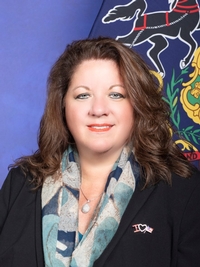
Rep. Donna Scheuren
Sponsored bills
Maddy summaryThis Pennsylvania House resolution (HR 157) urges the U.S. Congress to pass H.R. 3023 (or similar legislation) during the 119th Congress, which would require the Department of Veterans Affairs and Department of Defense to provide stellate ganglion block (SGB) therapy to veterans and military members with PTSD. SGB is a low-risk neck injection procedure that targets nerves controlling stress responses, potentially alleviating symptoms like anxiety and hyperarousal. The resolution cites that 23% of recent veterans and 12-15% of older veterans have PTSD diagnoses, with current treatments helping only 40% of patients. It emphasizes SGB's decades-long use and support from veterans' organizations as a potential treatment option.
Maddy summaryHB 980 changes the composition of Pennsylvania's State Board of Pharmacy by increasing the number of licensed pharmacists on the board from five to six and adding specific appointment requirements. It requires two pharmacist members from independent retail pharmacies, two from large retail pharmacy chains (with five or more locations), and two from hospital/acute care settings, plus one pharmacy technician position that rotates between settings. The bill also establishes term limits: pharmacy technicians serve one six-year term, while other members may serve up to two consecutive terms. This directly affects the board's membership structure and the appointment process for pharmacists and pharmacy technicians in Pennsylvania.
Maddy summaryThis bill designates May 17, 2026, as the "25th Anniversary of the Educational Improvement Tax Credit Program Day" in Pennsylvania. The resolution recognizes the program, which allows businesses to receive tax credits for donations to scholarship organizations that fund tuition for students in public and private schools. By formally acknowledging the program's 25-year history, the bill highlights its role in providing educational options for families across the state without changing any existing laws or policies.
Maddy summaryThis bill updates Pennsylvania's transportation laws to establish specific rules for selecting projects funded by the Multimodal Fund. It requires the Department of Transportation to award grants competitively without reserving a fixed percentage of money for any single applicant before the application process is finished. Additionally, the legislation mandates that the department give priority to projects using recycled materials, such as reclaimed asphalt pavement and recycled asphalt shingles. These changes aim to ensure fair competition while encouraging the use of sustainable building materials in state-funded infrastructure projects.
Maddy summaryThis bill amends Pennsylvania vehicle laws to provide temporary fuel price relief by reducing specific taxes on gasoline and fees for electric vehicle road users. For the first six months after it takes effect, the state will eliminate certain fuel taxes, and for the following six months, it will cut those fees by half. To ensure consumers benefit directly, the law requires fuel dealers to pass these savings on by lowering sale prices and prohibits them from keeping the tax reduction as extra profit. The Department of Revenue must estimate the resulting loss in state revenue, and the State Treasurer is then required to transfer that amount from a budget reserve fund to maintain highway maintenance financing.
Maddy summaryThis bill authorizes Pennsylvania to join the Respiratory Care Interstate Compact, a legal agreement designed to allow licensed respiratory therapists to practice in other member states without needing separate licenses for each location. The legislation establishes a framework where a therapist's home state retains primary regulatory authority while granting temporary practice privileges in other states to improve patient access and support military families. Key provisions include creating a central data system to track licenses, defining strict rules for handling disciplinary actions across state lines, and setting requirements for criminal background checks and jurisprudence exams. By adopting this compact, the state aims to streamline administrative processes and address workforce shortages while maintaining public safety standards.
Maddy summaryThis bill updates Pennsylvania's vehicle laws to increase penalties for driving after a license has been suspended or revoked. It establishes a $200 fine for a first offense, raises fines to between $500 and $2,500 for second or third violations, and mandates fines up to $2,500 plus 30 to 12 months in jail for fourth or subsequent offenses. Additionally, the legislation adjusts sentencing guidelines for repeat offenders of other traffic violations by increasing potential fines and jail time. These changes take effect 60 days after the bill is enacted.
Maddy summaryHB 1929 designates an annual "Charlie Kirk Day" in Pennsylvania for commemoration. The bill requires the governor to issue a yearly proclamation recognizing Charlie Kirk, though the bill does not specify his role or contributions. This is a procedural, symbolic measure with no policy changes, funding, or direct impact on residents or programs. It remains pending in the Tourism, Recreation & Economic Development committee.
Maddy summaryThis bill requires hyperscale data centers in Pennsylvania to build their own baseload power generation and pay for all costs to connect that power to the grid, regardless of distance. It mandates that electric distribution companies cooperate with these data centers by planning for their energy needs and prohibiting cross-subsidization of their rates with other customers. Additionally, the bill sets specific rules for long-term power contracts used by default service providers and gives the state commission authority to define what qualifies as a hyperscale data center.