

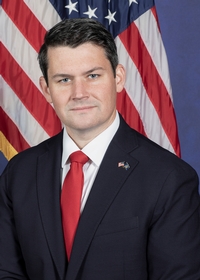
Photo of Joe Hogan
R Pennsylvania House · District 142 On the 2026 ballot

Rep. Joe Hogan

Compare
Total votes
3,104
all sessions
Attendance
100%
3 missed
Lower than 97% of chamber peers
With party
84%
of cast votes
Lower than 97% of chamber peers
Bipartisan score
8%
crosses aisle rarely
Higher than 96% of chamber peers
Sponsored
193
bills & resolutions
Near the chamber average
Committees
4
assignments
193 bills and resolutions

Sponsored bills

Total
193
Primary
32
Co-sponsor
161
This page
193
matching current filters
Primary HB 1274
In committee · Pennsylvania House · Lead sponsor
An Act amending Title 75 (Vehicles) of the Pennsylvania Consolidated Statutes, in State highway maintenance, providing for noise barrier construction required; and making a transfer.

Maddy summaryHB 1274 requires the Pennsylvania Department of Transportation to build a noise barrier along the southbound side of Interstate 295 in Middletown Township, Bucks County, between New Falls Road and Trenton Road (mile markers 2.2 to 0.7). It transfers $40 million from the General Fund to a restricted account within the Motor License Fund to cover the barrier construction costs. Any unspent funds after completion must be returned to the General Fund. This bill directly affects residents near the specified I-295 section by addressing noise pollution through a targeted infrastructure project.

In committee Apr 21, 2025 0 co-sponsors
Co-sponsor HB 1134
In committee · Pennsylvania House · Co-sponsor
An Act amending Title 3 (Agriculture) of the Pennsylvania Consolidated Statutes, in food protection, further providing for misbranding of food.

Maddy summaryHB 1134 requires food products containing specific synthetic colors (Blue 1, Blue 2, Green 3, Red 40, Yellow 5, or Yellow 6) to display a warning label on the front of the package. The warning must state: "WARNING: This product contains synthetic colors, which may have an adverse effect on activity and attention in children," in bold type at least as large as the "serving size" declaration. This law directly affects food manufacturers and retailers selling products with these dyes in Pennsylvania. The requirement applies to all such products sold within the state and takes effect one year after enactment.

In committee Apr 21, 2025 1 co-sponsor
Co-sponsor HB 1131
In committee · Pennsylvania House · Co-sponsor
An Act amending the act of March 10, 1949 (P.L.30, No.14), known as the Public School Code of 1949, in school health services, providing for prohibited substances in competitive foods.

Maddy summaryHB 1131 amends Pennsylvania's Public School Code to prohibit public schools from selling or offering competitive foods containing specific artificial dyes during the school day. The bill bans six dyes (Blue 1, Blue 2, Green 3, Red 40, Yellow 5, and Yellow 6) in foods sold on school grounds that compete with federally reimbursable meals like school lunches. It defines "competitive food" as any food sold during school hours that competes with National School Lunch Program meals. The prohibition applies to all public schools in Pennsylvania and takes effect July 1, 2027. This is a direct policy change restricting certain food additives in school food sales, not a health recommendation.

In committee Apr 21, 2025 1 co-sponsor
Co-sponsor HB 1132
In committee · Pennsylvania House · Co-sponsor
An Act amending the act of March 10, 1949 (P.L.30, No.14), known as the Public School Code of 1949, in school health services, providing for unhealthy ultra-processed food prohibited in competitive foods.

Maddy summaryHB 1132 prohibits Pennsylvania public schools from selling or offering "unhealthy ultra-processed foods" as competitive foods during the school day. It defines "ultra-processed food" as items containing specific additives like artificial colors, stabilizers, non-nutritive sweeteners, or flavor enhancers (excluding natural seasonings), and "unhealthy" as failing FDA standards for the term "healthy" on labels. Competitive foods - such as vending machine snacks or cafeteria items sold alongside school meals - are banned if they contain these unhealthy items. The law takes effect July 1, 2027, directly affecting public school food vendors, students, and school nutrition programs across Pennsylvania.

In committee Apr 21, 2025 1 co-sponsor
Co-sponsor HB 1133
In committee · Pennsylvania House · Co-sponsor
An Act amending Title 3 (Agriculture) of the Pennsylvania Consolidated Statutes, in food protection, further providing for misbranding of food.

Maddy summaryHB 1133 amends Pennsylvania's food protection laws to require a specific cancer warning on food products containing Butylated Hydroxyanisole (BHA). The bill mandates that any food bearing BHA (identified by CAS number 25013-16-5) must display the warning "WARNING: This product contains BHA, which may cause cancer" in bold type on the principal display panel, using a font size no smaller than the required "serving size" declaration. This directly affects food manufacturers and retailers selling products with BHA, requiring them to update labeling to comply with the new rule. The policy change focuses on enhancing consumer transparency about a specific ingredient's potential health risk through mandatory labeling.

In committee Apr 21, 2025 1 co-sponsor
Co-sponsor HB 1130
In committee · Pennsylvania House · Co-sponsor
An Act amending Title 3 (Agriculture) of the Pennsylvania Consolidated Statutes, in food protection, further providing for definitions and providing for reporting of GRAS substances and for public database of GRAS reports.

Maddy summaryHB 1130 requires food manufacturers to report "Generally Recognized as Safe" (GRAS) substances used in food to Pennsylvania's Department of Agriculture, including safety data. This affects companies adding GRAS substances to food products, with exemptions for small businesses and certain FDA-approved substances. The bill mandates a searchable public database on the state website where all submitted reports will be accessible to consumers. It creates new transparency requirements for substances deemed safe without full FDA food additive approval, aligning with federal GRAS reporting standards.

In committee Apr 21, 2025 1 co-sponsor
Co-sponsor HB 1205
In committee · Pennsylvania House · Co-sponsor
An Act amending Title 75 (Vehicles) of the Pennsylvania Consolidated Statutes, in general provisions relating to vehicles, further providing for definitions; in financial responsibility, providing for mini trucks; providing for additional special vehicles; and, in inspection of vehicles, further providing for operation of vehicle without official certificate of inspection and providing for vehicles exempt from emission inspections.

Maddy summaryHB 1205 defines "mini trucks" as small Japanese-imported vehicles (with engine displacement ≤660cc, overall length ≤130 inches, and other specific size limits) and establishes new rules for their operation in Pennsylvania. It requires mini trucks to carry minimum insurance coverage of $15,000 per person for injuries, $30,000 for multiple injuries, and $5,000 for property damage, while exempting them from other insurance requirements. The bill mandates specific equipment (like brakes, speedometers, and seat belts) and restricts operation to roads with speed limits of 55 mph or lower, with potential exceptions up to 70 mph by the transportation secretary. This directly affects owners of these imported vehicles by creating a separate regulatory category for their use on Pennsylvania roads.

In committee Apr 15, 2025 1 co-sponsor
Co-sponsor HB 31
In committee · Pennsylvania House · Co-sponsor
A Joint Resolution proposing integrated and distinct amendments to the Constitution of the Commonwealth of Pennsylvania, repealing provisions relating to Legislative Reapportionment Commission and providing for Independent Redistricting Commission and for redistricting criteria.

Maddy summaryHB 31 proposes a constitutional amendment to replace Pennsylvania's current Legislative Reapportionment Commission - which includes legislative leaders - with an Independent Redistricting Commission. The new commission would draw state legislative and congressional district boundaries after each federal census, following specific redistricting criteria outlined in the amendment. This change aims to reduce partisan influence by removing direct legislative control over redistricting. The bill does not detail the exact criteria but requires the commission to adhere to them when creating district maps.

In committee Apr 15, 2025 1 co-sponsor
Co-sponsor HB 1170
In committee · Pennsylvania House · Co-sponsor
An Act amending Title 61 (Prisons and Parole) of the Pennsylvania Consolidated Statutes, in general administration relating to correctional institutions, providing for electronic control gloves.

Maddy summaryHB 1170 allows Pennsylvania corrections officers to use electronic control gloves - gloves with electrodes emitting under 500 volts to temporarily immobilize individuals - in specific prison units. It requires these gloves only for officers assigned to units housing inmates who received disciplinary sanctions and are segregated from the general population. The department must create public policies on glove use, training, and maintenance, and officers must complete department-approved training before use. The bill also mandates compliance with existing use-of-force laws (18 Pa.C.S. § 508) and defines the gloves’ technical specifications.

In committee Apr 9, 2025 1 co-sponsor
Co-sponsor HB 1152
In committee · Pennsylvania House · Co-sponsor
An Act amending the act of May 17, 1921 (P.L.682, No.284), known as The Insurance Company Law of 1921, in casualty insurance, further providing for billing.

Maddy summaryHB 1152 requires insurance companies to directly reimburse non-network emergency medical services (EMS) agencies for 911 emergency calls within 45 days at 350% of the Medicare ambulance rate for the same service in the same area. EMS agencies must register with the state annually to qualify for direct payments, and insurers cannot demand contracts to facilitate this reimbursement. The insurer's payment covers the full service cost (excluding the patient's copay, coinsurance, or deductible), so EMS agencies cannot bill patients for the remaining amount. This law applies only to non-network EMS providers offering 911 emergency medical services, unless preempted by federal law.

In committee Apr 4, 2025 1 co-sponsor
Showing 71 to 80 of 193 bills
Previous 1 … 7 8 9 … 20 Next