

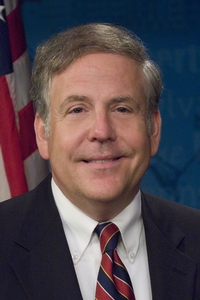
Photo of Bob Freeman
D Pennsylvania House · District 136 On the 2026 ballot

Rep. Bob Freeman

Compare
Total votes
8,340
all sessions
Attendance
100%
8 missed
Near the chamber average
With party
98%
of cast votes
Near the chamber average
Bipartisan score
1%
crosses aisle rarely
Near the chamber average
Sponsored
4,026
bills & resolutions
Higher than 93% of chamber peers
Committees
2
assignments
4,026 bills and resolutions

Sponsored bills

Total
4,026
Primary
104
Co-sponsor
3,922
This page
4,026
matching current filters
Co-sponsor HB 1761
In committee · Pennsylvania House · Co-sponsor
An Act amending Titles 53 (Municipalities Generally) and 66 (Public Utilities) of the Pennsylvania Consolidated Statutes, in municipal authorities, further providing for purposes and powers; and, in rates and distribution systems, further providing for standby charge prohibited.

Maddy summaryHB 1761 prohibits water utilities and municipal authorities from charging "standby fees" to specific groups. It directly affects volunteer fire companies, nonprofit rescue squads, and nonprofit ambulance services (if they own/occupy buildings with fire protection systems and pay for them), as well as residential property owners with automatic fire protection systems. The bill defines a "standby charge" as an extra fee beyond the actual cost of water service for fire protection systems, and bans this practice. Existing charges for affected groups will continue until the next billing cycle after the law takes effect. The law amends both municipal and utility statutes to enforce this prohibition.

In committee Jul 23, 2025 1 co-sponsor
Co-sponsor HB 1299
Passed · Pennsylvania House · Co-sponsor
An Act amending the act of December 17, 1968 (P.L.1224, No.387), known as the Unfair Trade Practices and Consumer Protection Law, providing for unlawful retention policy.

Maddy summaryHB 1299 amends Pennsylvania's Unfair Trade Practices and Consumer Protection Law to regulate automatic renewal and continuous service offers. It requires businesses to clearly disclose renewal terms, pricing after trials, and cancellation options in a way consumers can retain, and to allow online cancellation. The law applies to most subscription-based goods/services but excludes health clubs, federally regulated utilities, natural gas/electricity contracts, and insurance entities. Violations would be treated as unfair trade practices under existing enforcement mechanisms.

Passed Jul 23, 2025 1 co-sponsor
Co-sponsor HB 1424
Passed · Pennsylvania House · Co-sponsor
An Act amending the act of December 31, 1965 (P.L.1257, No.511), known as The Local Tax Enabling Act, in local taxes, further providing for delegation of taxing powers and restrictions thereon.

Maddy summaryHB 1424 amends Pennsylvania's Local Tax Enabling Act to prohibit local governments from taxing admission fees at recreational campgrounds. It adds a new restriction (section 18) preventing municipalities from levying amusement taxes on guest charges for campground access. The bill also clarifies that camping property rentals aren't considered "places of amusement" for tax purposes. This change affects all local authorities covered by the original tax law, including cities, towns, and school districts.

Passed Jul 23, 2025 1 co-sponsor
Co-sponsor HB 1751
In committee · Pennsylvania House · Co-sponsor
An Act establishing the Office of Employee Ownership within the Department of Community and Economic Development; establishing the Employee Ownership Advisory Board; establishing the Main Street Employee Ownership Grant Program; and providing technical and financial assistance to employee-owned enterprises.

Maddy summaryHB 1751 creates a new Office of Employee Ownership within the state's Department of Community and Economic Development to support employee-owned businesses. It establishes an Employee Ownership Advisory Board to guide the program and a Main Street Employee Ownership Grant Program to provide funding for these businesses. The bill also directs the state to offer technical and financial assistance to help employee-owned enterprises grow and operate. This bill directly affects employee-owned businesses seeking support, grants, and guidance through state programs.

In committee Jul 22, 2025 1 co-sponsor
Co-sponsor HB 1749
In committee · Pennsylvania House · Co-sponsor
An Act amending the act of March 4, 1971 (P.L.6, No.2), known as the Tax Reform Code of 1971, in sales and use tax, further providing for exclusions from tax; and establishing a fueling opportunities for the revitalization, growth and efficiency of steel tax credit.

Maddy summaryHB 1749 amends Pennsylvania's 1971 Tax Reform Code to modify sales and use tax exclusions and create a new tax credit specifically for the steel industry. The bill establishes a "fueling opportunities" tax credit aimed at supporting steel businesses engaged in revitalization, growth, and operational efficiency. This credit directly affects steel manufacturers and related businesses by potentially reducing their tax burden for qualifying activities. The bill focuses on concrete tax code changes rather than broader policy shifts, with its key mechanism being the new credit program within the existing tax framework.

In committee Jul 22, 2025 1 co-sponsor
Co-sponsor HB 1429
Passed · Pennsylvania House · Co-sponsor
An Act amending the act of June 13, 1967 (P.L.31, No.21), known as the Human Services Code, in public assistance, providing for report on transition to chip-enabled access cards.

Maddy summaryHB 1429 requires the state agency administering public assistance programs (like food stamps or cash aid) to submit a report detailing a transition plan to replace current access cards with secure chip-enabled electronic cards. The bill directly affects recipients of public assistance and the agencies managing these programs by mandating a formal report on how the switch to chip cards will be implemented. Key provisions include specifying the report must cover timelines, costs, and how the transition will ensure continued access for beneficiaries. This is a procedural bill focused on reporting requirements, not altering benefit eligibility or funding.

Passed Jul 17, 2025 1 co-sponsor
Co-sponsor HB 1733
In committee · Pennsylvania House · Co-sponsor
An Act amending the act of July 9, 1987 (P.L.220, No.39), known as the Social Workers, Marriage and Family Therapists and Professional Counselors Act, further providing for legislative intent, for definitions, for license required, for State Board of Social Workers, Marriage and Family Therapists and Professional Counselors, for powers and functions of board, for qualifications for license, for procedures for licensing, for exemption from licensure examination, for reciprocity, for endorsement of out-of-State licenses and for reinstatement of license; providing for restriction on use of title "licensed professional art therapist" and related titles; and further providing for penalties, for license renewal, records and fees and for unlawful practice.

Maddy summaryHB 1733 adds art therapy to Pennsylvania's regulated health professions by creating specific licensure requirements for "licensed professional art therapists" and "licensed associate art therapists." It defines "art therapy" as a clinical practice using art-based techniques to address mental health needs, requiring therapists to meet education standards from accredited institutions. The bill restricts the use of the title "licensed professional art therapist" to those holding a valid license, while "licensed associate art therapists" must work under supervision and cannot practice independently. This directly affects art therapists seeking to legally use the title or provide services in Pennsylvania, establishing new standards for training, supervision, and scope of practice.

In committee Jul 14, 2025 1 co-sponsor
Primary HB 1575
Passed · Pennsylvania House · Lead sponsor
An Act amending the act of March 4, 1971 (P.L.6, No.2), known as the Tax Reform Code of 1971, in tax credit and tax benefit administration, further providing for definitions; and providing for factory or mill building economic revitalization.

Maddy summaryHB 1575 creates a new tax credit program to revitalize vacant industrial properties in Pennsylvania. It directly affects building owners of pre-1973 factories or mills that have been at least 75% vacant for 24 months and are designated by their municipality for rehabilitation. The bill establishes a credit equal to 20% of qualified renovation costs (like structural repairs or equipment upgrades) that meet specific value thresholds, applied against certain business taxes. To qualify, properties must be rehabilitated for mixed commercial/residential use, and the program is administered by the Department of Community and Economic Development.

Passed Jul 14, 2025 0 co-sponsors
Primary HB 1532
Passed · Pennsylvania House · Lead sponsor
An Act amending the act of July 31, 1968 (P.L.805, No.247), known as the Pennsylvania Municipalities Planning Code, in general provisions, further providing for definitions; in comprehensive plan, providing for municipal specific plans; and, in intergovernmental cooperative planning and implementation agreements, further providing for specific plans.

Maddy summaryHB 1532 updates Pennsylvania's Municipalities Planning Code to allow municipalities to create more tailored "specific plans" for defined areas (like downtowns or industrial zones), beyond general comprehensive plans. It clarifies definitions, streamlines the process for local governments to develop these targeted plans, and improves coordination for shared planning between municipalities and counties. This directly affects Pennsylvania towns and cities managing land use and development, giving them greater flexibility in planning for specific neighborhoods or projects. The bill passed in July 2025 and is now law.

Passed Jul 14, 2025 0 co-sponsors
Co-sponsor HB 1712
In committee · Pennsylvania House · Co-sponsor
An Act amending Title 35 (Health and Safety) of the Pennsylvania Consolidated Statutes, in Commonwealth services, further providing for organization.

Maddy summaryHB 1712 updates Pennsylvania's emergency communication rules under Title 35 (Health and Safety). It requires the state emergency management agency to maintain a single integrated system for weather advisories, disaster warnings, and coordination with local agencies, police, and the National Weather Service. The bill mandates two new statewide phone numbers: one for the public and emergency personnel to report hazardous materials or disasters, and another for the legislative branch to directly communicate with the agency during weather emergencies. These changes directly affect county/municipal emergency responders, state agencies (including the State Police), and legislative offices. The law takes effect 60 days after enactment.

In committee Jul 10, 2025 1 co-sponsor
Showing 391 to 400 of 4,026 bills
Previous 1 … 39 40 41 … 403 Next