

Maddy summaryHB 2253 requires Pennsylvania public high schools to hire school life support coaches to provide daily nonclinical emotional support to students. High-need schools (defined by factors like poverty rates, attendance issues, or dropout risk) must employ one coach for every 300 students, while other schools must have one for every 500 students. Coaches must hold specific educational qualifications (e.g., bachelor's degree with two years of experience), complete training in trauma-informed care and crisis response, and focus on mentorship and resource connection without providing therapy or diagnosis. The Department of Education will guide districts on equitable compensation, and coaches must refer students needing clinical services to licensed staff.
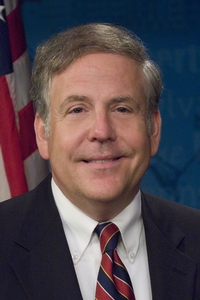
Rep. Bob Freeman
Sponsored bills
Maddy summaryHB 660 establishes minimum energy and water efficiency standards for specific products sold in Pennsylvania, directly affecting businesses that sell or install these items. The bill covers commercial equipment like dishwashers, fryers, and ovens, as well as residential products including faucets, showerheads, and water coolers. It requires these products to meet defined efficiency levels to reduce energy/water waste, save consumers money, and lower environmental impact, with fines for non-compliance. The law updates existing rules but excludes products sold outside Pennsylvania, used items, and certain installations like mobile homes.
Maddy summaryHB 1923 establishes new workplace safety requirements for meat packing and food processing facilities by mandating facility health and safety committees. It creates a dedicated workers' rights coordinator position within the Department of Labor and Industry to oversee compliance and address concerns. The bill also adds specific public health emergency protections for workers during outbreaks or crises, requiring employers to follow state health guidelines. These changes directly affect workers and employers in the meat and food processing industry across the state.
Maddy summaryHB 1738 updates Pennsylvania laws to clarify local government authority over veterans' memorials and public monuments. It grants boroughs specific powers to erect, maintain, and repair memorials for veterans, and gives third-class cities control over memorial maintenance and repair. The bill also strengthens rules for preserving, repairing, and completing public monuments related to war veterans across all public grounds. These changes directly affect boroughs and third-class cities statewide by standardizing their responsibilities for memorial care.
Maddy summaryHB 1556 amends Pennsylvania's Tax Reform Code of 1971 to add new tax credits under the PA EDGE program specifically for "advanced clean manufacturing projects." This bill directly affects businesses constructing or expanding facilities that produce clean energy technology, such as solar panels or battery components. The key change expands the existing PA EDGE tax credit program to include these advanced clean manufacturing projects, providing financial incentives for qualifying investments. The bill does not alter other existing PA EDGE provisions or create new tax credit categories beyond this specific addition.
Maddy summaryHB 2217 requires Pennsylvania public schools to provide specific minimum recess and lunch periods for students. It mandates at least 30 minutes of recess daily for full-day kindergarten through fifth grade, 15 minutes for half-day kindergarten, and 30 consecutive minutes of lunch for all full-day kindergarten through twelfth grade. The bill prohibits withholding lunch for discipline or make-up work, ensures students can opt out of cafeteria lunch for religious reasons, and prevents schools from reducing non-tested subject instruction time to provide recess without balancing with tested subjects. This applies to all school entities (including districts, charter schools, and cyber charters) and takes effect July 1, 2027.
Maddy summaryHB 2212 requires Pennsylvania health insurance companies and other health care payers (including health maintenance organizations and self-insured employers) to reimburse out-of-network medical facilities that meet specific criteria, such as having a four-star patient satisfaction rating, offering faster service than nearby in-network facilities, or being partially owned by physicians who are in-network with the payer. The bill mandates that payers use a "baseball-style arbitration" process for payment disputes, where an independent third party selects either the payer's or facility's proposed payment amount without modification. It defines key terms like "highest in-network rate" to standardize how payers determine fair reimbursement for services. This law directly affects health care benefit plans regulated under Pennsylvania insurance law, aiming to reduce discrimination against qualifying out-of-network providers.
Maddy summaryHB 2215 requires AI chatbot providers to verify user age using reliable methods like government-issued ID, not just birth dates, to prevent minors from accessing AI companions designed for emotional interaction. The bill prohibits creating or distributing AI chatbots that risk encouraging minors to engage in or share sexually explicit content or violent behavior, with penalties of up to $100,000 per violation. It defines "AI companion" as chatbots simulating friendship or therapy and mandates that age verification must reliably block minors without relying on IP addresses or other technical indicators. This law applies to any entity making AI chatbots available in the U.S., focusing on protecting minors from harmful content through concrete verification requirements.
Maddy summaryHB 710 updates Pennsylvania's vehicle financial responsibility rules by requiring drivers to prove they can cover accident costs. It directly affects Pennsylvania drivers who need to show proof of financial responsibility (like insurance) when registering vehicles or after incidents. The key change is creating an online verification system to replace paper documents, allowing real-time checks by law enforcement and state agencies. This simplifies the process for drivers and officials while ensuring compliance with existing financial responsibility standards.
Maddy summaryThe provided context does not include the specific policy language or provisions of HB 17. While the bill's title references amendments to the Public School Code of 1949 regarding "subjects of instruction and flag code," the details of what changes are proposed - such as which subjects would be added or modified, or specific flag-related requirements - are not described in the given information. Without these concrete details, a factual summary of the bill's mechanisms, affected parties, or policy changes cannot be created. The procedural history (e.g., committee referrals) does not substitute for the bill's substantive content. For an accurate summary, the full text of the bill or detailed explanatory materials would be required.