

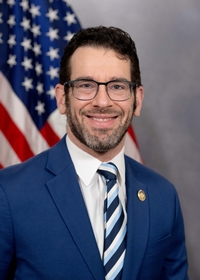
Photo of Mike Schlossberg
D Pennsylvania House · District 132 On the 2026 ballot

Rep. Mike Schlossberg

Compare
Total votes
8,519
all sessions
Attendance
99%
75 missed
Near the chamber average
With party
99%
of cast votes
Near the chamber average
Bipartisan score
1%
crosses aisle rarely
Near the chamber average
Sponsored
3,910
bills & resolutions
Higher than 83% of chamber peers
Committees
1
assignment
3,910 bills and resolutions

Sponsored bills

Total
3,910
Primary
57
Co-sponsor
3,853
This page
3,910
matching current filters
Co-sponsor HB 619
In committee · Pennsylvania House · Co-sponsor
An Act amending the act of June 3, 1937 (P.L.1333, No.320), known as the Pennsylvania Election Code, providing for employee voter leave.

Maddy summaryHB 619 requires Pennsylvania employers to provide employees with up to two hours of paid time off to vote in elections, affecting all public and private sector workers in the state. The bill mandates that employees give employers at least two working days' notice before an election and prohibits employers from asking about voting preferences or party affiliation. Employers must post a uniform notice about this policy (available from the Secretary of the Commonwealth) at least 10 days before an election and face fines of $100-$500 for violations. The law aims to ensure voting access without penalty, with employees required to verify voting attendance to retain paid time off.

In committee Feb 20, 2025 1 co-sponsor
Co-sponsor HB 675
In committee · Pennsylvania House · Co-sponsor
An Act amending Title 35 (Health and Safety) of the Pennsylvania Consolidated Statutes, in Commonwealth services, providing for firefighting personal protective equipment; and imposing penalties.

Maddy summaryHB 675 bans the sale or distribution of firefighting personal protective equipment (PPE) containing intentionally added PFAS chemicals in Pennsylvania starting January 1, 2028, directly affecting manufacturers, sellers, and distributors of such gear. The law includes an exception if the State Fire Commissioner determines PFAS use is unavoidable and issues official guidance. Violations carry civil penalties of up to $5,000 for first offenses and $10,000 for repeat offenses, with fines split equally between the Fire Company Grant Program and Emergency Medical Services Grant Program. This bill aims to reduce exposure to harmful PFAS chemicals while maintaining safety standards for firefighters.

In committee Feb 20, 2025 1 co-sponsor
Co-sponsor HB 674
In committee · Pennsylvania House · Co-sponsor
An Act amending Title 74 (Transportation) of the Pennsylvania Consolidated Statutes, in sustainable mobility options, establishing the Supplemental Public Transportation Operating Assistance Allocation for Growing Counties Grant Program.

Maddy summaryHB 674 establishes a new grant program to provide operating assistance for public transportation in Pennsylvania counties experiencing growth in either population or employment. Eligible applicants include public transit entities already receiving certain existing transportation grants (under Sections 1513 or 1516) that serve counties meeting specific growth criteria based on five-year data. Funding is split equally between counties growing in employment (using Labor Department data) and population (using Census Bureau data), with each county’s grant amount determined by its percentage growth over that period. This program operates in addition to existing transportation funding and cannot require a higher local match than current rules.

In committee Feb 20, 2025 1 co-sponsor
Co-sponsor HB 680
In committee · Pennsylvania House · Co-sponsor
An Act amending the act of June 22, 1937 (P.L.1987, No.394), known as The Clean Streams Law, in procedure and enforcement, further providing for summary proceedings.

Maddy summaryHB 680 amends Pennsylvania's Clean Streams Law to clarify enforcement procedures for pollution cases. It specifies that cases involving sewage, industrial waste, or pollution can be filed either by the Attorney General or directly before district justices in the county where the offense occurred or the public was affected. This change simplifies the court process for environmental enforcement by streamlining jurisdiction and clarifying who represents the Commonwealth in appeals. The bill affects how pollution violations are handled in Pennsylvania courts, with no new environmental requirements.

In committee Feb 20, 2025 1 co-sponsor
Co-sponsor HB 77
Passed · Pennsylvania House · Co-sponsor
An Act amending Title 3 (Agriculture) of the Pennsylvania Consolidated Statutes, in food protection, further providing for definitions, providing for food allergy awareness and further providing for powers of department.

Maddy summaryHB 77 updates Pennsylvania's food protection laws to align with the 2022 FDA Food Code. It requires retail food facilities (like restaurants and grocery stores) to prominently display employee allergy awareness posters detailing major allergens and symptoms, and to include allergen information on menus or written materials for customers. The bill also revises definitions of "potentially hazardous food" and mandates that the Pennsylvania Department of Agriculture adopt the FDA Food Code standards, with updates published in the Pennsylvania Bulletin. The law takes effect 60 days after enactment.

Passed Feb 20, 2025 1 co-sponsor
Co-sponsor HB 580
In committee · Pennsylvania House · Co-sponsor
An Act amending Title 35 (Health and Safety) of the Pennsylvania Consolidated Statutes, providing for public health; imposing duties on the Department of Environmental Protection relating to lead levels in soil; and imposing penalties.

Maddy summaryThis bill establishes new limits for lead in soil at playgrounds and adjacent areas in Pennsylvania. It requires that bare soil on playgrounds must not exceed 200 parts per million (ppm) of lead, and soil in the surrounding yard must not exceed 1,200 ppm. The Department of Environmental Protection will enforce these limits and can issue compliance orders or penalties for violations involving owners or operators of playgrounds, schools, child care centers, and other entities maintaining such areas. These requirements directly affect public and private facilities where children play, aiming to reduce lead exposure risks.

In committee Feb 12, 2025 1 co-sponsor
Co-sponsor HB 584
In committee · Pennsylvania House · Co-sponsor
An Act amending Title 27 (Environmental Resources) of the Pennsylvania Consolidated Statutes, providing for lead abatement assistance; establishing the Lead Abatement Grant Program and the Lead Abatement Assistance Fund; and imposing an architectural paint surcharge.

Maddy summaryHB 584 creates a program to help Pennsylvania homeowners address lead paint hazards in older homes. It establishes a Lead Abatement Grant Program, where municipalities receive competitive grants to fund lead hazard control work (like paint removal or soil cleanup) for single-family homes and rental properties. The program prioritizes low-income households (under 50% of median income) and homes with children under six. Funding comes from a 50¢ surcharge on each gallon of architectural paint sold to consumers, deposited into a dedicated Lead Abatement Assistance Fund. The surcharge applies to standard interior/exterior paint for homeowners or businesses, not industrial or aerosol products.

In committee Feb 12, 2025 1 co-sponsor
Co-sponsor HB 568
In committee · Pennsylvania House · Co-sponsor
An Act amending Title 18 (Crimes and Offenses) of the Pennsylvania Consolidated Statutes, in firearms and other dangerous articles, providing for gun violence task forces.

Maddy summaryHB 568 establishes county-level "gun violence task forces" in Pennsylvania communities with high and increasing gun violence rates. These task forces, created upon a district attorney's written request to the Attorney General, investigate violations of firearm laws (sections 6105 and 6111 of Title 18) and recommend prosecutions. The task forces include local law enforcement, community stakeholders, faith leaders, and neighborhood representatives, operating under the Attorney General’s authority. The Attorney General gains authority to prosecute certain firearm offenses in these counties, considering factors like the severity of the offense and the offender’s criminal history, while local prosecutors may request prosecution for specific cases involving murder or violent crimes.

In committee Feb 12, 2025 1 co-sponsor
Co-sponsor HB 549
In committee · Pennsylvania House · Co-sponsor
An Act amending the act of April 17, 2016 (P.L.84, No.16), known as the Medical Marijuana Act, in medical marijuana controls, further providing for grower/processors; and, in dispensaries, further providing for facility requirements.

Maddy summaryHB 549 requires Pennsylvania medical marijuana grower/processors and dispensaries to maintain continuous video surveillance and retain recordings for at least 180 days. This applies to all licensed businesses under the state's medical marijuana program, including those growing, processing, and dispensing marijuana. The bill adds this security and record-keeping requirement to existing regulations without changing other aspects of the program. It aims to improve oversight and provide documented evidence for investigations or legal purposes.

In committee Feb 11, 2025 1 co-sponsor
Co-sponsor HB 529
In committee · Pennsylvania House · Co-sponsor
An Act amending Title 53 (Municipalities Generally) of the Pennsylvania Consolidated Statutes, establishing the Smart Growth Zoning and Housing Program and the Smart Growth Zoning District Fund.

Maddy summaryHB 529 establishes a program allowing Pennsylvania municipalities to create "Smart Growth Zoning Districts" in areas with good transit access or existing development (like downtowns or near transit stations). It creates a "Smart Growth Zoning District Fund" that pays municipalities a one-time "density bonus payment" for each new housing unit built in these districts, specifically targeting "attainable housing" for residents earning up to 120% of the area's median income. Municipalities must submit detailed housing plans showing how they will meet local housing needs through these districts. The bill directly affects local governments, developers, and residents seeking affordable housing options in designated zones.

In committee Feb 10, 2025 1 co-sponsor
Showing 381 to 390 of 3,910 bills
Previous 1 … 38 39 40 … 391 Next