

Maddy summaryHB 1131 amends Pennsylvania's Public School Code to prohibit public schools from selling or offering competitive foods containing specific artificial dyes during the school day. The bill bans six dyes (Blue 1, Blue 2, Green 3, Red 40, Yellow 5, and Yellow 6) in foods sold on school grounds that compete with federally reimbursable meals like school lunches. It defines "competitive food" as any food sold during school hours that competes with National School Lunch Program meals. The prohibition applies to all public schools in Pennsylvania and takes effect July 1, 2027. This is a direct policy change restricting certain food additives in school food sales, not a health recommendation.
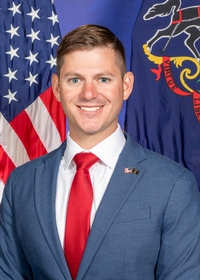
Rep. Joe Kerwin
Sponsored bills
Maddy summaryHB 1132 prohibits Pennsylvania public schools from selling or offering "unhealthy ultra-processed foods" as competitive foods during the school day. It defines "ultra-processed food" as items containing specific additives like artificial colors, stabilizers, non-nutritive sweeteners, or flavor enhancers (excluding natural seasonings), and "unhealthy" as failing FDA standards for the term "healthy" on labels. Competitive foods - such as vending machine snacks or cafeteria items sold alongside school meals - are banned if they contain these unhealthy items. The law takes effect July 1, 2027, directly affecting public school food vendors, students, and school nutrition programs across Pennsylvania.
Maddy summaryHB 1264 allows the Pennsylvania Adjutant General to lease portions of Fort Indiantown Gap to private businesses or nonprofits that meet specific criteria. These businesses must directly benefit military personnel, veterans, their families, and the local community, with all revenue deposited into the new Service Members, Veterans and their Families Fund. The bill establishes clear selection criteria for lessees, prioritizing businesses offering services that support the military community and local residents. It also limits administrative or judicial review of leasing decisions to streamline the process. This bill primarily affects Fort Indiantown Gap personnel, veterans, their families, and local businesses seeking to operate on the installation.
Maddy summaryHB 1172 defines "utility terrain vehicle" (UTV) as a four-wheel off-road vehicle with specific size and weight limits (max 64 inches wide or 1,700 pounds), excluding ATVs, snowmobiles, and other vehicle types. The bill clarifies that state, local, and county authorities can designate roads for UTVs, snowmobiles, and ATVs, including whether these roads may share space with regular traffic. It requires helmets for snowmobile and ATV operators and passengers on shared roads but exempts UTVs equipped with bucket seats, seat belts, and roll cages. The law also directs the Department of Transportation to specify approved helmet types through regulations.
Maddy summaryHB 1005 would repeal Pennsylvania's Use and Storage Tax Act of 1953, which imposed a tax on the use and storage of physical goods (like furniture, electronics, or vehicles) within the state. This law required businesses selling such goods to register, collect the tax from customers, and remit it to the state, with the revenue funding public schools. The bill would eliminate this tax obligation for businesses and remove the administrative requirements for collecting and reporting the tax. The repeal directly affects businesses that previously collected this tax and the public school funding mechanism tied to it.
Maddy summaryHB 767 would allow Pennsylvania vehicle owners to obtain a special license plate featuring the Gadsden flag (a yellow flag with a coiled rattlesnake and the phrase "Don't Tread On Me") for an additional $26 fee on top of regular registration. The plate would be available for passenger cars, light trucks under 14,000 pounds, and motorcycles. This is a procedural change adding a new plate option, not a substantive policy shift affecting vehicle regulations or safety.
Maddy summaryHB 437 proposes a constitutional amendment to Pennsylvania's voting rules, requiring voters to present valid identification at all elections. It mandates that voters show a government-issued ID when voting in person (Section 12) and include proof of ID with mail-in ballots (Section 16). Voters without ID can request a free government-issued ID at the polling place (Section 19). This amendment would directly affect all Pennsylvania voters participating in elections, adding ID verification to existing residency and citizenship requirements.
Maddy summaryHB 454 repeals Pennsylvania's requirement for a license to carry a firearm (openly or concealed) for most individuals, making it legal to carry without a license statewide, including in Philadelphia where previous restrictions on public streets and property are removed. The bill also repeals provisions about proof of license and related exceptions, while maintaining existing prohibitions for convicted felons and other restricted locations like schools. Additionally, it includes a new provision for a sportsman's firearm permit and specific regulations for antique firearms. The changes directly affect law-abiding Pennsylvanians who previously needed a license for general firearm carry.
Maddy summaryHB 68, the State-Owned Vehicle Assignment Limitation Act, prohibits Pennsylvania state officials (members of the General Assembly) from being assigned or leasing state-owned vehicles for official use, effective 60 days after enactment. The bill directly affects legislators who previously received state vehicles, banning new assignments while allowing current users to retain their vehicles until they leave office or return the vehicle. Exceptions apply for emergency response duties requiring vehicle use. The law aims to restrict the use of public funds for personal vehicle assignments by lawmakers, with no new leases or assignments permitted after the effective date.
Maddy summaryThis bill authorizes the creation of a Gold Star Families Memorial Monument on Pennsylvania State Capitol grounds to honor military members who died in service and their families. The monument, designed by Woody Williams and Kenton Blackwood, will consist of four black granite slabs featuring inscriptions and scenes representing homeland, patriotism, family, and sacrifice. The MI Charitable Foundation is designated to fund and manage the construction and ongoing maintenance of the site, while the Department of General Services will assist in preparing the location and facilitating the project. The specific location is defined as the area south of the Forum Building, east of the Speaker K. Leroy Irvis Office Building, and north of Walnut Street.