

Maddy summaryThis bill designates April 8, 2026, as "THON Day" in Pennsylvania to honor a student-run fundraising event at Pennsylvania State University that raises money to fight pediatric cancer. The resolution recognizes the event's efforts to support Four Diamonds at Penn State Health Golisano Children's Hospital, which provides treatment, research, and family support for children with cancer. It highlights the significant contributions of over 16,500 volunteers and the millions of dollars raised through the 46-hour dance marathon. The measure serves as a formal acknowledgment of the event's impact and the dedication of the students and organizations involved.
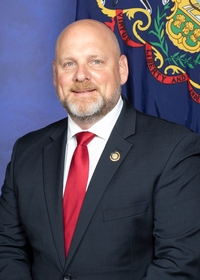
Rep. Doyle Heffley
Sponsored bills
Maddy summaryThis bill designates the week of April 12 through 18, 2026, as "National Public Safety Telecommunicators Week" in Pennsylvania. It directly honors 911 dispatchers and public safety telecommunicators who coordinate emergency responses for medical, fire, and police services. The resolution acknowledges the critical role these professionals play as the first point of contact for residents during emergencies. This is a commemorative measure that recognizes the diligence and professionalism of these workers without changing any laws or policies.
Maddy summaryHB 2209 requires all state-funded institutions of higher education in Pennsylvania to implement a mandatory one-credit course on "the dangers and realities of communism and socialism" starting in the 2027-2028 school year. The course must cover specific topics including definitions of capitalism, communism, and socialism; historical examples like China, Cuba, and the Soviet Union; comparisons between free markets and communist systems; and the impact on civil liberties. It applies to all public universities, community colleges, and state-funded private institutions as defined in the bill. The law mandates this curriculum for all students at these institutions, with no exemption for existing courses. The bill takes effect 60 days after enactment.
Maddy summaryHB 2213 establishes a regulatory framework for "skill video gaming" in Pennsylvania, directly affecting businesses that operate or distribute gaming systems. The bill requires licenses from the Department of Revenue for operators, distributors, and establishments, imposes fees, and mandates a central reporting system to track transactions like "coin in/out" and jackpots. Key provisions include banning access for people under 18, prohibiting "miniature casinos," requiring security measures for players, and creating criminal penalties for operating unlicensed systems or distributing to minors. It aims to eliminate illegal gambling devices disguised as skill-based games while leveraging the State Lottery's existing experience in retail gaming oversight.
Maddy summaryThe provided context does not include the specific policy language or provisions of HB 17. While the bill's title references amendments to the Public School Code of 1949 regarding "subjects of instruction and flag code," the details of what changes are proposed - such as which subjects would be added or modified, or specific flag-related requirements - are not described in the given information. Without these concrete details, a factual summary of the bill's mechanisms, affected parties, or policy changes cannot be created. The procedural history (e.g., committee referrals) does not substitute for the bill's substantive content. For an accurate summary, the full text of the bill or detailed explanatory materials would be required.
Maddy summaryHB 2158 amends Pennsylvania's Controlled Substance Act by adding specific kratom-related compounds to Schedule I, the most restrictive category for controlled substances. The bill prohibits possession, sale, or distribution of any product containing 7-hydroxymitragynine at 2% or more of total alkaloids, or synthetic versions of kratom alkaloids like mitragynine. This change directly affects businesses selling kratom products and individuals who use such substances, making them illegal without medical authorization. The policy change aligns with existing Schedule I criteria of high abuse potential and no accepted medical use.
Maddy summaryThis resolution designates February 2, 2026, as "Rheumatoid Awareness Day" in Pennsylvania. It aims to increase public understanding of rheumatoid arthritis, a chronic inflammatory disease affecting joints and organs that impacts over 1.3 million Americans and carries significant health risks like higher heart attack rates. The resolution is symbolic - meaning it does not create new laws or funding, but rather formally recognizes the day to highlight the disease's challenges and connect to broader health awareness efforts. It directly affects Pennsylvanians by encouraging community recognition of rheumatoid arthritis through official state acknowledgment.
Maddy summaryThis legislative resolution designates August 16, 2025, as "Pottsville Maroons Championship Day" in Pennsylvania to commemorate the 1925 NFL championship victory of the Pottsville Maroons football team. It honors their 1925 season, including their pivotal win over the Chicago Cardinals and their exhibition victory against the Notre Dame All-Stars. The resolution recognizes the team's role in advancing professional football's credibility and Pennsylvania's sports heritage, with copies to be sent to the Pottsville Area Historical Society and Pro Football Hall of Fame. As a ceremonial resolution, it does not create new laws or affect any individuals or entities.
Maddy summaryHR 154 is a state resolution designating October 6, 2025, as "German American Day" in Pennsylvania. It formally recognizes the cultural heritage and contributions of German Americans within the state through official acknowledgment, without creating new laws or funding. The resolution directly affects Pennsylvanians by highlighting this community's historical and cultural impact at the state level. As a procedural resolution, it serves a symbolic purpose rather than implementing policy changes.
Maddy summaryHB 1528 establishes the Grand-family Assistance Program to provide financial support to grandparents and other relatives raising grandchildren. It creates a dedicated fund to make regular payments to local area agencies on aging, which will administer the program and assist eligible families. The bill requires the Department of Aging to manage the program and oversee fund distribution, ensuring direct support reaches affected relatives caring for children. This policy change directly affects grandfamilies and local aging services agencies through structured financial aid and administrative responsibilities.