

Maddy summaryThis resolution designates July 17, 2025, as "100th Anniversary of American Legion Baseball Day" within Pennsylvania. It is a ceremonial resolution recognizing the centennial of American Legion Baseball in the state, with no binding legal effect or direct impact on individuals or policies. The resolution was adopted by the legislature on July 8, 2025, as a symbolic gesture honoring this youth sports program's history.
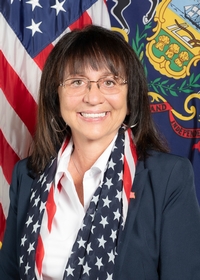
Rep. Brenda Pugh
Sponsored bills
Maddy summaryHB 1682 amends Pennsylvania's 1929 Administrative Code to require that if the state budget (general appropriation bill) isn't passed by June 30 for the next fiscal year, compensation for the Governor, Lieutenant Governor, and members of the General Assembly is suspended until the budget is enacted. Once the budget passes, the suspended pay is paid retroactively starting July 1. This procedural bill directly affects state executive and legislative leaders by linking their pay to the timely passage of the annual budget. It does not change substantive policy but establishes a specific financial consequence for budget delays.
Maddy summaryHB 825 amends Pennsylvania's public utilities law to allow utility companies to install "double utility poles" that carry both power lines and communication lines (like fiber optic cables) on the same pole structure. This change directly affects public utility providers regulated under Title 66 by altering their permitted infrastructure options. The key provision modifies the utilities' powers and duties to facilitate this dual-use pole configuration, potentially streamlining infrastructure deployment. Specific impacts on communities, costs, or regulatory details are not described in the provided context.
Maddy summaryThe provided context does not include the substantive provisions or specific policy changes of HB 1306. The bill's title only indicates it amends definitions and classes of income under the 1971 Tax Reform Code, but no concrete details about tax rates, brackets, affected groups, or mechanisms are described in the available information. The recent actions (e.g., "Second consideration," "Final passage") reflect procedural steps, not policy content. Without specific language or policy changes outlined in the context, a factual summary of what the bill actually does cannot be provided.
Maddy summaryHB 1632 requires Pennsylvania teachers to complete a new human trafficking awareness training as part of their continuing education requirements starting in the 2025-2026 school year. The training, developed by the Department of Education with input from the Attorney General's office and human trafficking organizations, covers federal/state laws, victim identification methods, risk factors, and reporting resources like the state hotline. It must be at least one hour long, available online, and counts toward teachers' existing professional development credits. The bill directly affects all professional educators in Pennsylvania who need continuing education under current certification rules.
Maddy summaryHR 194 is a symbolic resolution designating August 2025 as "National Wellness Month" in Pennsylvania. It does not create new laws, allocate funding, or directly affect specific groups; it serves only to recognize wellness awareness during that month. The resolution was referred to the Health Committee and later laid on the table, indicating it did not advance further in the legislative process. This type of resolution is purely commemorative with no policy impact.
Maddy summaryHB 1511 creates the Violent Incident Clearance and Technological Investigative Methods Program within Pennsylvania's Commission on Crime and Delinquency. The bill requires the Commission to establish this program, which provides funding and guidance for law enforcement agencies to use technology like digital forensics and data analysis to solve violent crimes more effectively. It directly affects Pennsylvania law enforcement agencies handling violent incidents by mandating new reporting requirements and resource allocation for technology-driven investigations. The program aims to improve clearance rates for violent crimes through standardized, tech-enhanced investigative methods.
Maddy summaryHB 1250 amends Pennsylvania's Manufactured Home Community Rights Act to protect residents in manufactured home communities. It requires community owners to allow resident associations and group meetings, and mandates 90-day advance notice for rent increases. The bill caps annual rent hikes at 2-4% (based on regional inflation data), prohibits increases during unresolved health/safety violations, and requires clear disclosure of all fees in leases. These changes directly affect approximately 150,000 manufactured home residents and community owners across Pennsylvania, aiming to prevent exploitative rent practices and stabilize housing costs.
Maddy summaryHB 1596 exempts certain personal electronics and school supplies from Pennsylvania's sales tax during a specific annual August period. It excludes from tax the purchase of personal computers, tablets, or related devices under $1,500 for individual nonbusiness use, and school supplies like notebooks, art materials, or calculators priced at $50 or less per item. The exemption applies only to individual purchases made during the "exclusion period" (the first Saturday to the third Saturday in August), not to business purchases or items like servers, video game consoles, or music discs. This bill directly affects consumers buying eligible items during the defined August sales tax holiday.
Maddy summaryHB 1581 amends Pennsylvania law to restrict the sale and possession of solvents and noxious substances that release toxic vapors, commonly misused for inhalant abuse. It specifically prohibits retailers from selling these products to minors if they suspect the product will be used for inhalant abuse, and bans possession for such misuse. Retailers violating the minor sales rule face a second-degree misdemeanor charge, while other violations carry a third-degree misdemeanor penalty. This bill directly affects retailers selling solvents and individuals attempting to misuse these substances for inhalant purposes.