

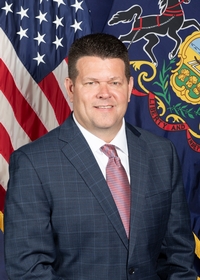
Photo of Jamie Walsh
R Pennsylvania House · District 117 On the 2026 ballot

Rep. Jamie Walsh

Compare
Total votes
1,626
all sessions
Attendance
100%
of floor votes
Near the chamber average
With party
81%
of cast votes
Among the lowest in the chamber
Bipartisan score
10%
crosses aisle rarely
Higher than 98% of chamber peers
Sponsored
141
bills & resolutions
Near the chamber average
Committees
5
assignments
141 bills and resolutions

Sponsored bills

Total
141
Primary
8
Co-sponsor
133
This page
141
matching current filters
Co-sponsor HB 1135
In committee · Pennsylvania House · Co-sponsor
An Act amending the act of March 1, 1974 (P.L.90, No.24), known as the Pennsylvania Pesticide Control Act of 1973, providing for prohibited pesticides.

Maddy summaryHB 1135 prohibits the use of paraquat, a specific chemical pesticide, within Pennsylvania. It defines paraquat by its chemical identifier (CAS number 4685-14-7) and includes related salts, making it unlawful for farmers, agricultural businesses, or any pesticide users to apply it in the state. The bill amends Pennsylvania's 1973 Pesticide Control Act to add this prohibition, effective one year after enactment, and overrides any conflicting existing regulations. This directly affects pesticide users and applicators operating in Pennsylvania.

In committee Jun 23, 2026 1 co-sponsor
Co-sponsor HB 1941
In committee · Pennsylvania House · Co-sponsor
An Act amending Title 75 (Vehicles) of the Pennsylvania Consolidated Statutes, in general provisions relating to operation of vehicles, further providing for obedience to authorized persons directing traffic.

Maddy summaryHB 1941 amends Pennsylvania's vehicle code to clarify that drivers must obey authorized personnel directing traffic, such as police officers or emergency responders. This directly affects all drivers operating vehicles in Pennsylvania when encountering such personnel. The key provision specifies that drivers must comply with directions given by these authorized individuals to ensure traffic safety during emergencies or traffic control. The bill aims to strengthen existing traffic laws by making the requirement for obedience explicit and enforceable.

In committee Jun 22, 2026 1 co-sponsor
Co-sponsor HB 2618
In committee · Pennsylvania House · Co-sponsor
An Act amending Title 75 (Vehicles) of the Pennsylvania Consolidated Statutes, in licensing of drivers, further providing for persons ineligible for licensing, license issuance to minors and junior driver's license.

Maddy summaryThis bill introduces a new junior driver's license for 16 and 17-year-olds in Pennsylvania, which automatically converts to a regular license at age 18. Under the proposed rules, junior drivers would generally be prohibited from driving between 11 p.m. and 5 a.m. unless accompanied by a parent, spouse, or guardian. However, the legislation creates an exception allowing these drivers to drive during those hours for school-sponsored activities if they possess a letter from the school confirming the event. If a junior driver is stopped by police without this letter but can later prove they had it, the charges would be dismissed. The law also defines terms like "school-sponsored activity" to include events such as field trips, athletic activities, and club meetings.

In committee Jun 9, 2026 1 co-sponsor
Co-sponsor HB 2599
In committee · Pennsylvania House · Co-sponsor
An Act amending Title 18 (Crimes and Offenses) of the Pennsylvania Consolidated Statutes, in firearms and other dangerous articles, further providing for firearms not to be carried without a license, for licenses and for proof of license and exception.

Maddy summaryHB 2599 amends Pennsylvania's firearm laws to require a valid license for anyone carrying a concealed firearm on their person or inside a vehicle, with specific exceptions for those who already hold a valid license from another state or the federal government. The bill establishes that carrying a concealed firearm without a license is a third-degree felony for those with a prior criminal record, while reducing the penalty to a first-degree misdemeanor for first-time offenders. It also clarifies that individuals must present their license or proof of eligibility to law enforcement upon request and sets the law into effect 60 days after passage.

In committee Jun 3, 2026 1 co-sponsor
Co-sponsor HB 2594
In committee · Pennsylvania House · Co-sponsor
An Act amending the act of March 10, 1949 (P.L.30, No.14), known as the Public School Code of 1949, in pupils and attendance, further providing for attendance policy at charter, regional charter and cyber charter schools, for excuses from attending school, for procedure when child is truant, for procedure by school when child habitually truant and for penalties for violating compulsory school attendance requirements.

Maddy summaryThis bill updates Pennsylvania's Public School Code to clarify attendance rules for charter and cyber charter schools while protecting students from unfair penalties. It requires cyber charter schools to define how students are marked present for online classes, specifically mandating that students be visible on camera during live lessons and complete weekly benchmarks for independent work. The legislation also prohibits school districts from counting absences as unexcused when students miss school due to a lack of transportation or when they arrive late to a single class, and it establishes a formal appeal process for parents to contest these determinations. Additionally, the bill strengthens reporting requirements, mandating that cyber charter schools submit data on student attendance and weekly benchmark completion to the state department.

In committee Jun 3, 2026 1 co-sponsor
Co-sponsor HB 2588
In committee · Pennsylvania House · Co-sponsor
An Act amending the act of July 31, 1968 (P.L.805, No.247), known as the Pennsylvania Municipalities Planning Code, in general provisions, further providing for definitions; and, in zoning, further providing for ordinance provisions.

Maddy summaryThis bill amends Pennsylvania's Municipalities Planning Code to restrict where large data centers can be built. It specifically prohibits municipalities from allowing hyperscale data centers, which cover more than five acres, in areas designated for agriculture unless they are allowed in every district within that community. Additionally, the law bans data centers on agricultural land if at least half of the property consists of prime agricultural soil or land rated as fourth class by the USDA. Local governments will need to update their zoning ordinances to comply with these new definitions and restrictions on data center development.

In committee Jun 2, 2026 1 co-sponsor
Co-sponsor HB 993
Passed · Pennsylvania House · Co-sponsor
An Act amending Title 51 (Military Affairs) of the Pennsylvania Consolidated Statutes, in general provisions, providing for consolidated annual report; in veteran-owned small businesses, providing for veteran-owned business logotype; and imposing a penalty.

Maddy summaryHouse Bill 993 creates an official logotype for veteran-owned businesses in Pennsylvania. The Department of Military and Veterans Affairs will develop this logotype and establish an application process and eligibility guidelines for businesses to use it. A veteran-owned business is defined as one where at least 51% of the ownership is held by a veteran. The bill also establishes a penalty for fraudulently claiming veteran status to use the logotype and creates a Veteran-Owned Business Coordinator to assist veteran entrepreneurs.

Passed Jun 1, 2026 1 co-sponsor
Primary HB 2533
In committee · Pennsylvania House · Lead sponsor
An Act amending the act of July 31, 1968 (P.L.805, No.247), known as the Pennsylvania Municipalities Planning Code, in zoning, providing for optional moratorium on filing or consideration of new applications for high impact data centers.

Maddy summaryThis bill allows Pennsylvania municipalities to voluntarily pause the review of new applications for high-impact data centers for up to 18 months. The measure is designed to give local governments time to assess infrastructure needs, such as water and electrical grid capacity, and to draft updated zoning rules before approving such facilities. While the moratorium blocks new filings and variances, it does not affect existing data centers or their routine maintenance, and it includes a process for applicants to request waivers if they face unique hardships. Municipalities must hold public hearings and make reasonable progress on planning studies during the pause, and the law clarifies that this temporary measure does not constitute a legal taking of property.

In committee May 27, 2026 0 co-sponsors
Co-sponsor HB 2531
In committee · Pennsylvania House · Co-sponsor
An Act amending Title 18 (Crimes and Offenses) of the Pennsylvania Consolidated Statutes, in obstructing governmental operations, further providing for disarming law enforcement officer.

Maddy summaryThis bill introduces a new crime in Pennsylvania called disarming a law enforcement officer, which would apply to corrections officers and school security guards as well. It makes it a third-degree felony to take or try to take a firearm, rifle, shotgun, or other weapon from these officials when they are working, provided the person knows or has reason to know who they are. The law would take effect 60 days after it is signed into law.

In committee May 27, 2026 1 co-sponsor
Primary HB 2532
In committee · Pennsylvania House · Lead sponsor
An Act amending the act of March 4, 1971 (P.L.6, No.2), known as the Tax Reform Code of 1971, repealing provisions relating to computer data center equipment incentive program; in general provisions, providing for transfer of tax from certain sale of computer data equipment; and establishing a restricted account in the Motor License Fund.

Maddy summaryThis Pennsylvania bill repeals the existing tax incentive program for computer data center equipment and replaces it with a new system that transfers taxes collected from the sale of such equipment into a restricted account within the Motor License Fund. The legislation defines specific equipment and facilities that qualify for the transfer, including servers, cooling systems, and power management infrastructure used in data centers. By redirecting these funds, the bill aims to support the Motor License Fund without providing direct tax breaks to businesses or individuals.

In committee May 27, 2026 0 co-sponsors
Showing 11 to 20 of 141 bills