

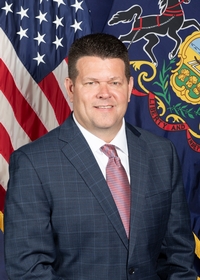
Photo of Jamie Walsh
R Pennsylvania House · District 117 On the 2026 ballot

Rep. Jamie Walsh

Compare
Total votes
1,626
all sessions
Attendance
100%
of floor votes
Near the chamber average
With party
81%
of cast votes
Among the lowest in the chamber
Bipartisan score
10%
crosses aisle rarely
Higher than 98% of chamber peers
Sponsored
141
bills & resolutions
Near the chamber average
Committees
5
assignments
141 bills and resolutions

Sponsored bills

Total
141
Primary
8
Co-sponsor
133
This page
141
matching current filters
Co-sponsor HB 606
In committee · Pennsylvania House · Co-sponsor
An Act amending the act of March 10, 1949 (P.L.30, No.14), known as the Public School Code of 1949, in terms and courses of study, providing for early human life development education.

Maddy summaryHB 606 requires Pennsylvania public and private schools to integrate "early human life development education" into biology courses starting in the 2025-2026 school year. This mandates including specific ultrasound videos showing fetal development at 8, 12, 17, 22, 27, 32, and 37 weeks' gestation, plus a computer-generated animation of fertilization and prenatal development stages. The bill applies to all school entities (districts, charters, cyber charters) and directly affects all K-12 students in Pennsylvania. It amends the 1949 Public School Code to standardize this curriculum component within existing biology requirements.

In committee Feb 12, 2025 1 co-sponsor
Co-sponsor HB 548
In committee · Pennsylvania House · Co-sponsor
An Act amending Titles 18 (Crimes and Offenses) and 53 (Municipalities Generally) of the Pennsylvania Consolidated Statutes, in firearms and other dangerous articles, further providing for limitation on the regulation of firearms and ammunition; and, in preemptions, providing for regulation of firearms and ammunition.

Maddy summaryHB 548 strengthens Pennsylvania's state preemption of local firearm regulations by declaring that all aspects of firearm regulation - including purchase, sale, possession, and transportation - must follow state law, invalidating any conflicting local ordinances. It directly affects counties, municipalities, and townships that previously enacted stricter gun rules, as well as residents, gun dealers, or organizations challenging such local laws. Key provisions include creating legal remedies for those harmed by illegal local regulations (allowing lawsuits for damages, attorney fees, and injunctions) and explicitly stating that state law supersedes all local efforts. The bill takes effect in 90 days for its core preemption rules, requiring local governments to align with state firearm laws immediately.

In committee Feb 11, 2025 1 co-sponsor
Co-sponsor HB 517
In committee · Pennsylvania House · Co-sponsor
An Act amending Title 75 (Vehicles) of the Pennsylvania Consolidated Statutes, in licensing of drivers, further providing for issuance and content of driver's license.

Maddy summaryHB 517 allows individuals diagnosed with autism spectrum disorder to request a public notation on their Pennsylvania driver's license or ID card. To add this notation, applicants must submit a sworn statement from a licensed medical professional verifying the diagnosis. Parents or guardians may also request this notation for minors under 18, following the same verification process. The bill requires the state department to create implementing regulations and takes effect 60 days after enactment.

In committee Feb 5, 2025 1 co-sponsor
Co-sponsor HB 452
In committee · Pennsylvania House · Co-sponsor
An Act amending the act of April 23, 1956 (1955 P.L.1510, No.500), known as the Disease Prevention and Control Law of 1955, providing for amnesty for disciplinary actions regarding COVID-19 protocols.

Maddy summaryHB 452 removes disciplinary actions and refunds penalties for retail food facilities that were penalized for not following specific COVID-19 health protocols during Pennsylvania's state of emergency (March 6, 2020, to when the emergency ended). It covers violations related to the Disease Prevention and Control Law, Governor's orders, and health department guidance about the novel coronavirus. The bill requires health authorities to erase these records from official files and refund any penalties paid during the emergency period. This applies only to violations tied to the pandemic response, not general health code compliance.

In committee Feb 3, 2025 1 co-sponsor
Co-sponsor HB 451
In committee · Pennsylvania House · Co-sponsor
An Act amending Title 63 (Professions and Occupations (State Licensed)) of the Pennsylvania Consolidated Statutes, in powers and duties, providing for amnesty for disciplinary actions regarding COVID-19 protocols.

Maddy summaryHB 451 reinstates licenses suspended or revoked for failing to comply with Pennsylvania's pandemic-related health orders during the state's emergency period (March 6, 2020, to when the Governor's proclamation ended). It directly affects healthcare professionals and other licensed workers whose licenses were disciplined for non-compliance with specific COVID-19 protocols, including Governor proclamations, health department orders, or pandemic guidance. The bill automatically removes these disciplinary actions from records without requiring new applications or hearings. It takes effect immediately upon enactment.

In committee Feb 3, 2025 1 co-sponsor
Co-sponsor HB 450
In committee · Pennsylvania House · Co-sponsor
An Act amending the act of April 12, 1951 (P.L.90, No.21), known as the Liquor Code, in Pennsylvania Liquor Control Board, providing for amnesty for disciplinary actions regarding COVID-19 protocols.

Maddy summaryHB 450 amends Pennsylvania's Liquor Code to remove disciplinary actions against liquor licensees who had their licenses suspended or revoked for not following pandemic-related health protocols during the state's emergency period (March 2020 to when the emergency ended). The bill requires the Pennsylvania Liquor Control Board to automatically reinstate licenses or remove penalties for non-compliance with Governor's orders, health department directives, or official guidance specifically related to COVID-19. This applies only to actions taken during the declared disaster emergency, not for ongoing violations. The policy directly affects bars, restaurants, and other businesses holding liquor licenses that faced penalties during the pandemic.

In committee Feb 3, 2025 1 co-sponsor
Co-sponsor HB 454
In committee · Pennsylvania House · Co-sponsor
An Act amending Titles 18 (Crimes and Offenses) and 23 (Domestic Relations) of the Pennsylvania Consolidated Statutes, in firearms and other dangerous articles, repealing provisions relating to firearms not to be carried without a license, providing for license not required, repealing provisions relating to carrying firearms on public streets or public property in Philadelphia, further providing for prohibited conduct during emergency, providing for sportsman's firearm permit, further providing for licenses and for antique firearms and repealing provisions relating to proof of license and exception; and making editorial changes.

Maddy summaryHB 454 repeals Pennsylvania's requirement for a license to carry a firearm (openly or concealed) for most individuals, making it legal to carry without a license statewide, including in Philadelphia where previous restrictions on public streets and property are removed. The bill also repeals provisions about proof of license and related exceptions, while maintaining existing prohibitions for convicted felons and other restricted locations like schools. Additionally, it includes a new provision for a sportsman's firearm permit and specific regulations for antique firearms. The changes directly affect law-abiding Pennsylvanians who previously needed a license for general firearm carry.

In committee Feb 3, 2025 1 co-sponsor
Co-sponsor HB 403
In committee · Pennsylvania House · Co-sponsor
An Act amending Title 29 (Federal Relations) of the Pennsylvania Consolidated Statutes, providing for immigration preemption and cooperation; and establishing the Immigration Cooperation Fund.

Maddy summaryHB 403 preempts Pennsylvania municipalities from adopting policies that block law enforcement cooperation with federal immigration enforcement. It prohibits local governments from restricting officers from complying with federal immigration requests, assisting ICE, allowing ICE access to county jails, inquiring about immigration status of people in custody, or sharing release information. The bill establishes an "Immigration Cooperation Fund" to support this cooperation, though specific funding mechanisms are not detailed in the provided text. This directly affects all Pennsylvania cities, towns, counties, and their law enforcement officers, judicial staff, and correctional personnel.

In committee Jan 31, 2025 1 co-sponsor
Co-sponsor HB 234
In committee · Pennsylvania House · Co-sponsor
An Act amending the act of May 1, 1933 (P.L.103, No.69), known as The Second Class Township Code, in storm water management plans and facilities, further providing for fees.

Maddy summaryHB 234 amends Pennsylvania's Second Class Township Code to establish a fee structure for storm water management facilities, systems, and plans. Townships may charge reasonable, property-based fees that cannot exceed costs required by federal and state storm water regulations. The bill requires townships to offer exemptions or credits for properties with approved storm water facilities or for agricultural operations using USDA-approved best management practices. This change directly affects townships and property owners by creating a standardized approach to funding storm water infrastructure.

In committee Jan 22, 2025 1 co-sponsor
Co-sponsor HB 235
In committee · Pennsylvania House · Co-sponsor
An Act amending Title 53 (Municipalities Generally) of the Pennsylvania Consolidated Statutes, in municipal authorities, further providing for purposes and powers.

Maddy summaryHB 235 amends Pennsylvania law to allow municipal stormwater authorities to establish rates based on property characteristics, such as the installation and maintenance of approved stormwater management practices. The bill specifically permits authorities to set rates considering features like land use, while requiring practices to be approved and inspected by the authority. It also includes an exception for agricultural operations, allowing rates to be based on USDA or state-approved conservation practices. This change gives local governments more flexibility in funding stormwater management programs through targeted rate structures.

In committee Jan 22, 2025 1 co-sponsor
Showing 121 to 130 of 141 bills
Previous 1 … 12 13 14 … 15 Next