

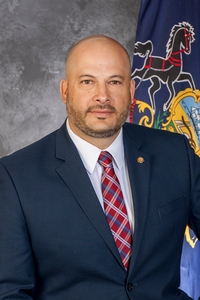
Photo of Jonathan Fritz
R Pennsylvania House · District 111 On the 2026 ballot

Rep. Jonathan Fritz

Compare
Total votes
8,615
all sessions
Attendance
98%
189 missed
Near the chamber average
With party
97%
of cast votes
Near the chamber average
Bipartisan score
1%
crosses aisle rarely
Near the chamber average
Sponsored
362
bills & resolutions
Near the chamber average
Committees
5
assignments
362 bills and resolutions

Sponsored bills

Total
362
Primary
36
Co-sponsor
326
This page
362
matching current filters
Co-sponsor HB 2442
In committee · Pennsylvania House · Co-sponsor
An Act amending the act of May 1, 1984 (P.L.206, No.43), known as the Pennsylvania Safe Drinking Water Act, providing for temporary operating license; and imposing duties on the Department of Agriculture.

Maddy summaryHB 2442 amends Pennsylvania's Safe Drinking Water Act to allow the Department of Agriculture to issue temporary operating licenses to applicants seeking retail food facility permits. To qualify, applicants must prove they have submitted a complete public water system permit application and provide certified lab tests showing their water system meets federal standards. The temporary license remains valid only while the permit application is pending and automatically expires if the permit is issued, denied, or if the applicant fails to submit required compliance tests every six months.

In committee Apr 22, 2026 1 co-sponsor
Primary HB 2395
In committee · Pennsylvania House · Lead sponsor
An Act amending the act of March 4, 1971 (P.L.6, No.2), known as the Tax Reform Code of 1971, in sales and use tax, further providing for exclusions from tax.

Maddy summaryHouse Bill 2395 amends Pennsylvania's Tax Reform Code to temporarily exempt individuals from paying sales and use tax on lumber purchased for personal, non-business use. The bill defines 'lumber' as processed hardwood or softwood intended for construction and sets a six-month window starting July 1, 2026, during which this tax break applies. To ensure clarity, the Department of Revenue is required to publish online guidance explaining how to implement this temporary exclusion.

In committee Apr 16, 2026 0 co-sponsors
Co-sponsor HB 2372
In committee · Pennsylvania House · Co-sponsor
An Act amending Title 66 (Public Utilities) of the Pennsylvania Consolidated Statutes, in restructuring of electric utility industry, further providing for declaration of policy, for standards for restructuring of electric industry and for duties of electric distribution companies.

Maddy summaryThis bill requires hyperscale data centers in Pennsylvania to build their own baseload power generation and pay for all costs to connect that power to the grid, regardless of distance. It mandates that electric distribution companies cooperate with these data centers by planning for their energy needs and prohibiting cross-subsidization of their rates with other customers. Additionally, the bill sets specific rules for long-term power contracts used by default service providers and gives the state commission authority to define what qualifies as a hyperscale data center.

In committee Apr 9, 2026 1 co-sponsor
Co-sponsor HB 2335
In committee · Pennsylvania House · Co-sponsor
An Act amending the act of May 22, 1951 (P.L.317, No.69), known as The Professional Nursing Law, further providing for definitions and for scope of practice for certified registered nurse anesthetists.

Maddy summaryThis bill amends Pennsylvania's Professional Nursing Law to update the legal definitions and scope of practice for certified registered nurse anesthetists (CRNAs). It allows CRNAs to perform anesthesia services under the overall direction of a physician, podiatrist, or dentist who is present and available onsite during the procedure. The legislation grants CRNAs expanded authority to prescribe and administer certain medications, order and interpret diagnostic tests, and manage patient care throughout the anesthesia process, including preoperative preparation, induction, maintenance, and post-anesthesia care. These changes formalize the professional responsibilities of CRNAs within the state's nursing regulatory framework without altering the requirement for collaborative oversight by licensed medical professionals.

In committee Mar 30, 2026 1 co-sponsor
Co-sponsor HB 2308
In committee · Pennsylvania House · Co-sponsor
An Act amending the act of March 10, 1949 (P.L.30, No.14), known as the Public School Code of 1949, in institutions of higher education, establishing the PA WORKS Scholarship Grant Program and the trade career-incentive tax credit.

Maddy summaryThis bill creates the PA WORKS Scholarship Grant Program and a trade career-incentive tax credit for Pennsylvania residents pursuing specific skilled trade careers in higher education. The scholarship provides up to $5,000 per academic year to students enrolled in approved courses such as carpentry, welding, plumbing, or electrical work, provided they maintain satisfactory academic progress and have not yet earned a bachelor's degree. Recipients must agree to live and work in Pennsylvania for 36 months in an in-demand occupation after completing their degree, with the scholarship amount prorated based on years of service and requiring repayment if they fail to meet these requirements. Additionally, the bill establishes a tax credit for business firms that hire graduates from these trade programs, though specific credit amounts and eligibility details are not fully detailed in the provided text.

In committee Mar 23, 2026 1 co-sponsor
Co-sponsor HR 362
Introduced · Pennsylvania House · Co-sponsor
House Discharge Resolution discharging Committee on Education from further consideration of House Bill No. 158.

Maddy summaryHR 362 is a procedural resolution that directs the House to discharge the Committee on Education from further consideration of House Bill 158, allowing HB 158 to move directly to the full House floor for a vote. This action bypasses the committee's review process, which typically requires committee approval before a bill can be debated on the floor. The resolution was placed on the calendar under Rule 53 on October 29, 2025, signaling it will now proceed to a floor vote. This change affects the legislative workflow for HB 158 but does not alter the content or policy of HB 158 itself.

Introduced Mar 23, 2026 1 co-sponsor
Primary HB 2301
In committee · Pennsylvania House · Lead sponsor
An Act amending the act of March 4, 1971 (P.L.6, No.2), known as the Tax Reform Code of 1971, in Pennsylvania Economic Development for a Growing Economy (PA EDGE) tax credits, further providing for definitions and providing for tax credits for critical minerals extraction.

Maddy summaryThis Pennsylvania bill expands the PA EDGE tax credit program to include companies extracting critical minerals from produced water, which is wastewater from oil and gas wells. The legislation defines "critical minerals" as materials essential for national security and energy systems, and sets a $1 million minimum investment requirement for facilities to qualify for tax credits. To receive the credit, companies must use Pennsylvania-produced water for extraction, hire local workers, and comply with state procurement laws. The Department of Revenue will review applications and approve tax credits for eligible projects that meet all specified criteria.

In committee Mar 19, 2026 0 co-sponsors
Co-sponsor HB 2270
In committee · Pennsylvania House · Co-sponsor
An Act amending the act of November 21, 2016 (P.L.1318, No.169), known as the Pharmacy Audit Integrity and Transparency Act, in preliminary provisions, further providing for definitions; and, in pharmacy benefits manager contracts, providing for State pharmacy benefits manager.

Maddy summaryThis bill amends Pennsylvania's Pharmacy Audit Integrity and Transparency Act to update definitions for "specialty drug" and "spread pricing" while establishing a new role for a State pharmacy benefits manager. The updated definitions clarify which prescription medications qualify as specialty drugs based on cost, handling requirements, and patient needs, while defining spread pricing as when a pharmacy benefits manager charges more than it pays pharmacists. The bill requires the Department of Human Services to select a single third-party administrator to manage all pharmacy benefits for Medicaid recipients by July 2026, ensuring all managed care organizations contract with this designated manager. The procurement process mandates competitive selection with strict conflict-of-interest disclosures to prevent conflicts between the manager and other healthcare entities like pharmacies, drug distributors, or managed care organizations.

In committee Mar 18, 2026 1 co-sponsor
Co-sponsor HB 2213
In committee · Pennsylvania House · Co-sponsor
An Act providing for skill video gaming; imposing duties on the Department of Revenue; providing for issuance of licenses for skill video gaming; imposing a fee and criminal and civil penalties; and providing for zoning.

Maddy summaryHB 2213 establishes a regulatory framework for "skill video gaming" in Pennsylvania, directly affecting businesses that operate or distribute gaming systems. The bill requires licenses from the Department of Revenue for operators, distributors, and establishments, imposes fees, and mandates a central reporting system to track transactions like "coin in/out" and jackpots. Key provisions include banning access for people under 18, prohibiting "miniature casinos," requiring security measures for players, and creating criminal penalties for operating unlicensed systems or distributing to minors. It aims to eliminate illegal gambling devices disguised as skill-based games while leveraging the State Lottery's existing experience in retail gaming oversight.

In committee Feb 11, 2026 1 co-sponsor
Co-sponsor HB 2196
In committee · Pennsylvania House · Co-sponsor
An Act amending Title 66 (Public Utilities) of the Pennsylvania Consolidated Statutes, providing for consumer choice billing; imposing penalties; and making repeals.

Maddy summaryHB 2196 requires electric and natural gas suppliers in Pennsylvania to provide consolidated billing, replacing separate bills from utilities and suppliers with a single bill showing all charges. This directly affects residential and commercial customers who choose alternative energy suppliers (currently only 23% of residential electric and 11.3% of natural gas customers). The key mechanism mandates that suppliers must consolidate all electric and natural gas charges onto one bill, using smart meter data to enable more tailored pricing options like time-of-use rates. The bill also includes penalties for non-compliance with these billing requirements.

In committee Feb 5, 2026 1 co-sponsor
Showing 11 to 20 of 362 bills