

Maddy summaryHB 701 amends a Pennsylvania law that gives the Governor authority over U.S. flag displays on public grounds and buildings. The bill requires that any U.S. flag displayed under this law must be manufactured in the United States. This affects public institutions, schools, and certain other organizations that display the flag on their property. The change adds a sourcing requirement to existing flag display regulations without altering the Governor's regulatory role.
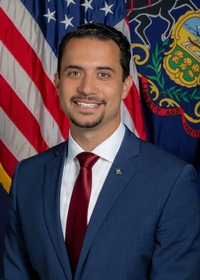
Rep. Robert Leadbeter
Sponsored bills
Maddy summaryHB 695 requires health insurance plans to cover vaccinations administered on schedules chosen by parents or guardians that differ from CDC recommendations, provided at least one vaccine is given annually. It prohibits insurers from offering financial incentives to providers based on per-member vaccination rates. Health care practitioners must continue providing pediatric care for patients on non-CDC schedules and cannot bill for discussions about alternative schedules. Violations by practitioners could result in disciplinary action from their licensing board.
Maddy summaryHB 581, titled the Parental Rights in Education Act, prohibits public schools from teaching about sexual orientation or gender identity to students in kindergarten through fifth grade. It requires schools to notify parents in writing before providing health care services (like mental health support) or administering well-being questionnaires/surveys to K-5 students, including an option for parents to withhold consent. Schools must also allow parents access to their child's education and health records and cannot retaliate against students who report violations. The bill creates a legal right for students or parents to sue schools for noncompliance within 180 days of a violation.
Maddy summaryHB 582 amends Pennsylvania's 1971 Tax Reform Code to exclude the sale of firearms and ammunition from state sales and use tax. It directly affects firearm retailers and buyers, as these items will no longer be subject to tax when purchased at retail. The bill adds a specific exclusion (section 204(77)) defining "firearm" as a weapon designed to expel projectiles via explosives and "ammunition" as bullets or shells for such weapons. This change takes effect immediately upon passage.
Maddy summaryHB 606 requires Pennsylvania public and private schools to integrate "early human life development education" into biology courses starting in the 2025-2026 school year. This mandates including specific ultrasound videos showing fetal development at 8, 12, 17, 22, 27, 32, and 37 weeks' gestation, plus a computer-generated animation of fertilization and prenatal development stages. The bill applies to all school entities (districts, charters, cyber charters) and directly affects all K-12 students in Pennsylvania. It amends the 1949 Public School Code to standardize this curriculum component within existing biology requirements.
Maddy summaryHB 546 creates a military exception for minors under 18 seeking a junior driver's license in Pennsylvania. It allows the state to count time spent with a learner's permit and driving practice hours completed in another state toward eligibility requirements. This applies specifically to minors who are family members of active duty military members living in Pennsylvania with them, hold a valid out-of-state learner's permit, and have received a Pennsylvania learner's permit. The Pennsylvania Department of Transportation must credit this prior experience if all conditions are met.
Maddy summaryHB 548 strengthens Pennsylvania's state preemption of local firearm regulations by declaring that all aspects of firearm regulation - including purchase, sale, possession, and transportation - must follow state law, invalidating any conflicting local ordinances. It directly affects counties, municipalities, and townships that previously enacted stricter gun rules, as well as residents, gun dealers, or organizations challenging such local laws. Key provisions include creating legal remedies for those harmed by illegal local regulations (allowing lawsuits for damages, attorney fees, and injunctions) and explicitly stating that state law supersedes all local efforts. The bill takes effect in 90 days for its core preemption rules, requiring local governments to align with state firearm laws immediately.
Maddy summaryHB 530 modifies Pennsylvania's criminal codes to adjust penalties for property damage crimes and create a new process for removing trespassers. It reclassifies criminal mischief as a felony if financial damage exceeds $1,000 (for building entry) or $5,000 (for public services), and as a misdemeanor for smaller losses. The bill also establishes a formal procedure allowing property owners to request law enforcement to remove trespassers by submitting a signed affidavit proving the person isn't a tenant, has been asked to leave, and lawful eviction occurred if applicable. This directly affects property owners seeking to remove unauthorized occupants, tenants facing potential unlawful removal, and law enforcement officers handling such requests. The law requires officers to provide individuals removed a chance to prove lawful occupancy and prohibits violations of Pennsylvania's Landlord and Tenant Act.
Maddy summaryHB 528 modifies Pennsylvania's driver license application process by removing the requirement for applicants to provide personal medical information, next of kin details, or emergency contact information on their forms. It also establishes a new process allowing coroners to access, at no cost, three specific records from the Pennsylvania Justice Network: emergency contact details (if voluntarily provided), organ donor status, and a color photograph from the license. These changes apply to all individuals applying for or renewing a driver's license or learner's permit in Pennsylvania. The bill takes effect 60 days after enactment.
Maddy summaryHB 437 proposes a constitutional amendment to Pennsylvania's voting rules, requiring voters to present valid identification at all elections. It mandates that voters show a government-issued ID when voting in person (Section 12) and include proof of ID with mail-in ballots (Section 16). Voters without ID can request a free government-issued ID at the polling place (Section 19). This amendment would directly affect all Pennsylvania voters participating in elections, adding ID verification to existing residency and citizenship requirements.