

Maddy summaryHB 1319 amends Pennsylvania's Mechanics' Lien Law of 1963 by updating the definition of "Materials" to explicitly include "rented equipment reasonably necessary for construction." This change directly affects contractors, suppliers, and property owners involved in construction projects who use lien claims to secure payment. The bill clarifies that equipment rented for construction - like scaffolding or heavy machinery - counts as "Materials" under lien law, ensuring it qualifies for payment protection. The amendment makes the existing law clearer but does not create new requirements or obligations. The bill passed in July 2025 and takes effect 90 days after enactment.
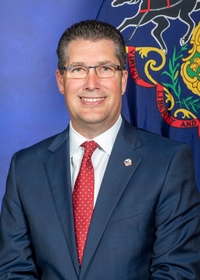
Rep. Tom Mehaffie
Sponsored bills
Maddy summaryHB 1749 amends Pennsylvania's 1971 Tax Reform Code to modify sales and use tax exclusions and create a new tax credit specifically for the steel industry. The bill establishes a "fueling opportunities" tax credit aimed at supporting steel businesses engaged in revitalization, growth, and operational efficiency. This credit directly affects steel manufacturers and related businesses by potentially reducing their tax burden for qualifying activities. The bill focuses on concrete tax code changes rather than broader policy shifts, with its key mechanism being the new credit program within the existing tax framework.
Maddy summaryHB 1711 creates a program that pays vendors who supply concrete with at least 20% lower carbon emissions than the regional average for state-funded construction projects. The concrete must be verified through an environmental product declaration, and vendors must deliver at least 50 cubic yards (or equivalent precast) for qualifying projects. The Pennsylvania Department of General Services will manage the payments, which are intended to incentivize lower-carbon concrete use. This bill directly affects state procurement agencies and concrete suppliers working on Commonwealth-funded projects.
Maddy summaryHB 553 authorizes several land transfers between Pennsylvania state agencies and local entities. It permits the Department of General Services to transfer specific lands in Harrisburg to the Susquehanna Regional Transportation Authority, convey an easement for Lake Winola Access in Wyoming County, and exchange parcels between Tioga County and the Commonwealth in Tioga County. The bill also facilitates a land swap involving the Pennsylvania Game Commission and the Department of Conservation and Natural Resources, adding a parcel to Lehigh Gorge State Park. These actions directly affect state agencies, local governments, and park management, with no new policy changes beyond land ownership adjustments. The bill was enacted on June 30, 2025.
Maddy summaryHB 1670 requires health insurance plans in Pennsylvania, including Medicare and Medicaid coverage, to provide hearing aid benefits. Specifically, it mandates that insurers offer at least $2,500 in coverage every three years for hearing aids sold under state registration rules, with benefits applicable to either hearing aid sellers or contracted fitters. This applies to most health insurance policies but excludes dental, vision, Medicare supplements, and other specified plans. The law takes effect 90 days after enactment, impacting insurers and enrollees in covered health plans across the state.
Maddy summaryHB 967 amends Pennsylvania's 1968 Unfair Trade Practices and Consumer Protection Law by adding or refining specific definitions within the statute. This definitional update directly affects consumers and businesses operating under the law, as clearer definitions help determine what constitutes unfair trade practices. The bill does not introduce new prohibitions or penalties but clarifies existing legal terms to improve application of the law. As a procedural amendment focused solely on definitions, it does not create new policy requirements or alter substantive protections.
Maddy summaryHB 1499 updates Pennsylvania's child custody laws under Title 23. It clarifies definitions, establishes clearer rules for awarding primary physical custody, and requires courts to consider criminal convictions when making custody decisions. The bill also mandates parenting plans and specifies factors judges must evaluate, directly affecting parents, judges, and child welfare agencies involved in custody cases. The legislation was recently referred to the Judiciary Committee on May 28, 2025.
Maddy summaryThe context provided does not include the specific policy details or provisions of HB 754. While the bill's title indicates it amends Pennsylvania's County Pension Law (1971) regarding "supplemental benefits," the description lacks concrete information about what those benefits entail, who would receive them, or how the changes would operate. Without additional details on the bill's content, a factual summary of its policy mechanisms or direct effects cannot be provided. For a complete summary, the full text of the bill or an official description would be required.
Maddy summaryHB 926 requires healthcare facilities to establish violence prevention committees to address workplace violence. These committees must develop safety plans, and facilities must report violent incidents to the Department of Labor and Industry. The Department gains authority to enforce compliance, impose fines, and issue administrative penalties for violations. This bill directly affects hospitals, clinics, and all healthcare workplaces covered under state labor regulations.
Maddy summaryHB 500 repeals existing tax credit provisions for local resource manufacturing (petrochemicals/fertilizers) and Pennsylvania milk processing, while creating new tax credits for clean energy and advanced manufacturing sectors. It establishes tax credits for reliable energy investments, regional clean hydrogen hubs, semiconductor manufacturing, biomedical research, geothermal energy, and sustainable aviation fuel. Eligible businesses must meet specific criteria for capital investment, job creation, and project location to apply for these credits through the Department of Revenue. The bill also updates definitions and application processes for these new credits, with annual funding limits and rules for credit usage.