

Issue · Labor & Employment
Labor & Employment
Every labor & employment bill, vote, and legislator stance in Pennsylvania, automatically classified by Maddy, our AI policy reader.
Total bills
325
2025-2026 Regular Session
Top supporter
Frank Farry
93% support rate
Top opponent
Dawn Keefer
15% support rate
Ranked legislators
10
5 support · 5 oppose
Key legislators
Who's moving labor & employment in Pennsylvania
| Legislator | Party | Stance | Support rate | Votes |
|---|---|---|---|---|
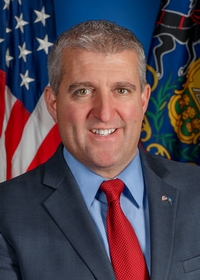
Frank Farry
Senate · District 6
|
R |
Strong +
|
93% | 45 |

Devlin Robinson
Senate · District 37
|
R |
Strong +
|
90% | 52 |

Camera Bartolotta
Senate · District 46
|
R |
Strong +
|
89% | 51 |

Joe Pittman
Senate · District 41
|
R |
Strong +
|
89% | 55 |

Elder Vogel
Senate · District 47
|
R |
Strong +
|
88% | 56 |

Dawn Keefer
Senate · District 31
|
R |
Strong −
|
15% | 46 |

Scott Hutchinson
Senate · District 21
|
R |
Oppose
|
29% | 46 |

Charity Krupa
House · District 51
|
R |
Oppose
|
29% | 256 |

Jarrett Coleman
Senate · District 16
|
R |
Oppose
|
29% | 54 |

Stephanie Borowicz
House · District 76
|
R |
Oppose
|
31% | 214 |
Showing 91–100 of 325
bills
All labor & employment bills
HB 27: An Act amending the act of July 19, 1979 (P.L.130, No.48), known as the Health Care Facilities Act, in licensing of health care facilities, providing for surgical smoke evacuation systems.
Topics
✓ EnvironmentSupports EnvironmentBill mandates surgical smoke evacuation systems in healthcare facilities to improve air quality, directly reducing a specific indoor pollutant (surgical smoke) under pollution control, aligning with environmental topic's pollution control focus.
✓ HealthcareSupports HealthcareMandates surgical smoke evacuation systems to improve air quality and safety for patients/staff, directly enhancing healthcare facility safety standards under existing law.
✓ Labor & EmploymentSupports Labor & EmploymentMandates surgical smoke evacuation systems in healthcare facilities, directly improving workplace safety for medical staff per bill summary's focus on safety for 'medical...' personnel.
Sub-Topics
Air Quality
SB 166: An Act making appropriations from the State Employees' Retirement Fund and from the SERS Defined Contribution Fund to provide for expenses of the State Employees' Retirement Board for the fiscal year July 1, 2025, to June 30, 2026, and for the payment of bills incurred and remaining unpaid at the close of the fiscal year ending June 30, 2025.
Topics
✓ Budget & TaxesSupports Budget & TaxesFunds operational expenses for the State Employees' Retirement Board, an essential state program, through specific appropriations for the fiscal year.
✓ Labor & EmploymentSupports Labor & EmploymentFunds retirement board operations to maintain state employee benefits, directly supporting employment-related retirement security.
HB 1052: An Act providing for the licensure of fire-resistant material applicators; establishing the Fireproofing Applicator Licensing Board; and imposing penalties.
Sub-Topics
Professional Licensing
HB 1765: An Act amending Title 53 (Municipalities Generally) of the Pennsylvania Consolidated Statutes, in employees, providing for insurance benefits for part-time police officers.
Topics
✓ Budget & TaxesSupports Budget & TaxesMandates municipalities to fund insurance benefits for part-time police, increasing public safety spending requirements.
✓ Criminal JusticeSupports Criminal JusticeExtends insurance benefits to part-time police officers, supporting law enforcement personnel welfare without direct reform impact.
✓ HealthcareSupports HealthcareExtends health insurance coverage to part-time police officers, expanding access to healthcare benefits for municipal employees under existing insurance provisions.
✓ Labor & EmploymentSupports Labor & EmploymentExtends mandatory insurance benefits to part-time police officers, expanding worker benefits under Labor & Employment policies
SB 440: An Act amending the act of March 4, 1971 (P.L.6, No.2), known as the Tax Reform Code of 1971, in Pennsylvania Economic Development for a Growing Economy (PA EDGE) tax credits relating to semiconductor manufacturing and biomedical manufacturing and research, further providing for definitions, for eligibility, for application and approval of tax credit and for sale or assignment.
Topics
✓ Budget & TaxesSupports Budget & TaxesSB 440 creates new tax credits for semiconductor/biomedical firms under PA EDGE, directly reducing tax liabilities for qualifying businesses per the Tax Reform Code amendment.
✓ Labor & EmploymentSupports Labor & EmploymentRequires companies to meet local wage standards to qualify for tax credits, directly advancing worker compensation standards in new job creation.
✓ TechnologySupports TechnologyBill provides tax credits for semiconductor manufacturing and biomedical research, directly funding technology sector growth through financial incentives for capital investment and job creation.
Sub-Topics
Tax Credits
HB 1491: An Act amending Title 35 (Health and Safety) of the Pennsylvania Consolidated Statutes, in emergency medical services system, further providing for declaration of policy, for definitions, for emergency medical services system programs and for duties of department; establishing the State EMS Advisory Board; and further providing for emergency medical services patient care reports, for funding, for notification of trauma center closure, for State Advisory Board, for regional emergency medical services councils, for comprehensive plan, for contracts and grants and for scholarships for recruitment, training and retention.
Topics
✓ HealthcareSupports HealthcareMandates ongoing EMS system reviews, recruitment/retention boosts, and establishes advisory board to strengthen emergency medical services quality and access.
✓ Labor & EmploymentSupports Labor & EmploymentBoosts EMS provider recruitment/retention through mandated system reviews and advisory board, directly strengthening workforce retention in labor sector.
Tags
Public Safety
SB 841: An Act amending the act of July 19, 1979 (P.L.130, No.48), known as the Health Care Facilities Act, in licensing of health care facilities, further providing for licensure.
Topics
✓ HealthcareSupports HealthcareMandates dementia training for home health care workers to improve care quality for Alzheimer's patients, aligning with patient access and care standards.
✓ Labor & EmploymentSupports Labor & EmploymentMandates dementia training for home care workers, enhancing job performance and workplace safety standards in healthcare settings.
SB 940: An Act requiring lactation rooms in Commonwealth buildings; and imposing duties on Department of General Services.
Topics
✓ HealthcareSupports HealthcareRequires lactation rooms in state buildings, supporting maternal health access and aligning with federal healthcare accommodations under ACA.
✓ Labor & EmploymentSupports Labor & EmploymentRequires private lactation rooms for nursing employees in state buildings, enhancing workplace accommodations and aligning with federal worker protections under the Affordable Care Act.
HB 1605: An Act amending Titles 24 (Education) and 71 (State Government) of the Pennsylvania Consolidated Statutes, in membership, contributions and benefits, further providing for creditable nonschool service; and, in membership, credited service, classes of service, and eligibility for benefits, further providing for creditable nonstate service.
Topics
✓ EducationSupports EducationExpands retirement benefits for education employees by including non-school service, directly supporting educators' financial security and retention.
✓ Labor & EmploymentSupports Labor & EmploymentExpands retirement benefits for public employees by including non-school/non-state service, strengthening employment benefits for education/state government workers.
Sub-Topics
Public Employees