

Mainstreaming Addiction Treatment Act of 2021 This bill removes the requirement that a health care practitioner apply for a separate waiver through the Drug Enforcement Administration (DEA) to dispense certain narcotic drugs (e.g., buprenorphine) for maintenance or detoxification treatment (i.e., substance use disorder treatment). Further, a community health aide or community health practitioner may dispense certain narcotic drugs for maintenance or detoxification treatment without registering with the DEA if the drug is prescribed by a health care practitioner through telemedicine. It preempts state laws related to licensure for this activity. The bill also directs the Substance Abuse and Mental Health Services Administration to conduct a national campaign to educate health care practitioners and encourage them to integrate substance use disorder treatment into their practices.
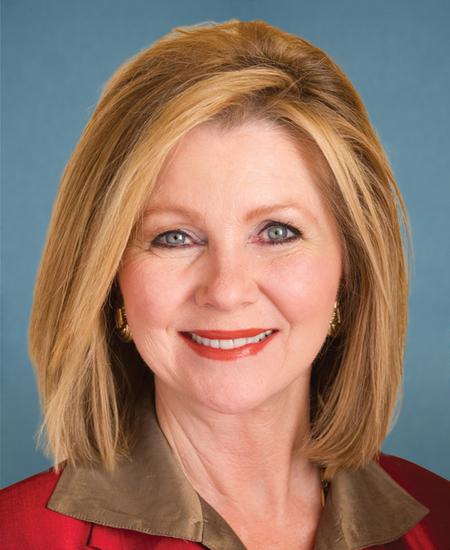
Sen. Marsha Blackburn
Sponsored bills
Iran Sanctions Relief Review Act of 2021 This bill restricts the President's authority to unilaterally undertake certain actions with respect to Iran and increases congressional oversight of those actions. Specifically, the President must report to Congress before terminating or waiving sanctions related to Iran or taking a licensing action that significantly alters U.S. foreign policy with respect to Iran. Each report must (1) describe the proposed action and its rationale, and (2) indicate whether or not the action is intended to significantly alter foreign policy concerning Iran. If the intention is to alter that policy, the report must provide additional information about the policy objectives and anticipated effects of the action. After the President submits a report, the bill provides Congress with a 30-day period to review it; this period is extended to 60 days for reports submitted between July 10 and September 7. During this period, Congress may enact a joint resolution approving or disapproving the action. During the review period, the President may not take the action unless Congress passes a joint resolution of approval; if Congress enacts a joint resolution of disapproval, the bill prohibits the President from taking the action. The bill also outlines procedures for the introduction and consideration of these types of joint resolutions.
This resolution opposes lifting specified sanctions on Iran and resolves that these sanctions may be terminated only after Iran has ceased providing support for acts of international terrorism and has dismantled its nuclear, biological, and chemical weapons and related technologies.
This resolution recognizes Black History Month as an opportunity to reflect on U.S. history and to commemorate the contributions of African Americans. It calls for the United States to (1) honor the contribution of pioneers who helped to ensure its legacy; and (2) move forward as a nation "indivisible, with liberty and justice for all."
Conscience Protection Act of 2021 This bill provides statutory authority for certain protections for health care providers that refuse to participate in abortions based on religious beliefs or other convictions. Health care providers include individual professionals, medical facilities, health insurance organizations, and social services providers that refer clients to health care services. The federal government and entities that receive federal funding for health-related activities, including state and local governments, may not discriminate against a health care provider that refuses to be involved in, or provide coverage for, abortions. Currently, similar requirements apply to various related activities, including certain employment or personnel decisions (the Church Amendments), abortion services training (the Coats-Snowe Amendment), qualified health plans offered through health insurance exchanges, and annual appropriations bills for the Department of Health and Human Services (HHS) and other federal agencies (the Weldon Amendment). The HHS Office for Civil Rights must investigate complaints of this kind of discrimination. Furthermore, HHS may terminate or reduce HHS funding for health-related activities if a person or entity fails to comply with nondiscrimination requirements. Additionally, the Department of Justice or any entity adversely affected by such discrimination may bring a civil action to obtain appropriate relief. A plaintiff does not need to seek or exhaust administrative remedies before bringing the action. A plaintiff may also bring an action, including one for money damages, against a governmental entity. In many cases, principles of sovereign immunity shield states and some localities from these kinds of actions.
Fair and Open Competition Act or the FOCA Act This bill prohibits federal construction contracts or controlling documents for federally supported construction projects from requiring or prohibiting project labor agreements. Such documents also may not discriminate against or give preference to a bidder or contractor who signs or refuses to sign a project labor agreement. An agency may exempt a project from this prohibition to avert an imminent threat to public health or safety or to serve the national security.
Visa Security Act This bill limits the validity period of B-1 (business visitor) and B-2 (tourist) visas issued to Chinese nationals until the Department of State makes certain certifications to Congress regarding the Chinese government. Specifically, the State Department may not issue such a visa with a validity period of more than one year unless it certifies to Congress that the Chinese government has taken certain actions, including (1) stopping its campaign of economic and industrial espionage against the United States; (2) ending its provocative and coercive behavior towards Taiwan; (3) withdrawing its national security law in Hong Kong and upholding its obligations to respect Hong Kong's autonomy; and (4) ending its systematic oppression of minority ethnic groups in China, including the Uyghurs and Tibetans. (Currently, such visas may be valid for up to 10 years.) These restrictions shall not apply to visa applicants from Taiwan or certain applicants from Hong Kong, generally those Hong Kong residents that the State Department has no reason to believe are acting on behalf of the Chinese government. (Taiwan is self-governing but the Chinese government considers it a part of China, while Hong Kong is a part of China but is supposed to have a largely separate legal and economic system.)
National Right-to-Work Act This bill repeals those provisions of the National Labor Relations Act and the Railway Labor Act that permit employers to make an agreement with a labor union to require employees to join such union as a condition of employment. Currently, at least 27 states have enacted laws prohibiting employers from compelling employees to become members of a union as a condition of employment.
Living Donor Protection Act of 2021 This bill prohibits certain insurance carriers from discriminating against, and provides other protections for, living organ donors. Specifically, carriers may not deny, cancel, or otherwise impose conditions on policies for life insurance, disability insurance, or long-term care insurance based on an individual's status as a living organ donor. The bill also expressly specifies that recovery from organ-donation surgery constitutes a serious health condition that entitles eligible employees to job-protected medical leave. In addition, the Department of Health and Human Services must update educational materials on live organ donation to include information about the benefits of live organ donation and about access to insurance for living organ donors.
21st Century Entrepreneurship Act This bill requires the Small Business Administration (SBA) to develop a curriculum for volunteers with the Service Corps of Retired Executives (SCORE) to teach underrepresented students (e.g., minority students, English learners, and children with disabilities) about entrepreneurship. The SBA shall develop and implement a strategy to encourage partnerships between the SCORE program and community learning centers to teach this curriculum and, in developing the curriculum, collaborate with education specialists and groups with experience serving underrepresented children. The SBA must submit a biennial report on partnerships between the SCORE program and community learning centers, the use of funds by the program, the number of students reached through the entrepreneurship curriculum, and plans for improving the curriculum.