

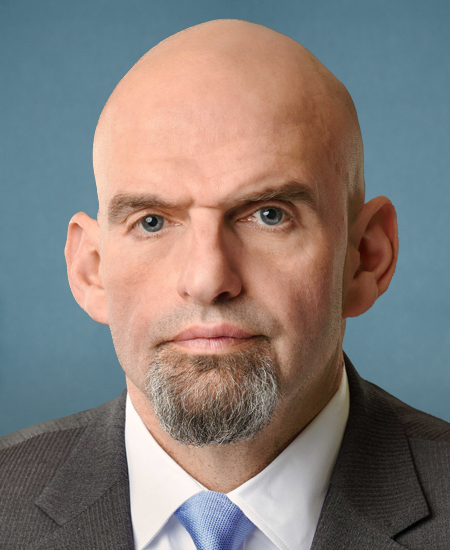
Photo of John Fetterman
D United States Senate · Pennsylvania

Sen. John Fetterman

Compare
Total votes
657
all sessions
Attendance
93%
46 missed
Lower than 83% of chamber peers
With party
87%
of cast votes
Lower than 98% of chamber peers
Bipartisan score
7%
crosses aisle rarely
Higher than 94% of chamber peers
Sponsored
907
bills & resolutions
Near the chamber average
Committees
10
assignments
907 bills and resolutions

Sponsored bills

Total
907
Primary
64
Co-sponsor
843
This page
907
matching current filters
Co-sponsor SRES 67
Passed · Oregon Senate · Co-sponsor
A resolution supporting the goals and ideals of "Career and Technical Education Month".

Maddy summarySRES 67 is a symbolic Senate resolution designating February 2023 as "Career and Technical Education (CTE) Month" to recognize CTE's role in preparing students for high-demand careers. It does not create new policies or funding but expresses Senate support for CTE programs that connect students with workforce skills in fields like healthcare, technology, and construction. The resolution encourages educators and parents to promote CTE as a valuable educational pathway, referencing the 106th anniversary of the foundational Smith-Hughes Vocational Education Act. As a procedural resolution, it has no direct impact on legislation or affected individuals.

Passed Feb 15, 2023 1 co-sponsor
Co-sponsor SRES 65
In committee · Oregon Senate · Co-sponsor
A resolution opposing a national sales tax on working families and supporting a tax cut to benefit the middle class.

Maddy summarySRES 65 is a Senate resolution opposing H.R. 25 (the FairTax Act of 2023), which would impose a 30% national sales tax on all goods and services. The resolution states this tax would raise average annual grocery costs by $3,500, car prices by $10,000, and home prices by $125,000 for working families and seniors. It supports middle-class tax cuts instead of burdening households, while opposing any tax changes that would cut Social Security, Medicare, or Medicaid funding. The resolution expresses the Senate’s position against policies that disproportionately impact lower- and middle-income households.

In committee Feb 15, 2023 1 co-sponsor
Co-sponsor S 448
In committee · Oregon Senate · Co-sponsor
Outdoors for All Act

Maddy summaryThe Outdoors for All Act establishes a federal grant program to fund outdoor recreation projects in underserved communities. It provides funding for eligible entities (like cities, counties, tribes, or nonprofits) to acquire land for parks or develop outdoor facilities in qualifying areas - urban regions with 25,000+ people, adjacent clusters, or tribal lands. Grants prioritize projects that improve park access in low-income neighborhoods, engage youth, create jobs, and support cultural gathering spaces, while requiring a 100% cash or in-kind match (with possible waivers). Funds cannot cover maintenance, indoor facilities, or restricted-access land, and recipients must submit annual progress reports to the Interior Secretary.

In committee Feb 15, 2023 1 co-sponsor
Co-sponsor SRES 63
Passed · Oregon Senate · Co-sponsor
A resolution celebrating Black History Month.

Maddy summaryThis resolution (SRES 63) is a symbolic Senate measure formally celebrating Black History Month. It acknowledges the contributions of African Americans to U.S. history and society, recognizes the origins of Black History Month (beginning as Negro History Week in 1926), and encourages nationwide reflection on this history. The resolution does not create new laws or policies but serves as a formal Senate acknowledgment of the significance of Black History Month in February. It aims to honor the legacy of African American pioneers and promote learning about their impact on the nation.

Passed Feb 14, 2023 1 co-sponsor
Co-sponsor S 399
In committee · Oregon Senate · Co-sponsor
Saving the Civil Service Act

Maddy summaryS 399, the "Saving the Civil Service Act," limits how federal agencies can move positions between the competitive service (where hiring is open and based on merit) and the excepted service (where hiring is more flexible). It restricts transferring positions to excepted service without meeting specific criteria, requires employee consent for any transfer between service types, and caps transfers during a presidential term at either 1% of an agency's workforce or five employees, whichever is greater. Agencies must also report all such transfers to Congress annually with justifications, and the Office of Personnel Management must issue implementing regulations within 90 days of the bill's enactment. This directly affects federal employees whose positions may be moved between service types and all federal agencies managing personnel transfers.

In committee Feb 14, 2023 1 co-sponsor
Co-sponsor S 413
In committee · Oregon Senate · Co-sponsor
Stock Buyback Accountability Act of 2023

Maddy summaryThis bill increases the tax rate on corporate stock buybacks from 1% to 4% for companies purchasing their own shares. It also creates an exception for stock issued to certain covered employees (like executives under existing compensation rules), meaning those shares wouldn't count toward the tax. The tax hike applies to buybacks occurring after the bill's enactment date, while the employee stock exception applies to stock issued after enactment. The bill directly affects corporations that repurchase shares, particularly those with executive compensation plans involving stock grants.

In committee Feb 14, 2023 1 co-sponsor
Co-sponsor S 325
In committee · Oregon Senate · Co-sponsor
Supreme Court Ethics Act

Maddy summaryS 325, the Supreme Court Ethics Act, establishes new ethics rules for Supreme Court justices and creates an enforcement mechanism. It requires the Judicial Conference to issue a binding code of conduct for justices within one year, followed by the appointment of an Ethics Investigations Counsel to handle public complaints about potential violations and conduct harming the Court's administration. The Counsel must investigate allegations, report annually on complaints, and disclose reasons for recusal or denial of recusal motions in public court records. This directly affects Supreme Court justices and the public's ability to monitor judicial conduct.

In committee Feb 9, 2023 1 co-sponsor
Co-sponsor S 357
In committee · Oregon Senate · Co-sponsor
No Tax Breaks for Outsourcing Act

Maddy summaryThe No Tax Breaks for Outsourcing Act modifies corporate tax rules to prevent companies from avoiding U.S. taxes on income generated through foreign operations. It requires country-by-country reporting of income for multinational corporations, closes loopholes related to "inverted corporations" (foreign companies acquiring U.S. firms to benefit from lower tax rates), and limits interest deductions for certain multinational financial reporting groups. The bill also treats foreign corporations managed and controlled in the U.S. as domestic for tax purposes. These changes primarily affect large multinational corporations with significant foreign operations, with provisions applying to taxable years beginning after December 31, 2022.

In committee Feb 9, 2023 1 co-sponsor
Co-sponsor S 344
In committee · Oregon Senate · Co-sponsor
Major Richard Star Act

Maddy summaryThis bill allows veterans with combat-related disabilities and less than 20 years of service to receive both military retired pay and VA disability compensation simultaneously. Previously, such veterans had their retired pay reduced to avoid "concurrent receipt" of both benefits. The bill removes the 20-year service requirement for this group, applying specifically to those retired under Chapter 61 of Title 10 with a combat-related disability as defined in existing law. It does not change eligibility for veterans with non-combat disabilities or those with 20+ years of service.

In committee Feb 9, 2023 1 co-sponsor
Co-sponsor S 262
In committee · Oregon Senate · Co-sponsor
Stop Spying Bosses Act

Maddy summaryThe Stop Spying Bosses Act requires employers to disclose workplace surveillance practices to employees and job applicants, including what data is collected, how it's collected, where it's stored, and how it affects employment decisions. It prohibits employers from using surveillance to monitor labor organizing activities, off-duty behavior, political views, religious activities, or health information unrelated to job duties, and bans selling employee data. The bill establishes a new Privacy and Technology Division within the Department of Labor to oversee implementation and enforcement. It also provides employees with the right to review and correct their data and includes whistleblower protections for those reporting violations.

In committee Feb 2, 2023 1 co-sponsor
Showing 891 to 900 of 907 bills